

The Museum of European Cultures presents the most valuable items from the textile collection of the Danube Swabian Central Museum: women’s and girls’ clothing from 1880 to 1990. Bright colors on a golden background alongside deep black wedding dresses: Danube Swabian traditional costumes provide surprising insights into the former lives of women and girls. This world was narrow because it was governed by village and church rules, but also broad because it offered the diversity of a multicultural society.
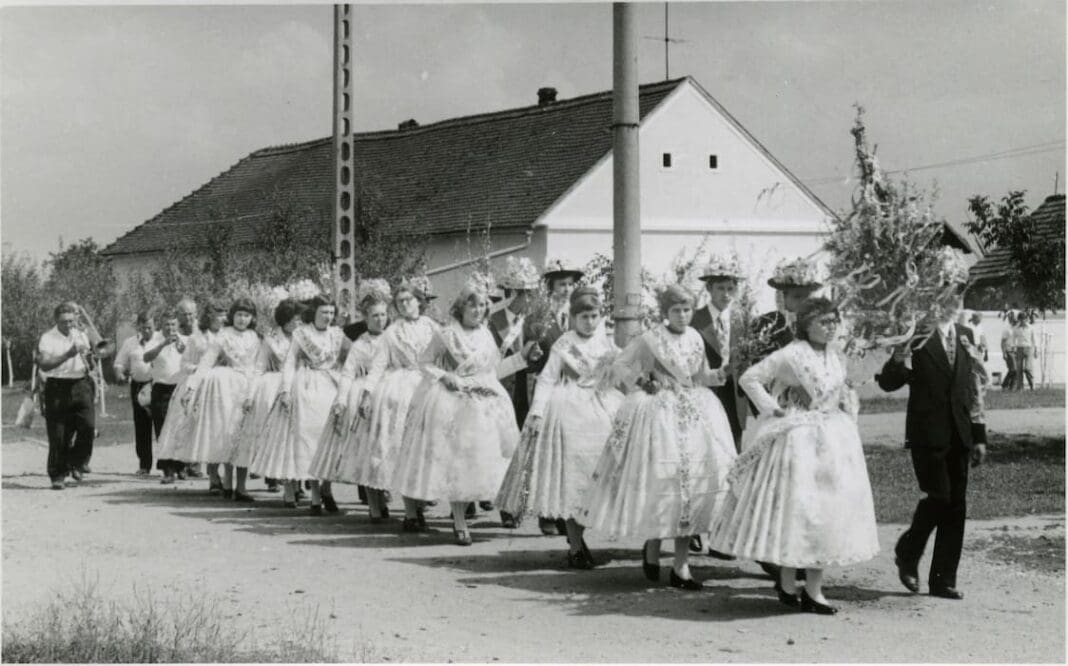
Image above: Parish fair parade of young couples in Neudorf (Banat, Romania), 1976. © Donauschwäbisches Zentralmuseum (DZM)
Henrike Hampe, the Ulm-based curator of the exhibition, explains: “The clothing ensembles consist of up to 15 pieces. Despite their eventful lives, their owners never parted with them. They thus illustrate the close relationship between people and their clothes – from work clothes to bridal attire, from girls’ traditional costumes to burial garments. Each of the costumes on display tells a story about individual women’s lives and at the same time provides information about the history of the Danube Swabians* through the ages.”
The exhibition builds bridges between tradition and modernity, ideology and reality, and textile upcycling in the past and present. It provides insights into the lives of the Danube Swabians, the descendants of German-speaking emigrants who settled in the Kingdom of Hungary from the late 17th to the 19th century. There they lived as one ethnic group among many.
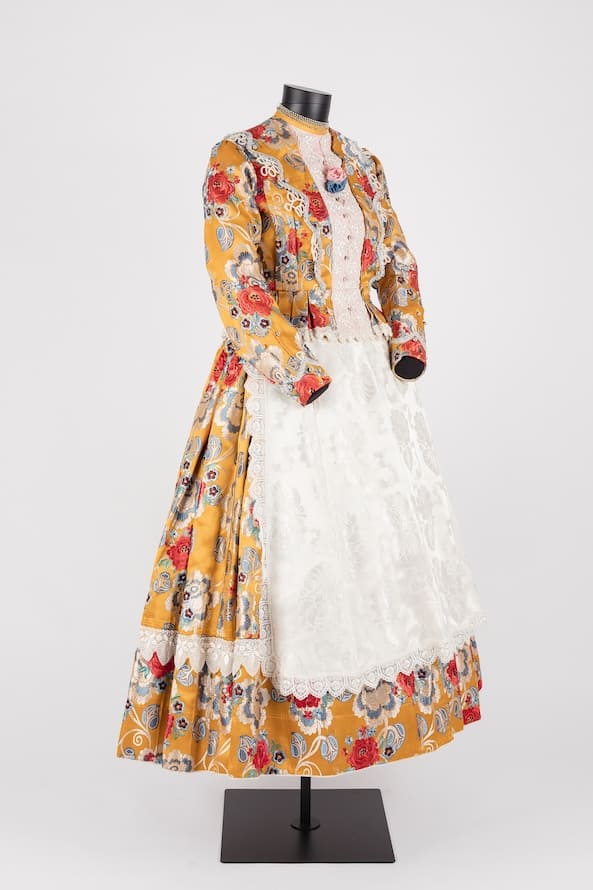
Twenty clothing ensembles, numerous photographs, drawings by Erna Piffl, and other objects make it clear: personal memories are woven into textiles, and life stories are inextricably linked to them. They invite visitors to immerse themselves in European history and stories of arrival, existence, separation, integration, uprooting, and re-rooting.
The exhibition was developed at the Danube Swabian Central Museum in Ulm. After a stop at the Ethnographic Museum in Budapest, it is now being shown with the support of the “Coordination East Central and Southeast Europe” office based at the Museum of European Cultures.
Numerous educational offerings and major events complement the exhibition. Under the motto “Off to the South,” a theme day about Danube Swabians will take place on Sunday, June 21, 2026, from 2 p.m. to 10 p.m., featuring workshops and guided tours. The day will be rounded off in the museum garden with live music from Southeast Europe as part of the Fête de la Musique.
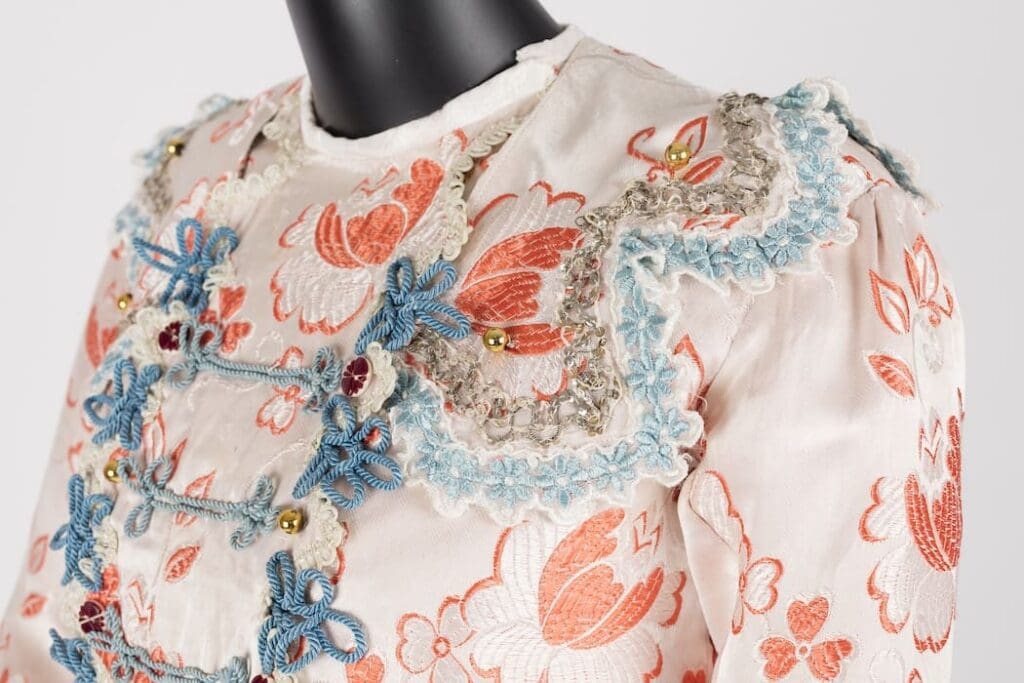
On Sunday, November 8, 2026, Textile Day will take place for the 20th time in cooperation with the trade association …textil.. e.V. and the Friends of the Museum of European Cultures. Between 11 a.m. and 5 p.m., visitors can learn a variety of techniques using different materials and find inspiration in the exhibition “Schwerer Stoff” (Heavy Fabric) – for example, during public tours at 1 p.m. and 3 p.m.
WHEN?
Opening: 23. April 2026, at 6 pm, in the foyer of the MEK.
Exhibition dates: 24. April 2026 until 29. March 2027
WHERE?
Museum Europäischer Kulturen
Arnimallee 25
14195 Berlin