

From 14 March 2026, Colombian-born artist Oscar Murillo will exhibit his work in the indoor and outdoor spaces of MINSK, transforming the Potsdam art gallery into the setting for a living experiment on exchange and community. The exhibition Collective Osmosis is a multi-layered meditation on visibility, landscape and the political implications of artistic work – across borders. The exhibition project marks the first collaboration between MINSK and the Museum Barberini: works by Oscar Murillo will be on display in both venues.
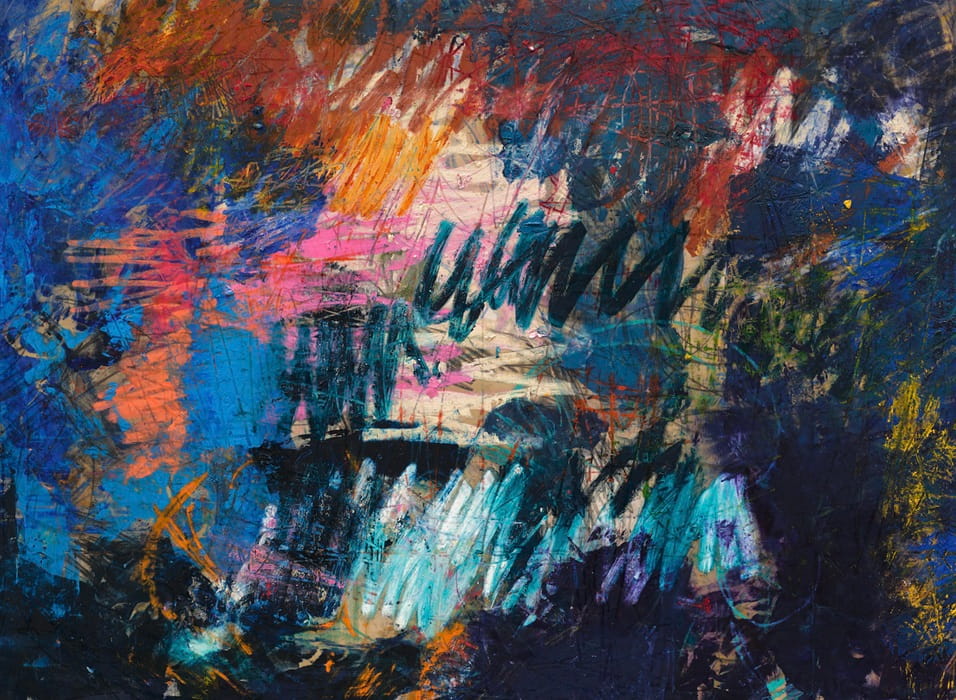
Image above: Oscar Murillo, (untitled) scarred spirits [(ohne Titel) vernarbte Seelen], 2025, Öl, Ölstift und Grafit auf Leinwand, 220 × 300 cm. Courtesy of the artist © Oscar Murillo. Foto: Tim Bowditch & Reinis Lismanis.
With the project Collective Osmosis, Murillo creates a dialogue between his abstract painting, the visitors and the impressionist works of Claude Monet. The starting point is Murillo’s preoccupation with the life, work and reception of the French painter. In his later years, Monet suffered from cataracts and gradually lost his eyesight until he underwent surgery, which resulted in changes in the composition and colouring of his paintings. Murillo recognises in this shift in the painter’s perception a symbol for the blind spots in our society, but also the potential to create new realities. Murillo addresses the political dimension of seeing and not seeing by exploring darkness as a space for speculation for a new interpretation of Impressionism.
The term “osmosis” used in the title describes the scientific process by which water particles move through a semipermeable membrane from a less concentrated solution to a more concentrated one until equilibrium is reached. Murillo uses the concept of this process to express his vision of a universal human community and equality. The principle of collective osmosis also stands for the opening up of the museum: the exhibition creates permeability and exchange between inside and outside, between museum and city, and between Potsdam and the world.
The participatory elements of the exhibition highlight the potential inherent in every human being to create artistic gestures with a brush, hand, or pen. For Murillo, art is a form of communication—the act of mark-making is an expression of freedom for him and the participants in his collective painting actions.
“Oscar Murillo succeeds in advancing the discourse on the medium of painting by questioning visible and invisible boundaries and redefining social and economic cycles,” says Anna Schneider, director of MINSK. “His work explores new possibilities for community building. Collective osmosis becomes a living experiment that promotes exchange and counteracts inequalities. Oscar Murillo’s decision to choose Claude Monet as his accomplice—the artist who translated light and landscape into globally admired works with vibrant colors—is a brilliant idea. In doing so, he succeeds in expanding his own frame of reference and approaching the idea of a universal human community.”
Die erste Zusammenarbeit der zwei Museen der Hasso Plattner Foundation – Oscar Murillo im Austausch mit Claude Monet
Murillo has created a series of new paintings for the exhibition, which will be on display at both MINSK and the Barberini Museum. At MINSK, three iconic works from Monet’s series on the London Parliament building, haystacks, and water lilies in Giverny from the Hasso Plattner Collection will enter into dialogue with Murillo’s Frequencies series. Murillo’s new paintings from the Disrupted Frequencies series will be on display, as well as the AI-generated video work Territorial Osmosis, which combines drawings by schoolchildren from different parts of the world into a hybrid moving image. All works are surrounded by an installation of numerous black canvases entitled The Institute of Reconciliation (ongoing since 2014) and place Monet’s historical paintings in the context of political, social, and ecological events in today’s globalized world.
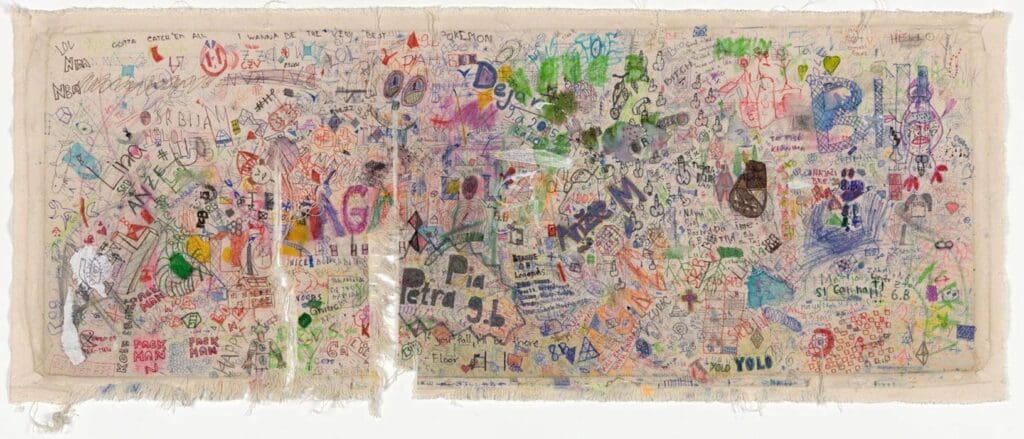
In addition, a selection of canvases from the Frequencies archive will be on display. Launched by Murillo in 2013, the Frequencies project invites schoolchildren from around the world to spend six months drawing on canvases attached to their school desks. Most recently, the project was carried out in six schools in Potsdam and Brandenburg; the resulting canvases document a global visual language of the younger generation.
Mark-making and participation as central elements of the exhibition at MINSK
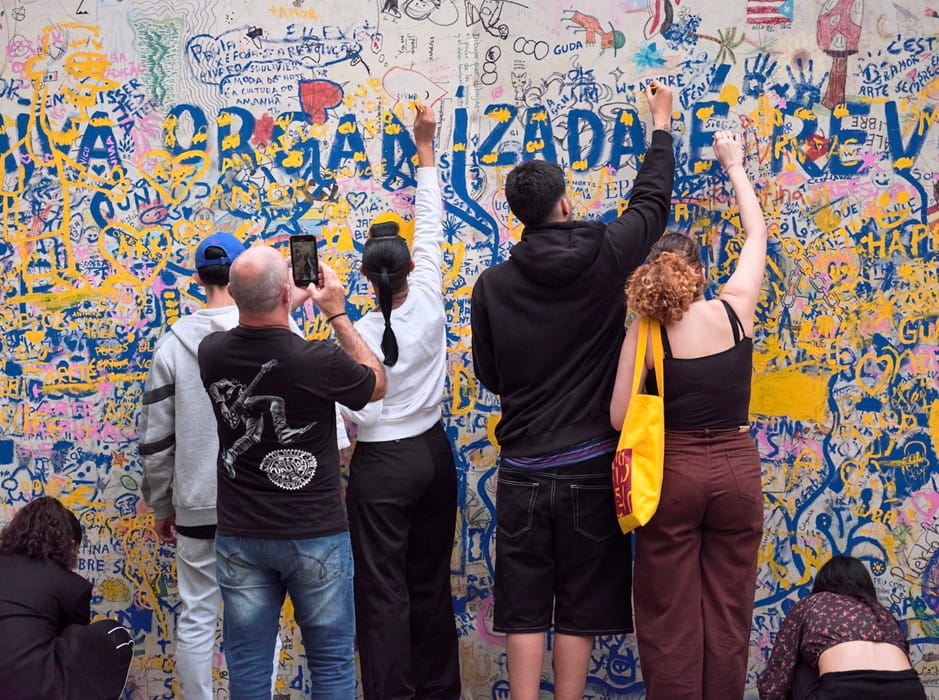
The ground floor of MINSK focuses on Murillo’s painting process, which involves a multitude of gestural traces and moments of imprinting. On display are new paintings from the Scarred Spirits series.
The presentation also features two participatory projects that Murillo has developed in various locations in recent years: Social Mapping and Collective Painting. For Social Mapping, Murillo invites participants to draw on large-format canvases. In a second process, these canvases are painted by visitors in exhibition situations at other locations in an act of Collective Painting—as in his presentation The flooded garden (2024) in the Turbine Hall of the Tate Modern or A song to a tearful garden (2025) in birapuera Park in São Paulo on the occasion of the 36th Biennial there. MINSK displays canvases and documentary material created in the course of these two artistic processes.
During the first weeks of the exhibition, painted canvases from the collaborative work A song to a tearful garden will be presented on the terrace. Then, starting on April 25, 2026, the participatory painting event at MINSK will begin: Visitors are invited to paint social mapping canvases in the open air starting on this date.
As part of the exhibition, Murillo is initiating a nationwide social mapping project: canvases will be painted at various locations across the country and sent back to DAS MINSK during the exhibition period.
Oscar Murillo with a new work at the Museum Barberini
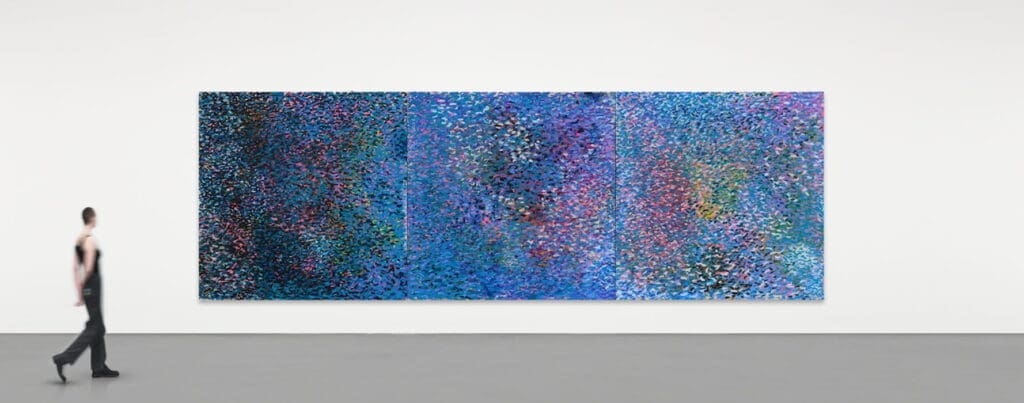
The Barberini Museum will be exhibiting a new large triptych entitled surge (social cataracts) in its collection presentation of Impressionist painting. This constellation of Murillo’s triptych and Monet’s series of works questions how the act of seeing is learned and implemented in painting, contrasting Monet’s figurative representation with Murillo’s abstraction.
Oscar Murillo says of his works from the Surge series: “Monet and his paintings are a medium through which I can understand paradoxes. On the one hand, his works are an expression of a universally recognised aesthetic – gesture, size, colour, harmony and joy. On the other hand, his experiences as a human being and with the cataracts he suffered from on both sides allow me to sense cosmic torment and darkness as a metaphor. The highly structured paintings I work on are a direct result of these considerations – considerations that flee into pixels of nothingness or circle around them.”
WHEN?
Exhibition dates: Saturday, 14 March 2026 – Sunday, 9 August 2026
Opening hours: Wednesday – Monday, 10 a.m. – 7 p.m.
WHERE?
DAS MINSK Kunsthaus in Potsdam
Max-Planck-Straße 17
14473 Potsdam