



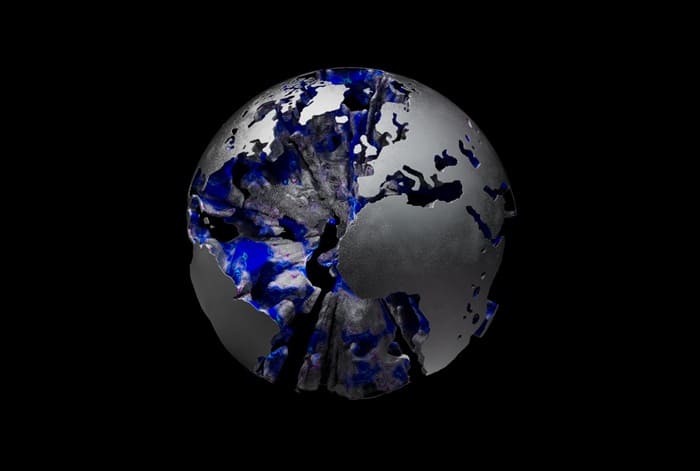

With YesterLight – Sensing Ruptures of Time, the Schinkel Pavilion presents the first institutional solo exhibition in Germany by Ukrainian artist Lesia Vasylchenko (born 1990) from March 13 to May 31, 2026. Her multimedia works examine the politics of time in times of war, technological acceleration, and ecological crisis, and show how conflicts transform perception and reality. At its heart is the monumental video Chronosphere (2024), which explores the concept of time and interweaves scientific, philosophical, and folkloric perspectives.
Image above: Chronosphere, 2024, video still. Courtesy the Artist.
With YesterLight – Sensing Ruptures of Time, Schinkel Pavillon presents the first institutional solo exhibition in Germany by Ukrainian artist Lesia Vasylchenko (b. 1990). She examines the politics of time in an era shaped by war, technological acceleration, and ecological crisis. Working in multimedia, the Kyiv-born artist explores how contemporary conflicts transform not only territories but also perception itself.
How has our notion of time shifted in recent years, as we witness world orders collapsing at hyperspeed?
Lesia Vasylchenko belongs to a generation that grew up in the wake of Ukraine regaining its independence following the dissolution of the USSR in 1991. Since 2014, Ukraine has faced continuous Russian aggression, escalating into the ongoing full-scale invasion that began in 2022. The ongoing war in Ukraine has pushed the limits of how reality is documented. Damage unfolds faster than it can be recorded; threats materialize before they are visible; consequences extend long beyond what any single image can show. In the context of war, seeing is no longer possible where landscapes are erased, where visibility itself collapses under destruction. Satellites, sensors, and algorithms form an extended sensorium in which sensing often bypasses human perception. Vasylchenko’s artistic work is deeply informed by these seismic technopolitical shifts and the fractured reality and perception of time they produce.
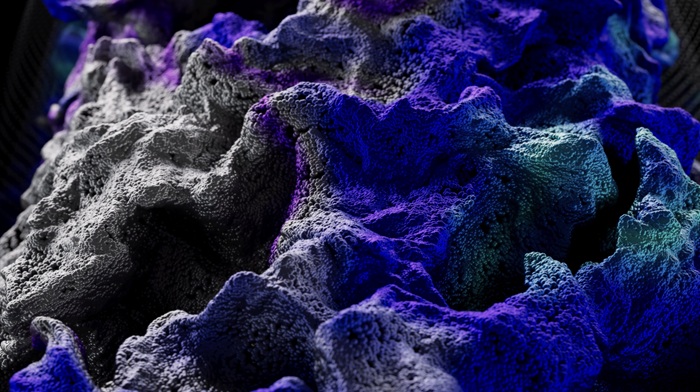
Her practice—situated at the intersection of video, photography, and installation—is invested in media archaeology and the complexities of chronopolitics: a term describing the reciprocal relationship between time and politics, and the use of time as an instrument of power.
At the heart of her first institutional exhibition in Germany titled YesterLight – Sensing Ruptures of Time is the monumental video work Chronosphere (2024). The parafictional narrative navigates the weaponization of time, ranging from the micro-temporal precision of satellite synchronization to the deep time of ecological trauma.
Time as a scale that shapes planetary infrastructures, politics, societies and histories connected to images as a carrier is often a starting point for Vasylchenko’s in depth research. From microseconds of satellite data production used to observe the planet 24/7, to deep time of ecological trauma caused by war, her artistic practice explores the interconnections between human politics and cultures; natural environments and artificial intelligence; synchronized micro and macro scales; between seeing and sensing time through the means of the photographic and synthetic image.
However, Vasylchenko’s research-based practice is not solely rooted in science and philosophy but opens up to Ukrainian folklore, drawing on tales passed down as oral history through generations. A new body of work centers on the symbol of the weeping willow—a tree marking recurrence and regeneration in the Ukrainian landscape as well as also revered in folk belief as a carrier of souls.
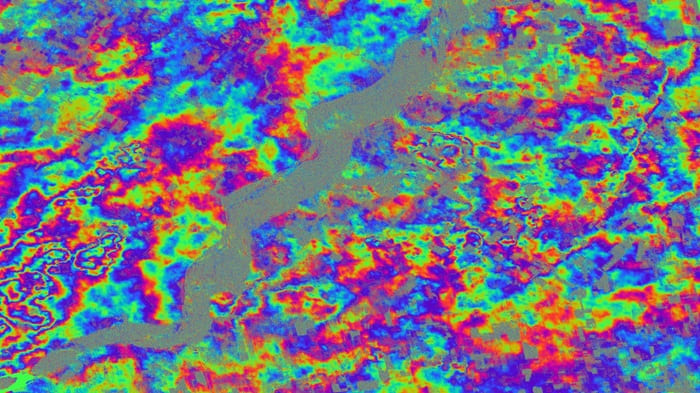
The preservation of memory and its endurance become a central, connecting element—one found as much in myths and oral histories as in the technological progress that allows us not just to map the world with precision but to capture time itself. Through speculative frameworks, Vasylchenko critically examines the dimensions of more-than-human time and the evolving infrastructures of visual culture. In doing so, she invites us to confront a fundamental question: How do we inhabit a present that is increasingly fragmented?
Curated by Lina Louisa Krämer and Dr. Luisa Seipp
WHEN?
Exhibition: Friday, 13. March – Sunday, 31. May 2026
Opening: Thursday, 12. March 2026 – 6 pm
WHERE?
Schinkel Pavillon
Schinkelplatz 1
10117 Berlín




 from March 13 to May 31, 2026. Cultural news, art exhibitions + art events to discover.)