

Today, the Georg Kolbe Museum in Berlin announced that the heirs of Heinrich Stahl have accepted the offer of full restitution of the Dancers’ Fountain. Given the persecution suffered by the Stahl family and the undeniable fact that the fountain is cultural property confiscated as a result of Nazi persecution, it was of paramount importance to the Georg Kolbe Museum and its board of trustees to achieve a just and fair solution in accordance with the Washington Principles.
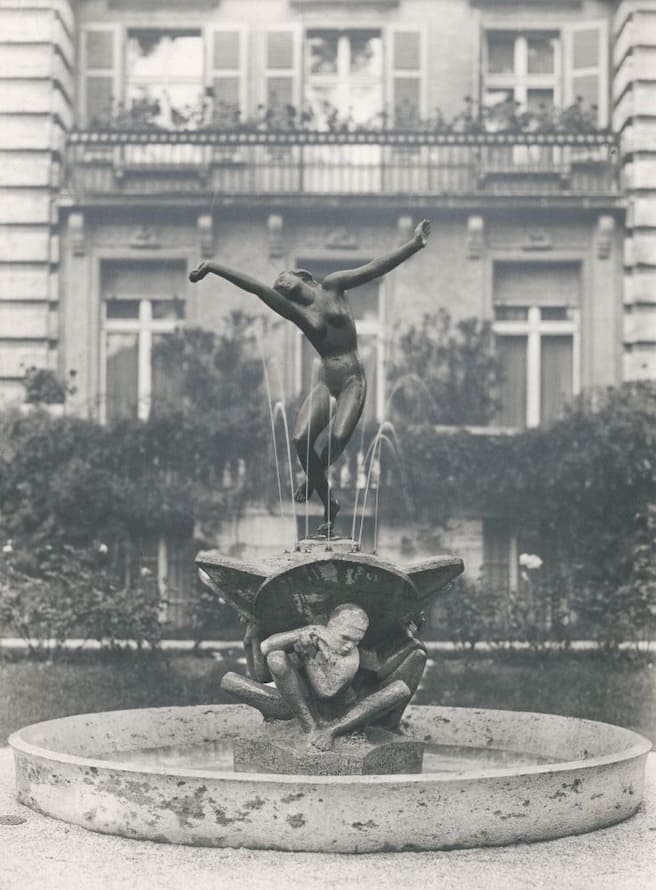
Image above: Georg Kolbe, „Tänzerinnen-Brunnen”, 1922, Villa Heinrich Stahl, Berlin Dahlem, Foto: unbekannt.
The Dancer Fountain in the sculpture garden of the Georg Kolbe Museum was the focus of ongoing provenance research and an accompanying research project. The Georg Kolbe Museum describes this work as being guided by the awareness of the injustice and the necessity of acknowledging the suffering inflicted on countless Jewish victims. In this context, the museum contacted the descendants it knew of again in 2024, among other things to work with them on a fitting commemoration of the fate of Heinrich Stahl, the original owner, and his family.
Heinrich Stahl, a Jewish businessman and the fountain’s patron, was murdered in the Theresienstadt concentration camp in 1942. The fountain was long considered lost and was reconstructed in the 1970s. Since the 1980s, the Georg Kolbe Museum has been in contact with the descendants, who – according to the information available at the time – waived their claims in 2001 but expressed a desire for a memorial.
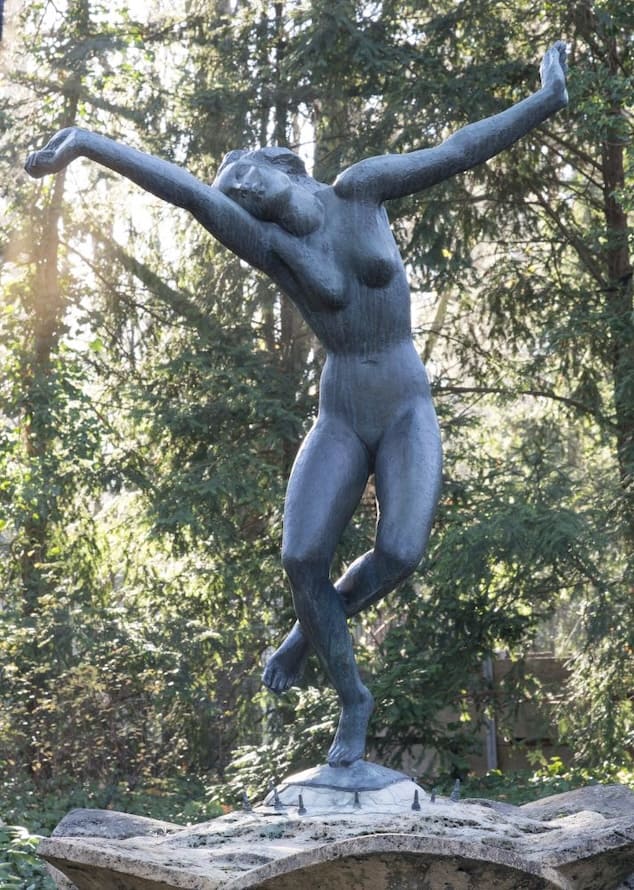
Under the directorship of Kathleen Reinhardt, the museum systematically examined its own history, collection, and Georg Kolbe’s work within different political systems from 2023 onwards. Since 2023, the museum has been working interdisciplinarily on the historical classification and contextualization of the Dancers Fountain as part of the project “The Fountain.” In the institution’s anniversary year of 2025, the museum proactively resumed its dialogue with the descendants.
The project aimed to clarify restitution issues and develop new forms of remembrance. Central to this was the exchange with descendants, as well as with artists, scholars, and the public. Visual language was as much a subject of research and critical analysis as the history of ownership.
This process-oriented approach combines remembrance and exposure of Nazi persecution and colonial image politics in an iterative, public process aimed at legal clarification, shared forms of commemoration, and an institutional reckoning with historical responsibilities. For example, the sculpture’s base depicts black figures supporting a white dancer—a colonially coded motif with an antisemitic history.
Against this backdrop, the initiated research, discussions, and legal reviews led to a crucial clarification. Building on the previous examination of the object’s history and in close consultation with the descendants, the museum has now specified the next steps. Today, the Georg Kolbe Museum and its board of trustees confirmed the full restitution of the Dancers Fountain to the heirs of Heinrich Stahl.
Given the persecution suffered by the Stahl family and the undeniable fact that the fountain is cultural property confiscated as a result of Nazi persecution, it was of paramount importance to the Georg Kolbe Museum and its board of trustees to achieve a just and fair solution in accordance with the Washington Principles. The museum and the foundation are aware that restitution does not undo the inexcusable injustice suffered; however, it is a gesture of acknowledgment of this injustice towards the descendants.
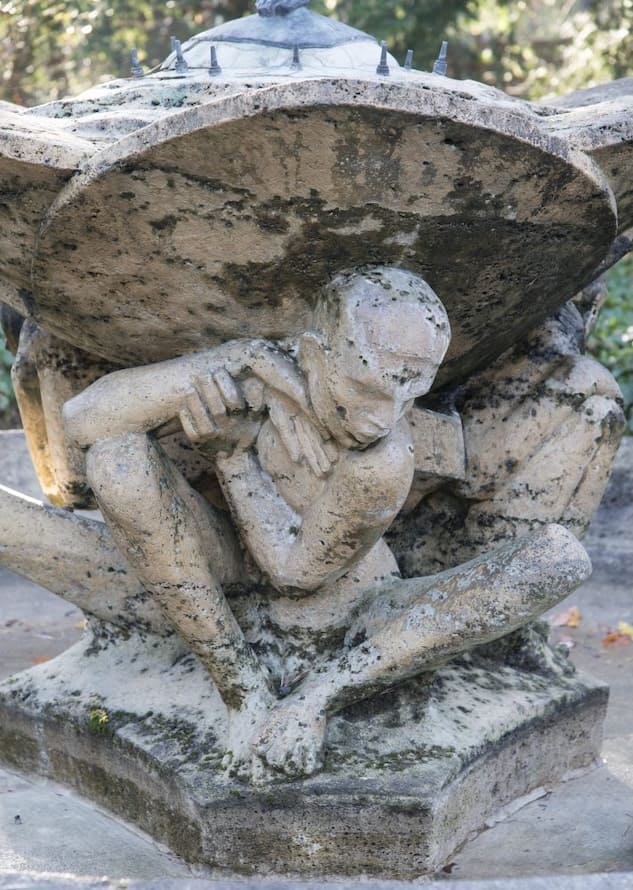
Following legal clarifications over the past few months, it is now established that Werner Stahl, the grandson of Heinrich Stahl, did not declare the renunciation of the Dancers Fountain on behalf of the entire Stahl family in 2001. Against this backdrop, the Georg Kolbe Museum and the Board of Trustees of the Georg Kolbe Foundation have expressed their intention to fully restitute the artwork to the heirs of Heinrich Stahl. The museum had already submitted a corresponding offer to the heirs in September 2025, which they have now accepted through their legal representatives. The heirs and the museum are currently coordinating the next steps regarding the restitution.
Since 2022, the Georg Kolbe Museum has been systematically examining its own history, its collection, and Georg Kolbe’s work, particularly during the Nazi era, and is part of important research networks on continuities after 1945. Since 2024, the museum has been working interdisciplinarily and iteratively on the research, historical classification, and contextualization of Georg Kolbe’s Fountain of Dancers (1922) as part of the research, education, and exhibition project “The Fountain.” At the beginning of 2025, the museum proactively initiated a dialogue with the descendants of the original owner, Heinrich Stahl, to clarify the issue of restitution and, based on this, to develop new forms of remembrance.
The Georg Kolbe Museum sees it as its duty, in close cooperation with the descendants, to continue to commemorate the injustice done to the Heinrich Stahl family. The museum and foundation thank all relatives and their representatives, as well as all those involved, for their support and patience
As part of its educational work and research, the museum continuously addresses new questions concerning art history during the Nazi era and its continuities after 1945 within international networks. In its exhibition, educational, and research formats, the museum is committed to the scholarly analysis of historical contexts and their broad dissemination. For many years, the museum has also been actively involved in educational work against antisemitism.