

The TUM Architecture Museum is addressing one of the most pressing issues of our time: global food production. From April 23 to October 18, 2026, the exhibition illuminates the complex networks behind our food supply and shows how climate change, resource scarcity, and economic interests are pushing the existing system to its limits. In twelve chapters, production methods, global interconnections, and possible future perspectives are presented critically and vividly.
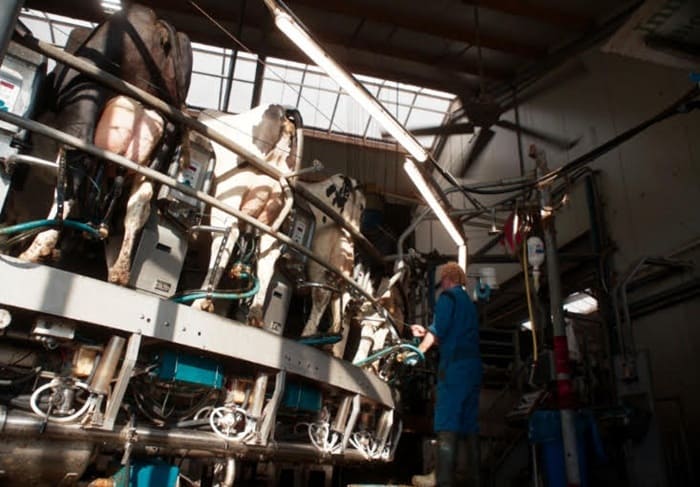
Image Above: A farm worker in the circular milking parlor, Dairy Campus Leeuwarden. Still from the film “The True Type” by Nicole Humiński and Víctor Muñoz Sanz. Camera: Nikolai Huber. Production: Andjelka Badnjar, Andres Lepik, Architecture Museum of the TUM, 2026.
The secure and equitable supply of food to the world’s population depends on a system of global networks: farmers, fishers, breeders, traders, transport companies, markets, and industrial processing plants are all closely intertwined. They not only produce and distribute what is necessary for human nutrition, but are also motivated by the logic of capitalist growth to produce ever more goods, which, through overconsumption, leads to poor nutrition and massive food waste. However, this system is currently reaching its limits due to climate change, political, and economic factors. Many oceans are already overfished, fertile farmland is being built over or eroding, and entire regions are being devastated due to insufficient rainfall. At the same time, food production itself contributes significantly to climate change through increasing CO₂ emissions – a vicious cycle that is becoming ever more apparent. Hardly any country in the world can still feed its population from its own resources.
The exhibition presents examples in twelve chapters of how our food is produced and distributed today. The focus is primarily on Europe, but global connections are always taken into account. The exhibition aims to make the spatial and technological foundations of our food production visible – and to show what challenges and opportunities arise for the future.
CLIMATE AS A SERVICE
The Netherlands is regarded as a pioneer in the development of high-tech greenhouses. In a precisely controlled climate, vegetables, fruit and herbs grow all year round, regardless of the weather or season. The sophisticated technology behind this has itself become a successful export product, yet at the same time it competes with conventional, natural cultivation.
THE STRAWBERRY AND THE GREENHOUSE
Like many other fruits, strawberries are now available in supermarkets almost all year round. A graphic essay illustrates the consequences of this constant availability for regional producers in the Munich area.
SALMON AND TOMATOES
Salmon farming has grown into a global industry. Yet its growth comes at a high price: wild-caught fish are processed into fishmeal to feed the farmed fish. Overfishing has caused the collapse of small-scale local fisheries in some coastal regions of West Africa. As a result, many people are losing their livelihoods and are being driven to migrate to the Canary Islands. Many who survive the dangerous crossing end up working illegally and in precarious conditions as undocumented workers in the tomato greenhouses of Almería.
TROPICALIA
In Sicily, the consequences of climate change are already being felt dramatically. Heat, drought and unpredictable extreme weather are taking a heavy toll on agriculture. By introducing new wheat varieties and growing tropical fruits, farmers are seeking ways to adapt to the changing conditions.
THE ANIMAL IS PRESENT
The modern cowshed is a prime example of the growing contradictions in today’s food production. Digital control systems, genetic breeding and reproductive technologies drive the race for ever more milk and meat. The animals are engineered for maximum output, whilst farmers are transformed into managers of predefined programmes and robotics.
TECHNOMINOTAURUS
An installation by the Hungarian artist and researcher Daniel Szálai explores the largely invisible role of breeding bulls as carriers of genetic information. The multimedia installation highlights the physicality and mythical dimension of these male animals.
OCTOPUS CHOREOGRAPHIES
Taking the small coastal community of Angeiras in northern Portugal as an example, the work and production chain of the local fishermen and fisherwomen is showcased. Alongside cod, sea bass, prawns and lobsters, they catch, above all, large quantities of common octopus. However, the region has long been unable to meet the growing demand for fish driven by tourism – yet octopus fishing leaves a significant mark on the built environment.
MONKS AND MACHINES
Carp farming has shaped part of the cultural landscape in Bavaria since the Middle Ages. Today, modern indoor aquaculture is giving rise to new forms of fish farming – even seafood such as prawns can now be farmed inland. New technologies promise greater efficiency and shorter transport routes for products that are being bought by an ever-increasing number of consumers.
LIVESTOCK FARMING BEHIND GLOBES
To enable people worldwide to consume ever-increasing amounts of meat, vast areas of land must be set aside for growing animal feed – often far removed from the places where the enormous numbers of cattle, pigs and other animals live or where the meat is consumed. The ‘Behind Globes’ concept highlights the territorial dependencies of food production.
SOYSCAPES
The global rise in demand for soya – used primarily as animal feed – remains the main cause of the ongoing deforestation of the rainforest in Brazil. A graphic essay traces the often opaque production and supply chains to Europe.
THE UKRAINIAN GRAIN CHAIN
By 2014, Ukraine had developed into a superpower of global grain production. This chapter analyses how Russia’s war of aggression is deliberately destroying silos, irrigation systems and fields, leaving behind land contaminated with mines and thereby also threatening UN aid programmes in crisis regions.
LIVING SOILS
Soils are the fundamental basis of almost all food systems – a living network of microorganisms that recycles nutrients, filters water and stores carbon. Yet through overbuilding, overfertilisation and erosion, this vitally important but also limited layer of the earth is inexorably disappearing – and with it the basis of our food supply.
Curators: Andjelka Badnjar and Andres Lepik
Co-curators for the exhibition section “The Animal Is Present”: Víctor Muñoz Sanz and Sofia Nannini
Exhibition architecture: Amelie Steffen, Maximilian Atta, and Jan Müller
Graphic design: strobo B M: Julian von Klier, Sabrina Baumann, and Matthias Friederich
Publication accompanying the exhibition
The comprehensive accompanying publication for the exhibition is aimed at a broad audience and includes academic texts, journalistic pieces, and political commentary. It brings together transdisciplinary voices that explore the complex relationships between politics, food production, landscapes, and architecture. The authors include architects, historians, sociologists, scientists, students, artists, economists, environmental journalists, activists, farmers, historians of science, photographers, and curators. The book is published in both German and English.
WHEN?
Exhibition: Thursday, 23. April – Sunday, 18. October 2026
Opening: Wednesday, 22. April 2026, 7 pm
WHERE?
Architekturmuseum der TUM in der Pinakothek der Moderne
Arcisstraße 21
80333 München