



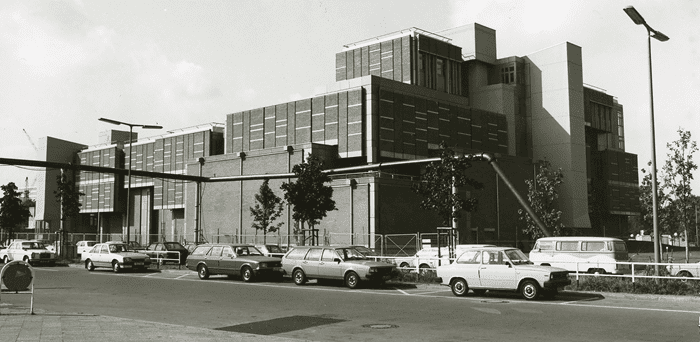

An anniversary, such as the 40th anniversary of the Museum of Decorative Arts (KGM), which opened in 1985 in the new building designed by Rolf Gutbrod at the Kulturforum in West Berlin, is often an occasion for a celebratory retrospective. The KGM chooses a different path and invites visitors to actively engage with the multifaceted aspects not only of its history, but above all of its future.
Image Above: Construction of the Museum of Decorative Arts, ca. 1985, photo: KGM archive, photographer unknown
The exhibition “Visitation: 40 Years of KGM at the Kulturforum” is conceived as a kind of séance – a collective listening to the echoes of the past, the potentials of the present, and the as-yet-unwritten futures of the building. Instead of a fixed narrative, it opens a space for the complex questions that have shaped this place for four decades.
Visions and ruptures
The history of the Museum of Decorative Arts in Berlin is characterized by visions and ruptures, not least by the former division into East and West Berlin, which resulted in two locations of the museum that still exist today – the Kulturforum in the west and Köpenick Palace in the east of Berlin.
The exhibition traces the founding idea of the museum as an institution intended to cultivate the tastes of craftsmen, its original driving forces as an educational institution with a model collection, and the conflicts that arose from such a deeply rooted 19th-century concept. However, instead of presenting a closed version of the museum’s history, it showcases aspects of the collection, methodology, and institutional past in a way that makes the multifaceted nature of the museum tangible.
What remains of this founding idea, or how was it transferred into the 20th century? The Kulturforum can be consulted to answer this question; it is not only a museum location but also a site of diverse controversies and debates: a testament to a vision of the future, whose current reality reflects the numerous compromises and unresolved questions in the history of the Museum of Decorative Arts.
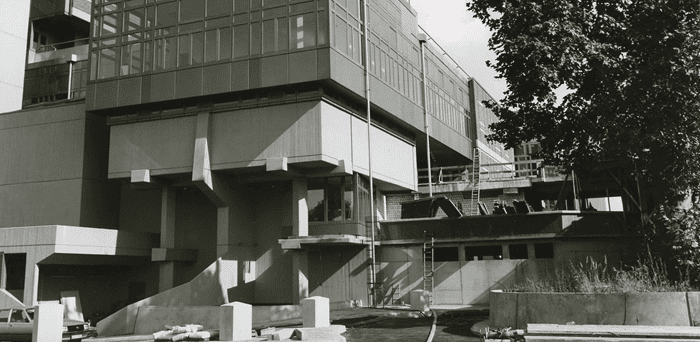
Visitation
The complex construction history of today’s museum at the Kulturforum, spanning nearly 20 years, brought with it both conflicts and opportunities, linked to new demands placed on museums in general. These concerned conservation and structural engineering requirements, but above all the museum’s primary mission and aspiration to be a democratic place of education.
The exhibition focuses in particular on these social and museological realities, for which Rolf Gutbrod found a pioneering and widely acclaimed solution by incorporating an educational gallery into the building. It illuminates the successes and failures of this built vision and simultaneously lifts the veil to offer insights into the reality unfolding in the restoration workshops and offices.
The future as an open question
The exhibition looks to the future, viewing it as an open process with ample scope for shaping the future. In light of necessary upcoming changes – such as renovation, refurbishment, and a strategic realignment – it opens the door to discussion about the future of the KGM. It is not a definitive answer, but rather an open question, formulated in the institution’s own language: an invitation to the public to participate in shaping the next chapter.
Team
Coordination and co-curation:
Ann-Kathrin Illmann, Carina Kitzenmaier, Dr. Claudia Kanowski, Kevin (Finn) Strüder, Dr. Sibylle Hoiman
Graphic design: Kevin (Finn) Strüder, Carina Kitzenmaier
WHEN?
Opening: Friday, 14. November 2025, 6 pm
Exhibition: Saturday, 15. November – Sunday, 14. June 2026
WHERE?
Kulturforum Berlin, Kunstgewerbemuseum
Johanna-und-Eduard-Arnhold-Platz / Matthäikirchplatz
10785 Berlin



, which opened in 1985 in the new building designed by Rolf Gutbrod at)