
One year after the sudden death of Friedhelm Hütte on 26 November 2024 in Berlin, DEEDS editor-in-chief and exhibition curator Stephanie Schneider remembers the trained art historian, senior art advisor at Deutsche Bank, passionate enabler in the field of art – and a friend.
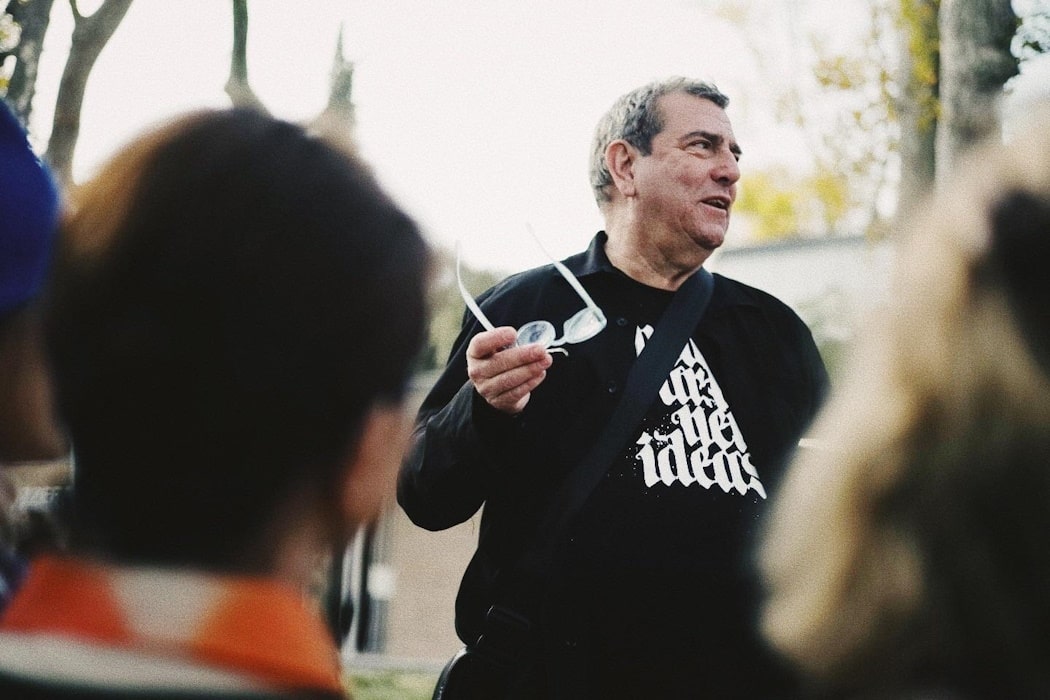
Image above: Friedhelm Hütte during a private tour of the Venice Biennale, photo © Annà Rieke, www.docupoetry.com.
Friedhelm Hütte preferred to talk about art rather than about himself. When he spoke about art in general and about his own experiences with it in particular—about exhibitions, artists, and works that had not yet been acquired but were already hanging on the walls of his mind—there was a sparkle in his eyes. On 26 November 2024, Friedhelm Hütte died completely unexpectedly in Berlin at the age of just 67. One year on, his way of looking at art continues to shape those who work with it and those who had the opportunity to get to know him.
From 3,000 to around 55,000 works
When Friedhelm Hütte joined Deutsche Bank in 1986, the in-house art collection comprised, in his own words, “around 3,000 works.” At the time, it was a respectable but still relatively modest corporate collection. From this starting point, over the course of more than three decades, Friedhelm Hütte built what is now regarded as one of the world’s largest corporate collections: some 55,000 works, with a particular focus on contemporary works on paper and photography.
For more than 30 years, first as Global Head of Art and later as Senior Art Advisor to the Deutsche Bank Collection, Friedhelm Hütte was the constant presence behind the scenes: preparing decisions, overseeing acquisitions, curating exhibitions and negotiating collaborations—from Frankfurt and Berlin to Doha. What mattered to him was less the prestige of a “large collection” than its function. Art, he believed, should hang in offices, corridors and meeting rooms, visible to employees and visitors alike. “Each floor a small solo exhibition,” he once described the concept of the twin towers in Frankfurt.
An art market without romance
Friedhelm Hütte was no romantic when it came to the art market. In a panel discussion for DEEDS Spotlight in January 2023, which I moderated, he remarked dryly, with a twinkle in his eye:
“Apart from the arms trade and the drug trade, the art market is one of the most deregulated markets of all.”
Friedhelm Hütte, 2023
This was not cultural-political pathos, but a precise, lightly sardonic diagnosis. The art market, he argued, is often opaque and unequal, with power structures rarely operating in favour of artists. And yet every protagonist in the art world matters: artists as much as galleries and museums. One cannot exist without the other. His response to this reality was pragmatic: one should buy from artists and from galleries alike. Many of his acquisitions for the Deutsche Bank collection emerged from studio visits, gallery conversations and long-term relationships.
For him, this was a matter of responsibility. Those who collect institutionally also bear responsibility for the development of artistic careers. Supporting artists did not simply mean exhibiting their work; it meant buying it, being reliable, staying engaged, providing sustained support. Another guiding principle followed naturally: art has to circulate. It must remain in motion, finding new places, new people and new contexts.
„MACHT KUNST“ – the queue outside the KunstHalle
Friedhelm Hütte’s attitude towards art and artists became publicly visible perhaps most clearly in 2013, when the Deutsche Bank KunstHalle opened in Berlin. Shortly before the opening, the idea emerged for an initiative titled “MACHT KUNST” (“MAKE ART”): all artists in the city were invited to submit a work to be shown for 24 hours in the exhibition spaces on Unter den Linden. On 8 April 2013, people queued through Berlin to submit their works—artists, students and self-taught practitioners alike. The response exceeded all expectations; the project was quite literally overwhelmed. In addition to the newly opened KunstHalle, the Alte Münze was swiftly added as an exhibition venue. More than 2,000 works were submitted, and over 12,000 visitors attended within 48 hours.
It was one of those moments in which Friedhelm Hütte’s personality became particularly apparent. He was not in the spotlight, but standing attentively at the margins, engaged and curious about what was unfolding. For a brief moment, the hierarchical structures of the art world were suspended. And that, precisely, was what interested him.
A plane wing in the exhibition space
Even before the KunstHalle, Friedhelm Hütte had shaped exhibitions in Berlin under the banner of Deutsche Guggenheim, developing projects conceived specifically for that space. In 2012, for example, the Slovak artist Roman Ondák realised the exhibition Do not walk outside this area there.
The central work—on which the artist insisted—was a real airplane wing, which visitors had to cross in order to enter the exhibition space. It was Friedhelm Hütte who sourced the wing for the artist and the exhibition: an organisational and logistical feat. The project was emblematic of many others he supported—art that subtly shifts everyday perception, renders routines visible and opens our inner eye.
Kirchmöser: an old school as a future project
For several years now, Kirchmöser, near Brandenburg an der Havel, has been regarded as an outpost of the Berlin art scene. As part of the summer exhibition Am Seegarten, initiated by Patrick Ebensperger, nine Berlin galleries—including Sprüth Magers and Esther Schipper—presented contemporary art there in 2023, in a former munitions factory.
Friedhelm Hütte, already planning his (un-)retirement, had rented storage space in a former school building in Kirchmöser. His intention was to make his small private collection of artworks and curiosities accessible there: unusual record sleeves, plastic bags, antique tin containers, quirky icons of pop culture and VW-Bulli memorabilia. The idea was a convivial place by Lake Plauer See, where encounters, conversations and events could intertwine. The project was never realised.
Seriousness and liver sausage
Those who knew Friedhelm Hütte only from panel discussions or guided tours at Berlin’s PalaisPopulaire—where, as artistic director and curator, he was jointly responsible for the conception and opening of the venue in 2018—encountered a focused, precise and reserved interlocutor. In private, however, there was another side: a friend who valued animated conversations about music, especially from the 1960s and 1970s, as well as good food and drink.
His Westphalian roots in Lippstadt occasionally surfaced, not least when he spoke with visible delight about liver sausage, accompanied by a dry remark about “the taste of childhood” or “Westphalian heritage.” Anyone who saw Friedhelm Hütte dancing exuberantly at parties with the love of his life and long-term partner might, however, have placed his origins more readily in Latin America than in the sometimes austere region of East Westphalia.
This unique combination of analytical clarity and entirely unpretentious enjoyment of everyday life was characteristic of him: art could be demanding, complex and contradictory—but life, please, need not be unnecessarily complicated.
One year on
One year after his death, I still find it hard to believe. When visiting exhibitions, it often feels as though Friedhelm might walk through the door at any moment—wearing one of his unmistakable T-shirts with slogans such as “Irgendwas ist immer” (“There’s always something”). In search of the next compelling artwork, and conversations with people as passionate about art as he was.
It has become ever clearer to me how much passion Friedhelm Hütte invested in weaving networks: between artists and institutions, between bank towers and studios, between Berlin, Frankfurt and many other places. The collection he helped build for Deutsche Bank now hangs in offices, branches and exhibition spaces around the world. It tells a story of art history—and of his insistence that art must be seen, and above all bought, so that artists can continue to make art.
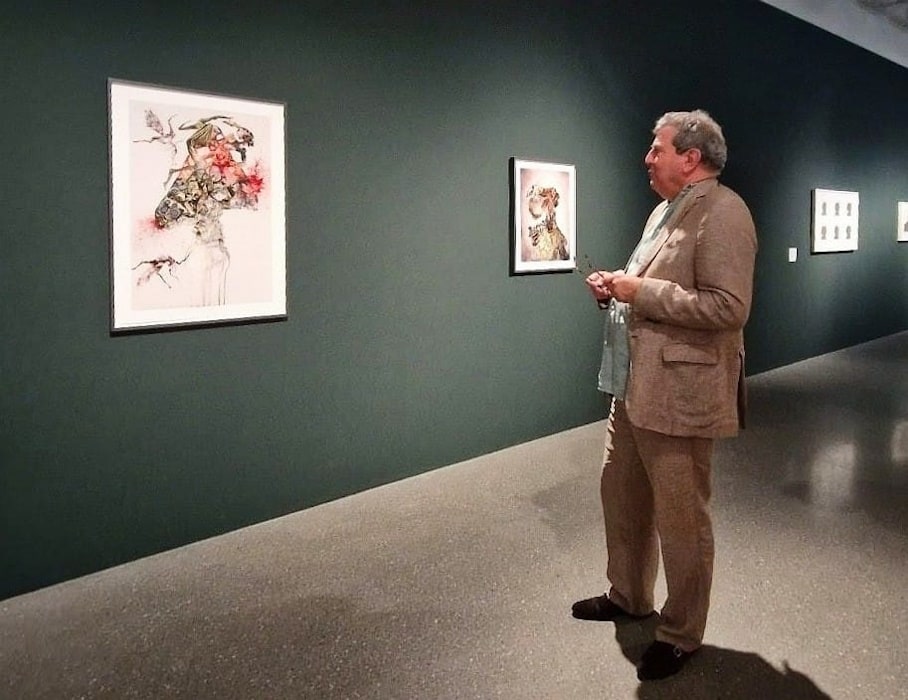
His critical remark about the art market, his practice of buying directly from studios as well, and his trust in emerging positions together form the picture of someone who took art seriously without mystifying it.
Friedhelm Hütte did not only collect art. He collected relationships, enabled situations and opened up spaces. That his way of looking at art remains a point of reference for us—precise in its vision and open in its thinking, alert to the new and attentive to the seemingly insignificant—is perhaps the greatest legacy he has left us. And that we do not forget to enjoy life, with all its small moments, dancing our way through it, and not allow supposedly more important matters to distract us from doing so. Because: Irgendwas ist immer.