

The restitution of cultural assets expropriated during the Nazi era remains a key task for museums in Germany. The case of the painting St. Anne with the Child and St. John the Baptist, attributed to Lucas Cranach the Elder, exemplifies the historical, legal and ethical challenges involved in returning works of art acquired in the context of persecution. On the basis of a comprehensive review of the provenance and taking into account the new assessment framework for dealing with Nazi-looted art, the Bavarian State Painting Collections have decided to return the work to the heirs of Ernst Magnus. The process illustrates both the development of restitution practice and the institutional responsibility for dealing with the legacy of Nazism in a transparent and critical manner.
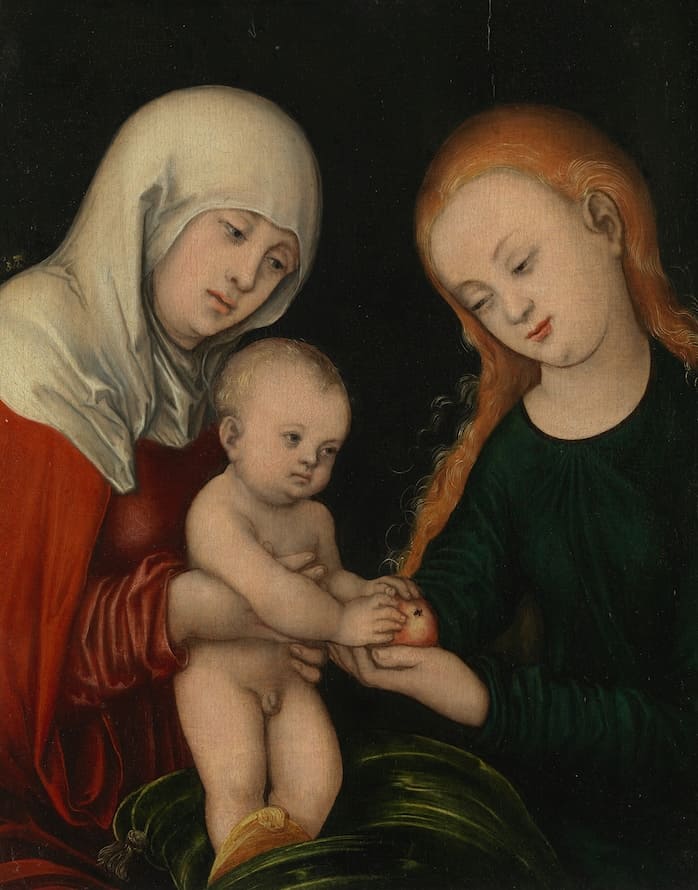
Image above: Lucas Cranach d. Ä. (Anonymer Schüler), Hl. Anna Selbdritt, um 1522-1525 Buchenholz (Fagus sp.), Ausflickung Falz Nadelholz, 32 x 25 cm Photo: Bayerische Staatsgemäldesammlungen, Sibylle Forster
Return of a painting from the circle of Lucas Cranach the Elder
The Bavarian State Painting Collections are returning the painting ‘St. Anne with the Child and St. Elizabeth’ (c. 1522–1525), from the circle of Lucas Cranach the Elder, to the heirs of Ernst Magnus (Hanover).
The small-format work was consigned by Ernst Magnus to the Fischer Gallery in Lucerne in 1940 and sold to Hermann Göring in 1941 through the art dealer Walter Andreas Hofer. After the end of the Second World War, the American Allies secured the painting at the Central Collecting Point and initially handed it over to the Bavarian Prime Minister on a trust basis. In 1961, the work was acquired from Nazi ownership and transferred to the collection of the Bavarian State Painting Collections.
The heirs had already submitted a restitution claim in 2009, which was rejected in 2010 under the legal situation at that time. A re-examination based on the new assessment framework of the Arbitration Tribunal for Nazi-Looted Art has now led to a revision of the decision and the approval of restitution.
Minister of Culture Markus Blume emphasises that the expanded list of criteria in the new assessment framework creates clear legal requirements for the return of the painting for the first time. The new framework specifies the Washington Principles and enables a contemporary, differentiated assessment of previously unresolved constellations such as dealer goods, foreign sales and so-called flight goods. This gives museums the opportunity to re-examine complex cases on a sound basis.
Anton Biebl, Director of the Bavarian State Painting Collections, sees the restitution as a visible sign of the further development of restitution practices and emphasises the responsibility towards the victims of Nazi injustice and their descendants.
Hannah Cavendish-Palmer, great-granddaughter of Ernst Magnus, thanks the German institutions for their willingness to listen, remember and acknowledge the injustice suffered, and calls for further restitution of looted artworks.
Biographical background of the Magnus family
Ernst Magnus (1871–1942) lived with his wife Ida in Hanover for many years. He was director of Commerz- und Disconto-Bank Hannover and a member of several supervisory boards. Together they built up a significant art collection. When the National Socialists came to power, the family was systematically disenfranchised. Accounts were frozen, assets sold below value, and high special taxes levied.
In 1935, Ernst Magnus emigrated to Lausanne, taking parts of his collection with him. In order to finance the costs of emigration and a visa for Cuba, he was forced to sell further works, including ‘St. Anne Selbdritt’. In 1941, the family managed to flee via Seville to Havana, where Ernst Magnus died in 1942. His wife and daughter were later able to travel on to the United States.
Provenance research and valuation of looted art
The case highlights the challenges of provenance research, particularly in relation to sales abroad during the Nazi era. These often took place under formally free market conditions, but were frequently characterised by existential hardship. The new assessment framework adopted in 2024 allows for a more differentiated classification by taking greater account of persecution-related economic hardship and also recognising forced sales outside the territory of the Reich.
For the Bavarian State Painting Collections and the newly established Department for Provenance Research, this means re-examining previous decisions and continuously expanding provenance research. The restitution of the painting ‘St. Anne with the Child and St. Elizabeth’ thus also represents the Bavarian State Painting Collections’ ongoing commitment to the responsible handling of cultural property confiscated as a result of Nazi persecution.