

From 7 December 2025, the CSR.ART Contemporary Show Room will present the first solo exhibition by Berlin-based artist Mo Ganji. Under the title ALMOST LOST | 幾乎遺失, CSR.ART will show a selection of 70 works from Ganji’s single-line series depicting 250 endangered or already extinct life forms. The essentialist works are executed on standard Post-it notes, a medium intended for important notes. For Ganji, it becomes a reminder of what is almost overlooked or even already lost. At the same time, by reducing his medium to a single line, Ganji questions the connection between all beings.
Ganji’s solo show in Berlin takes place parallel to the presentation of his complete 8th work group with 250 motifs at the MOORDN Art Fair in Guangzhou (China). The impressive complete work ALMOST LOST | 幾乎遺失 comprises 250 motifs in 99 work groups of hand-drawn serial unique pieces. The work groups are part of the overarching work theme CORE | 核心 | LIFELINE | 生命線.
Accompanying this, CSR.ART is showing the Düsseldorf painter Xianwe Zhu in the window cabinet with his iconic series Little Gentleman and a selection of his inner landscapes. The artist, who grew up in China, builds a bridge to Mo Ganji with his Daoist approach. The exhibition will be on display until 24 January 2026 at the CSR.ART location in BIKINI BERLIN.
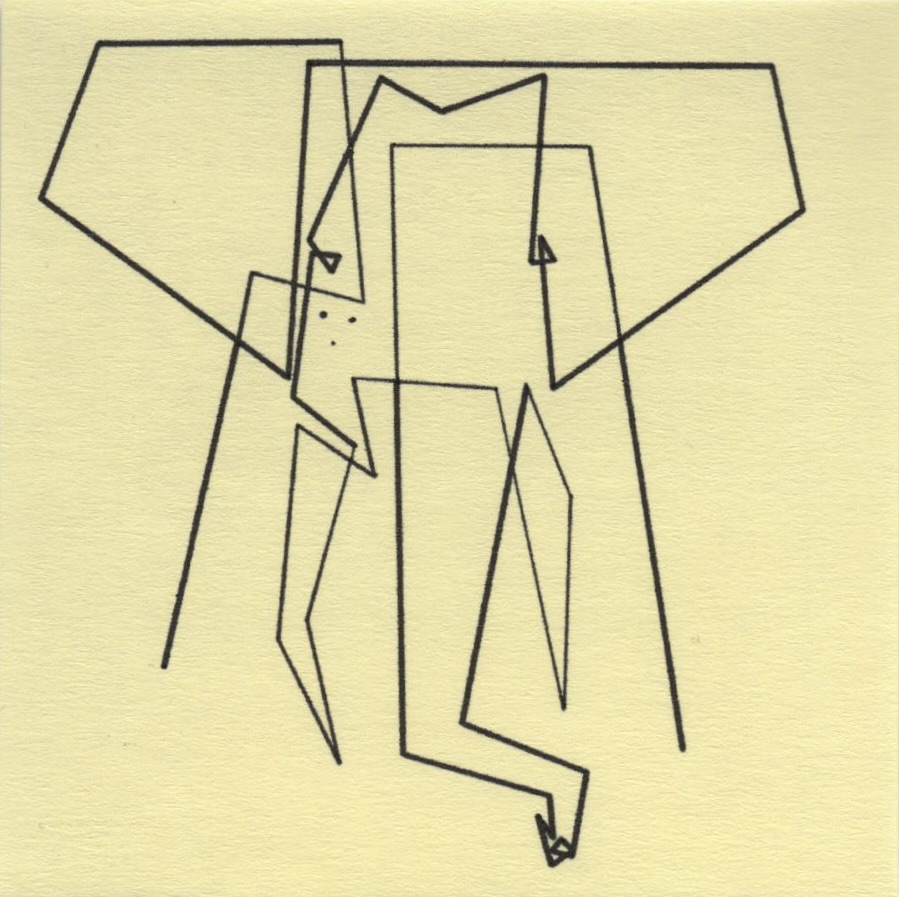
Image above: Mo Ganji, African Forest Elephant | Afrikanischer Waldelefant | Loxodonta cyclotis, 2025, Drawing pen on Post-It paper, 7,5 x 7,5 cm | 2.9 x 2.9 in, certified, dated, signed and numbered on the reverse, serial unique artwork, No. 001/250 (unique variant) from work group 8/99, WV|CR ART 0004251, © 360degrees.art
The line as essence
As a representative of essentialism, Mo Ganji has been working for many years with the reduced form of single-line drawing, in which each figure is created from a single, unbroken line. The work focuses on entities that represent fragility, endangerment and the fundamental interconnectedness of all life forms. The exhibition ALMOST LOST | 幾乎遺失 at CSR.ART shows 70 selected motifs of different species that can be found on the Red List of the International Union for Conservation of Nature (IUCN). 42,000 species worldwide have been classified there with their respective Red List status, which is divided into six levels – from “not endangered” to “extinct”.
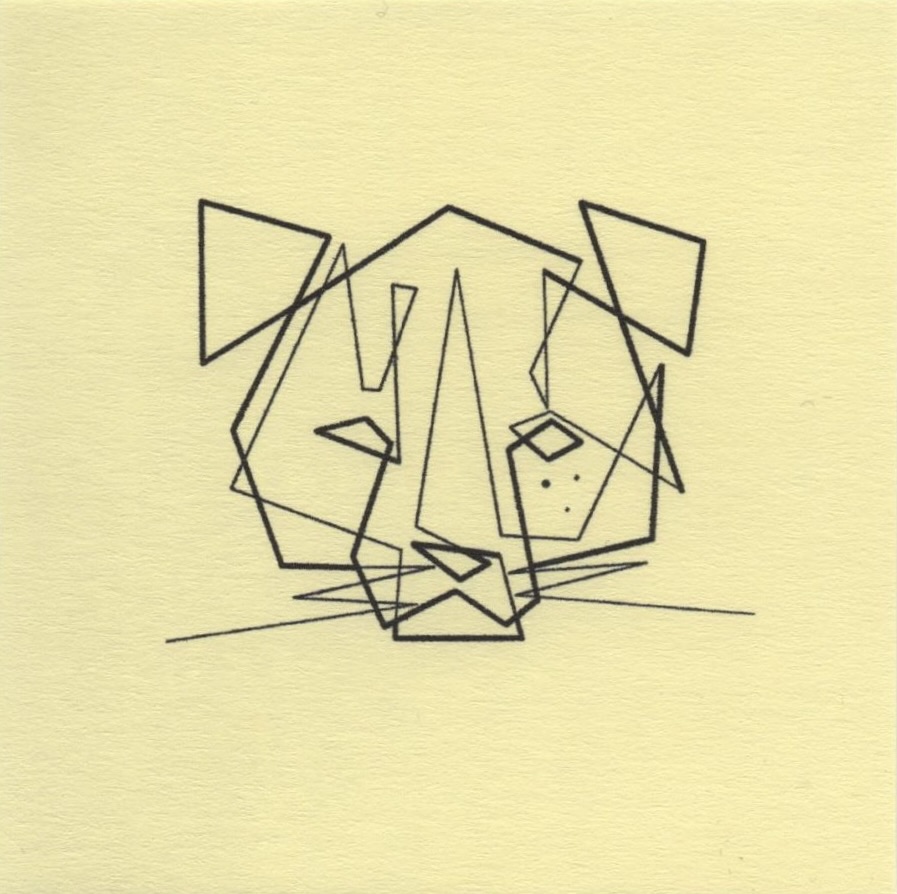
Ganji’s method lends the line a philosophical depth. In the series CORE | 核心 | LIFELINE | 生命線, the unbroken line becomes a metaphor for life itself: a continuum that undergoes changes of direction, loops and breaks, but nevertheless remains connected. Philosophically, this is reminiscent of Heraclitus’ idea of constant flux and of considerations that locate the essence of a living being in the continuous expression of its life movement. The line refers to an inner continuity that remains despite change; to what constitutes the core of a being. In Buddhist traditions, on the other hand, the line appears as an expression of ‘interbeing’: as an indication that no being exists in isolation, but is embedded in a network of connections.
In this way, each drawing produces not only the outline of a being, but also the trace of an existence. A visible condensation of its being, its presence and its living connections. It shows a living being in all its complexity, using no more than the bare essentials.
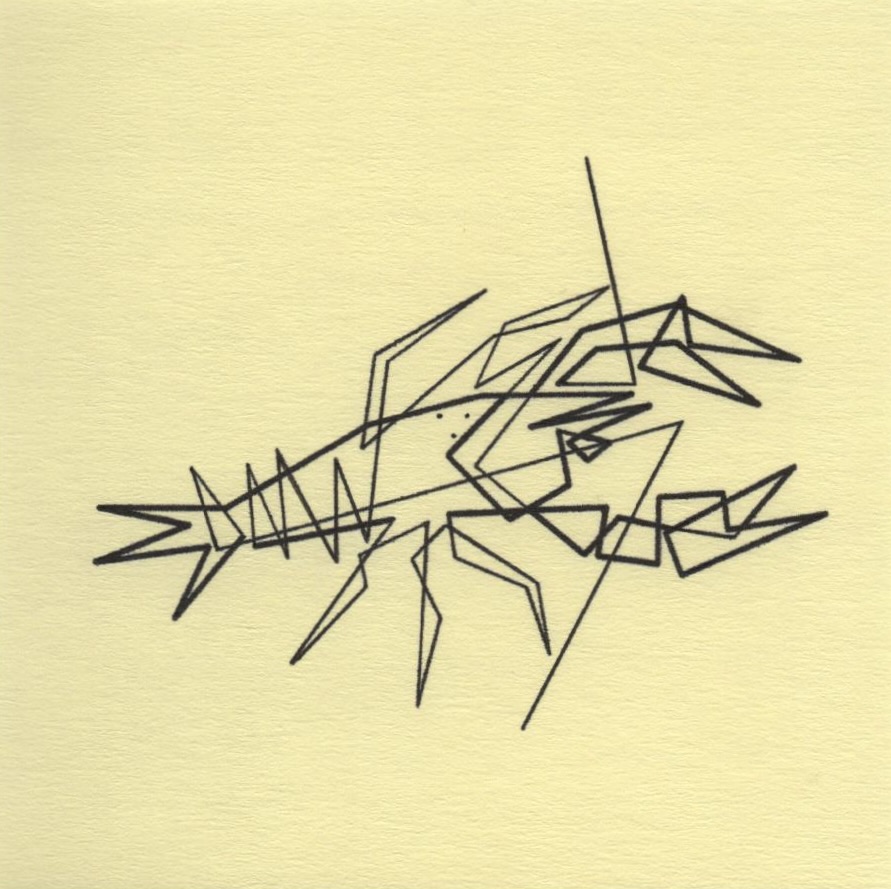
The decision to use Post-its as a medium adds an extra layer to the works. The medium, which is actually intended for fleeting notes, becomes a reminder: of what must not be forgotten. Of what is easily overlooked. This combination of lifeline and Post-it creates a peculiar tension: a living line on an object that traditionally stands for the temporary. Ganjis’ work calmly and without pathos questions the role our perception and attention play in our interaction with the natural world around us. And what consequences it has for us when we fail to be mindful of this world.
Themes of preservation and connectedness
Mo Ganjis work repeatedly raises the question of how much can be reduced without losing the essence. This reduction refers to much more than just the line as an artistic concept: it raises the question of preserving and recognising the connection between all living beings and all existence. Ganji’s seventh group of works, ALMOST LOST | 幾乎遺失, continues this motif and connects it with the idea of a shared lifeline that runs through the diversity of the beings depicted. It becomes clear that it is precisely through reduction that we are able to penetrate to the core of being. Nothing distracts, nothing obscures the essential. For Ganji, the line is a method of penetrating complexity without evading it, and at the same time a way of leaving things as they are – without decoration, without exaggeration.
‘Once we have recognised what is essential, it doesn’t take much to find meaning.’
Mo Ganji
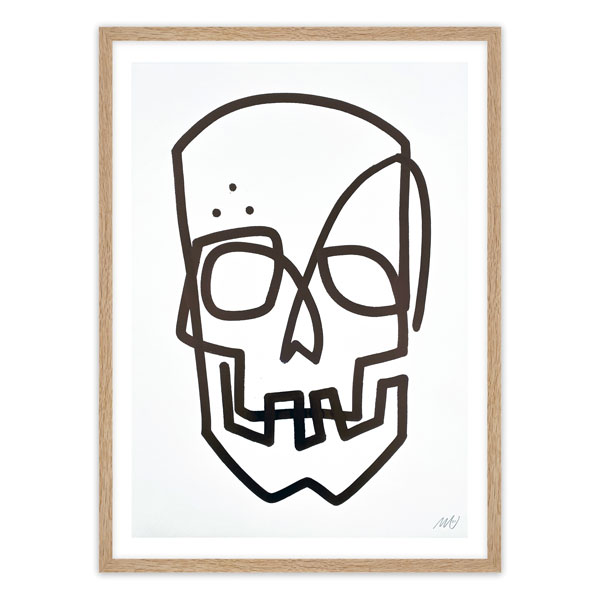
This attitude also gives rise to his conviction that recognising the essential can be achieved, in the literal sense, by revealing what is already present in an entity and forms its core – not in what we attribute to an entity in terms of external attributes and human concepts. In an interview with DEEDS, he states: ‘Once we have recognised the essential, it doesn’t take much to find meaning.’ The reduction to the essential is understood here as a precise tool: it reveals what threatens to disappear in abundance. The line shows more than forms; it portrays not only the personality of each being, but also its sensitivity and vulnerability. Ultimately, we recognise that the form described by the line only becomes what we attribute to it through our own interpretation. This view culminates in the exhibition in three single-line paintings, which, in their maximum reduction, reveal the core as essence. At the same time, they invite all viewers to see in the lines what their own imagination allows. Because the line is everything.
In all these perspectives, ALMOST LOST | 幾乎遺失 also becomes a reflection on what we have in common: on what connects all life and what is often overlooked in our self-image as human beings who mistakenly believe ourselves to be outside of nature. Ganji describes it as a search for the point at which differences lose their meaning. Not because they do not exist, but because at their core, in their essence, they refer back to the same thing that connects everything.
Mo Ganji
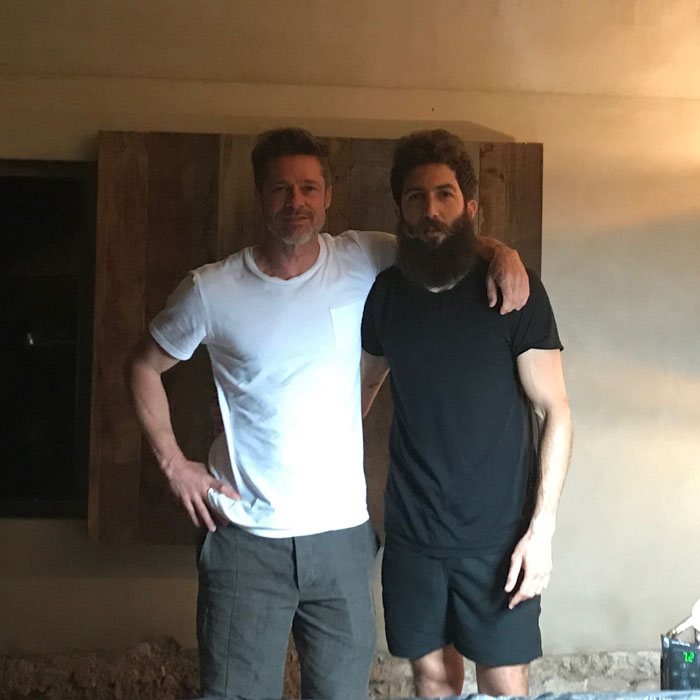
Born in Iran in 1983, Mo Ganji has lived in Berlin since 1985. Without any formal artistic training, he developed his practice autodidactically, initially in mural and figurative painting. Since the mid-2010s, he has focused entirely on single-line drawing, which has become his central means of expression. The artist creates his drawings not only on paper, but also on skin in the form of tattoos – actor Brad Pitt, for example, carries three of Mo Ganji’s works of art with him in this way. Today, Ganji is one of the best-known artists working with radical graphic reduction.
Ganji’s works are created from a single, unbroken line. His works revolve around questions of essence, connectedness, responsibility and perception. Recurring themes include human-nature relationships, ecological fragility, the motif of ‘we are one,’ and the search for a visual core of human and non-human existence. Mo Ganji’s works have been featured in international media and are often referenced in design and art contexts as examples of contemporary minimalist and single-line art. Among his best-known and most unusual works is ‘The World Piece,’ an international art project in which 61 people from 61 countries each had a continuous line artwork tattooed on their bodies, designed by Mo Ganji. The project made an impressive statement about global connectedness, understanding, and community across borders.
In the window cabinet: Xianwei Zhu – Little Gentleman + Inner Landscapes
Accompanying the main exhibition, CSR.ART presents works by artist Xianwei Zhu in the cabinet. His series ‘Little Gentleman’ deals with the theme of childhood. At its centre is a young person whose search for orientation and closeness is expressed in his relationship with animals, books, toys and flowers. The figures appear observant, sometimes quietly withdrawn. They reflect the search for a place in the world that frees them from the conformities and constraints of society and gives their souls room to unfold. In contrast, Zhu’s landscapes refer to a place within. Inspired by German Romantic painting, including Caspar David Friedrich, he places a tiny human figure in a landscape setting that never refers to a real place and is therefore universal.

A quiet connection can be discerned between the two positions – Mo Ganji and Xianwei Zhu. It concerns the handling of vulnerability, the awareness of the delicate and at the same time essential aspects of life. Where Ganji uses lines to refer to the essence and core, Zhu shows a person’s attempts to understand this world and find a place in it. Both works emphasise in different ways what it means to be connected – to nature, to relationships, to one’s own time.
Xianwei Zhu
Xianwei Zhu was born in Qingdao, China, in 1971. After studying art education at Shandong University/Shandong College (1989–1993) and painting at the China Academy of Art in Hangzhou (1993–1996), he worked as a lecturer at Qingdao University for several years. In 2001, he moved to Germany to study painting at the State Academy of Fine Arts in Stuttgart under Prof. Cordula Güdemann, graduating with a diploma/MFA in 2008. This was followed by teaching assignments and professorships at the Merz Academy in Stuttgart, the Beijing Film Academy, the Yunnan Art Academy and the Technical University of Dortmund, among others.
Zhu lives and works in Stuttgart, Düsseldorf and Krefeld. His painting combines traditional Chinese ink and landscape painting with elements of German Romantic landscape painting. His work is characterised by a combination of Chinese Taoist landscape tradition and modern, sometimes abstract painting techniques. Zhu focuses on themes such as emptiness, memory and travelling between cultures. In Xianwei Zhu’s work, the abstract nature of the landscape depicted becomes an inner landscape.

Zhu’s works have been shown in numerous solo and group exhibitions in Germany, China, the USA, Austria, Romania and Liechtenstein. Zhu is also represented in several public and private collections, including the Staatsgalerie Stuttgart, the Collection of the State of Baden-Württemberg and other institutional collections.
CSR.ART
Since 2022, CSR.ART Contemporary Show Room has been exhibiting contemporary art at various locations, regardless of the origin, age or gender of the artists. The exhibitions are often thematic or dialogical in nature and develop their own resonances through interaction. Since 2022, CSR.ART has shown 25 exhibitions featuring well over 250 artists from 37 countries.
WHEN?
Exhibition start:
Sunday, 7 December 2025, 1 p.m. to 6 p.m. (Sunday shopping)
Special opening day:
Sunday, 25. January 2026, 1 p.m. to 6 p.m. (Sunday shopping)
Exhibition dates:
Sunday, 7 December 2025 – Saturday, 24 January 2026
extended until Saturday, 14 February 2026
Open Tuesday to Saturday from 10 a.m. to 7 p.m. and by appointment
WHERE?
CSR.ART Contemporary Show Room
@BIKINI BERLIN on the ground floor on the left, entrance towards Zoo Palast cinema
Budapester Str. 38-50
10787 Berlin