

From April 17, 2026, the Berlinische Galerie will present “Marc Brandenburg. 20th Century Debris,” a comprehensive retrospective of the Berlin artist’s work. The exhibition will feature approximately 170 works, including recent pieces as well as very early, rarely seen drawings from the 1990s, along with videos, tattoo sheets, and photographs.
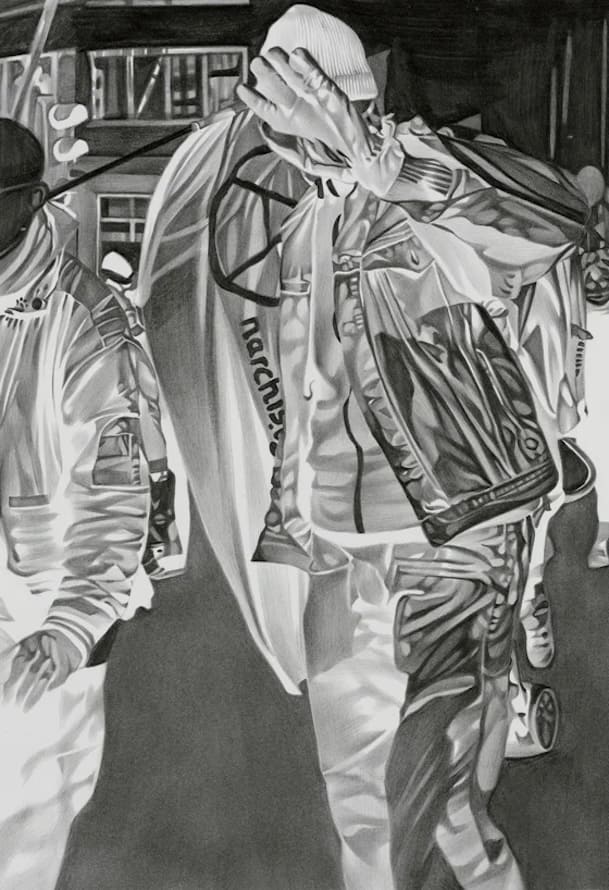
Image above: Marc Brandenburg, Untitled, 2010, Private Collection, © Marc Brandenburg, Photo: Jochen Littkemann, Courtesy Contemporary Fine Arts
The work of Berlin-based artist Marc Brandenburg (born 1965) moves between drawing, collage, installation, video, and performance. Since the 1980s, he has been an integral part of Berlin’s creative scene and is internationally recognized as one of the most important contemporary draughtsmen. At the heart of his work are detailed pencil drawings based on photographic sources. Brandenburg captures these images on walks through the city or finds them in magazines, films, and books. In several stages, he inverts the images, reversing the light and dark areas, distorts them, and then freely transfers them to paper. This process creates abstract representations of reality.
As a keen observer of metropolitan life, Brandenburg seeks out the oddities of urban reality and focuses his attention on the seemingly insignificant, those outside conventional notions of beauty. At the same time, symbols of popular culture are part of his visual world: portraits of celebrities, pornography, fast food, and kitsch. Brandenburg addresses excess and consumerism as well as social ills as consequences of late capitalism. A linear narrative is rarely conveyed; rather, a melancholic and ominous mood is created, subtly alluding to the crises of our time: 20th Century Debris.
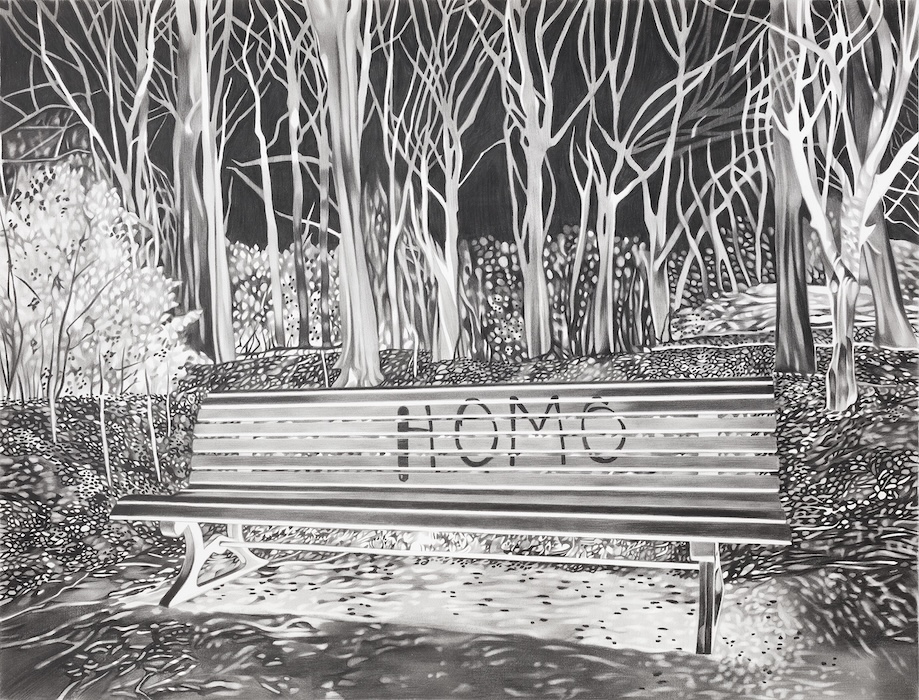
he exhibition presents more than 170 works by the artist, including loans from the Deutsche Bank Collection, the Federal Republic of Germany’s Collection of Contemporary Art, the Kupferstichkabinett (Museum of Prints and Drawings) of the National Museums in Berlin, and other private and public collections. On display are both recent and early, rarely exhibited drawings from the 1990s, as well as videos, tattoo editions, and photographs.
Artistic Practice
Pencil drawings are the central medium in Marc Brandenburg’s work. The meticulous execution of his photorealistic works exerts a particular fascination. His artistic process begins with photographs, which the artist understands as a kind of sketch. He freely translates images he has taken himself or taken from magazines into detailed drawings on paper, without the use of any technical aids. Since the late 1990s, Brandenburg has increasingly abstracted his motifs. The inversion of image values remains his most distinctive stylistic device. Around the turn of the millennium, he expanded this approach by further distorting his photographic source material and transforming it into abstract forms.
Early Works
Marc Brandenburg’s first series of drawings emerged in the 1990s. Working in clearly defined groups of works was a central component of his practice at that time. Drawings from five series are presented in the first exhibition room. The series From June to November (1993) is the earliest in the exhibition and includes realistic depictions of interiors and still lifes, portraits of celebrities, as well as motifs from cigarette advertisements and explicit scenes. A year later, in Bilderbuch (Picture Book), Brandenburg’s own photographic material took center stage for the first time. The still fragmentary motifs were now given firm frames by black lines or sketchy markings. In the series The Dangling Conversation (1996), a soft, drawn modeling contrasts with paper clips and staples that physically penetrate the paper. With Meddle (1998), Brandenburg finally developed his characteristic inversion of tonal values. In White Rainbow, the negative aesthetic is expanded to include abstract forms reminiscent of camera pans, creating impressions of movement and simultaneity.
Under Black Light
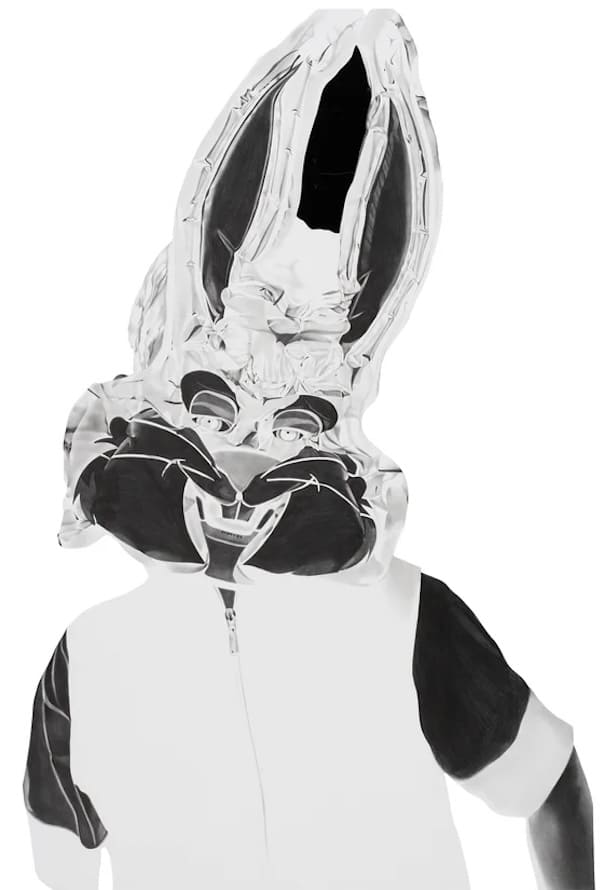
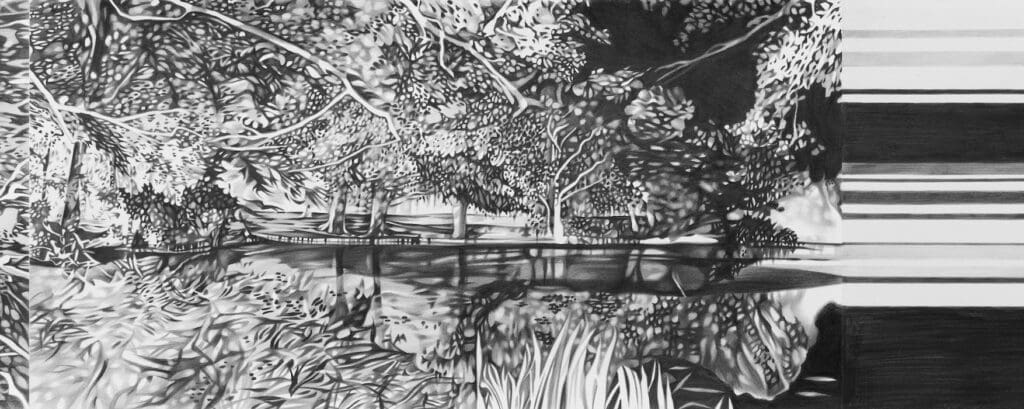
The second exhibition room is illuminated with black light—a presentation method Brandenburg has used since 2000. The special lighting causes the white paper surfaces to fluoresce, making the drawings appear to glow and together create a spatial experience. The exhibited works, spanning from the mid-2000s to the present, revolve around themes such as the body and (dis)clothing, as well as their manifestations within a society that, from the artist’s perspective, is characterized by increasing isolation, social inequality, and capitalist excess. With two large-format panoramic drawings of Berlin’s Tiergarten from 2024, Brandenburg also returns to the theme of landscape after a considerable hiatus.
Brandenburg understands his observation of the metropolis and its artistic interpretation as strictly documentary. The static drawings in the exhibition are complemented by new video works that reveal his keen powers of observation and show how motifs emerge in chance, everyday situations. The visual effect created by inversion and slowing down is further enhanced by a ghostly soundtrack.
Temporary Tattoos
Since 2012, Brandenburg has been developing editions of temporary tattoos based on his drawings. Over the years, more than ten such editions have been created, including some for the tenth anniversary of Berghain. Following the transformation of photography into drawing, another media shift occurs, in which the human body becomes the canvas. Brandenburg describes his working method using the term “sampling,” borrowed from music: found and original visual material are combined, creating contrasts and analogies. The individual combination of motifs on the skin also follows this principle.
Photographs
For Brandenburg, photography serves as a sketch-like starting point. Although he does not primarily consider himself a photographer, his artistic process begins with capturing situations using a camera. Over the years, this results in an extensive visual archive, from which individual motifs are only later translated into drawings. The photographs shown in the exhibition offer insight into the artist’s visual universe and, in particular, illustrate the precision with which he translates the aesthetics of the photographic snapshot into the medium of drawing.
WHEN?
Opening: Thursday, 16. April 2026, 7 pm
Exhibition dates: Friday, 17. April to Monday, 14. September 2026
WHERE?
Berlinische Galerie
Alte Jakobstraße 124–128
10969 Berlin
COSTS?
Admission 12 EUR, concessions 7 EUR
Concessions (7 EUR) every first Wednesday of the month for everyone.