

An apartment shifts within its architectural structure. Gradually, floor by floor, it sinks until it is on the verge of disappearing into the sewer system. The mysterious change is collectively ignored by the building’s residents. Meanwhile, the narrator in Ilse Aichinger’s short story continues to hope, until the very end, that someone will break the silence:
“Excuse me, but weren’t you living one floor higher yesterday?”
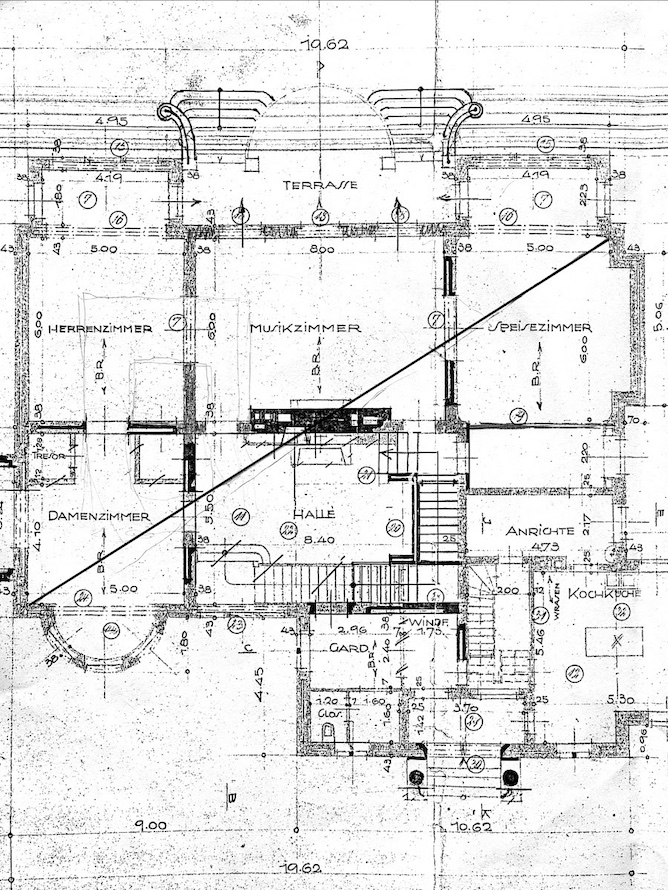
Image caption: Villa Knobloch, heute Haus am Waldsee, Grundriss 1923, Modifizierung durch Richard Venlet, 2026, Courtesy der Künstler
What kinds of structures shape the places we live in? What traces of use become inscribed in them and continue to resonate beyond them? Aichinger’s Where I Live not only lends its title to the exhibition with which Haus am Waldsee reflects on its 80th anniversary in the summer of 2026, but also points to the connections between social conditions and the built environment—connections that are reflected in the institution’s artistic program through an ongoing tension between artistic interventions, institution, history, and architecture.
Where I Live looks at the history of the institution through the villa built in 1922 for the Jewish textile manufacturer Herrmann Knobloch, where Haus am Waldsee began just a few weeks after the end of World War II. The language of the building—inhabited by both victims and perpetrators of National Socialism—is understood not only as a framework but as material from which the works in the exhibition reveal tensions between the private and the political. The violent events and social struggles of the past century reverberate through the architecture, the grounds, their location, and their use. They tell of an attempt at bourgeois separation that clings to an apparent normalcy, even as everything outside the windows begins to falter.
This international group exhibition engages with the architecture and history of the site and unfolds through a large-scale installation by artist Richard Venlet. It brings together historical and new works by Nigin Beck, Rhea Dillon, Robert Haas, Alexandre Khondji, Atiéna R. Kilfa, Henry Koerner, Yoora Park, Renée Sintenis, Ian Waelder, Frau von Zinowiew, and others. Works from the institution’s early exhibition history enter into dialogue with new interpretations of the site. References to the building’s use as both an exhibition space and a residence evoke past atmospheres in vivid flashes.
In parallel, the exhibition series Seit… continues in the café—formerly the villa’s garage—within a display architecture designed by Georgian curator and archivist Nina Akhvlediani. Under the title Green Sanctuary (C.O.T.B), Veit Laurent Kurz develops the second chapter of the series, focusing on the house’s English landscape garden.
In dialogue with the exhibitions, Ayumi Paul’s work Fischmond am Waldsee premieres in the garden. Conceived as an audio piece, Paul creates a sound walk based on research into geological processes, migration routes of plants and animals, as well as the building’s historical and personal-biographical memories.
The exhibition is curated by Anna Gritz and Pia-Marie Remmers.
WHEN?
Exhibition dates: Thursday, April 16 – Thursday, September 3, 2026
WHERE?
Haus am Waldsee
Argentinische Allee 30
14163 Berlin