

The coastal town of Étretat became a myth—and continues to fascinate to this day. The cliffs of Étretat, located in Normandy on the Atlantic coast, captivated numerous artists in the 19th century. From March 19 to July 5, 2026, the Städel Museum presents a major exhibition on the artistic discovery of this former fishing village and its influence on modern painting. Around 170 outstanding paintings, drawings, photographs, and historical documents from leading French, German, and other international museums, as well as private collections, will be on display in Frankfurt—including 24 works by Claude Monet alone.
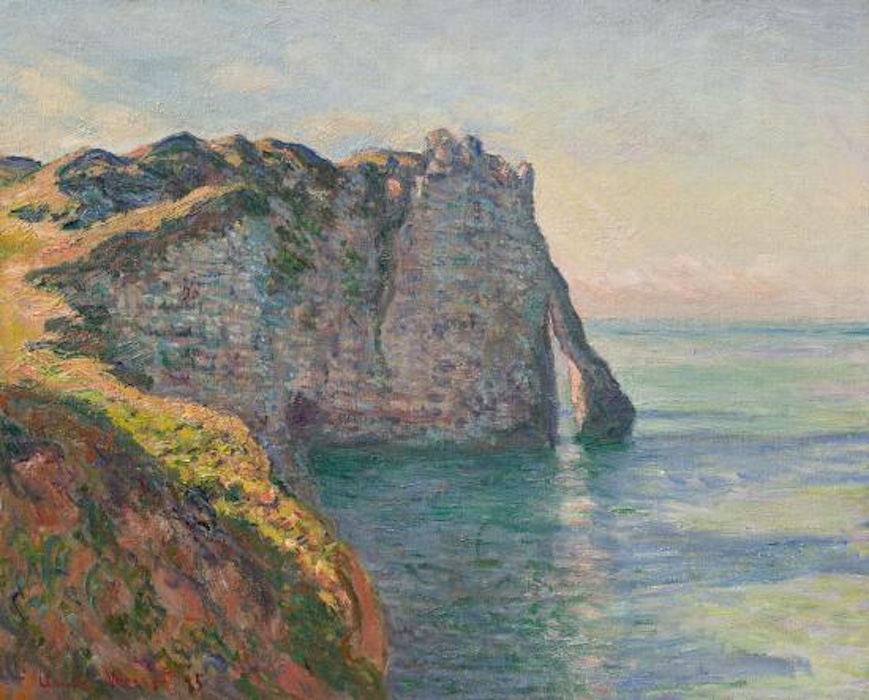
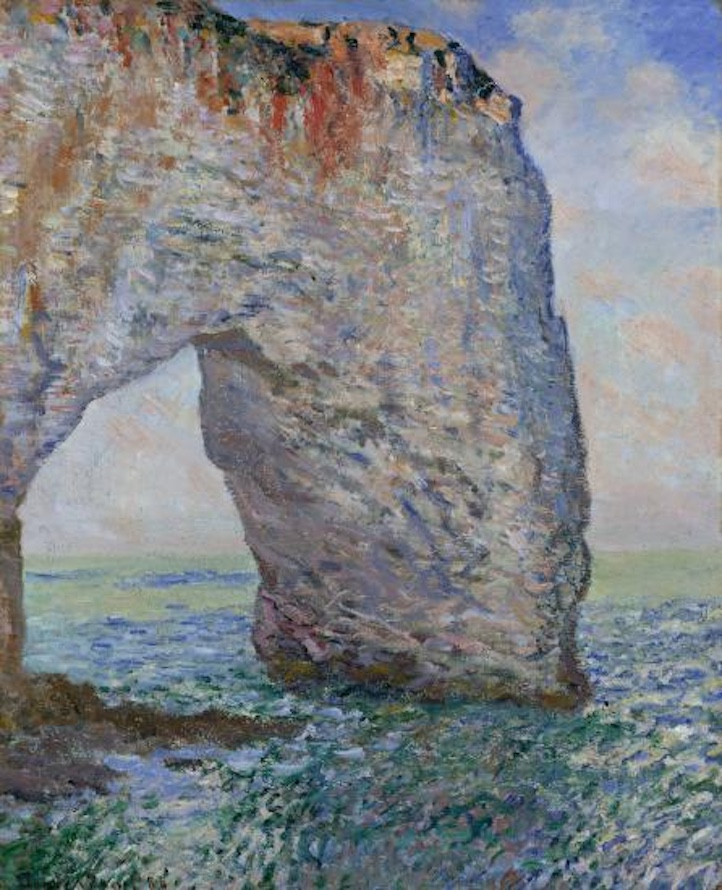
Image above: Claude Monet, Cliff of Aval, 1885, oil on canvas, 65 x 81 cm, Photo © Hasso Plattner Collection
Étretat played a significant role in the emergence of a new style of painting that would go down in art history as Impressionism. Artists were particularly drawn to the distinctive cliff landscape, perceived as both breathtakingly beautiful and somewhat threatening. Painters and writers traveled to Étretat and, through their works, made the remote location famous far beyond France’s borders. With the rise of tourism around 1850, Étretat developed into a popular seaside resort and a meeting place for artists, intellectuals, and the Parisian bourgeoisie: Gustave Courbet painted his famous wave paintings here, Guy de Maupassant elevated Étretat to a literary place of longing, and the gentleman thief Arsène Lupin, a fictional character created by Maurice Leblanc, stored his art treasures here. The emerging painter Claude Monet was also so fascinated by the unique cliffs with their three rock arches—Porte d’Amont, Porte d’Aval, and the Manneporte—that he devoted numerous paintings to them. Influenced by constantly changing light and weather conditions, Monet began painting series of motifs in Étretat—a working method that would later become his trademark.
In addition to works by Eugène Delacroix, Gustave Courbet, Claude Monet, and Henri Matisse, the exhibition brings together many other important figures of modern and contemporary art—from Johann Wilhelm Schirmer and Eugène Le Poittevin to Camille Corot, Eugène Boudin, and Elger Esser. Together, these works highlight the enduring fascination this place continues to exert. Loans come from institutions including the Berlin State Museums, the Fitzwilliam Museum in Cambridge, the Metropolitan Museum of Art in New York, the National Gallery of Canada in Ottawa, and the Musée d’Orsay in Paris.
Étretat’s development in the 19th century – fishing village, seaside resort, artists’ hub
As early as the Romantic period, the Alabaster Coast near Étretat was very popular. Early depictions of the rock formations attracted many artists, and over the course of the 19th century the remote fishing village developed into a center for writers and artists. One of the first artists to stay in Étretat for an extended period was Eugène Isabey (1803–1886), who created numerous watercolor landscapes conveying the site’s original character. Johann Wilhelm Schirmer (1807–1863) produced oil studies of Étretat in the 1830s noted for their precise observation of nature, while Eugène Delacroix (1798–1863) captured the coast in atmospheric gouaches and watercolors.
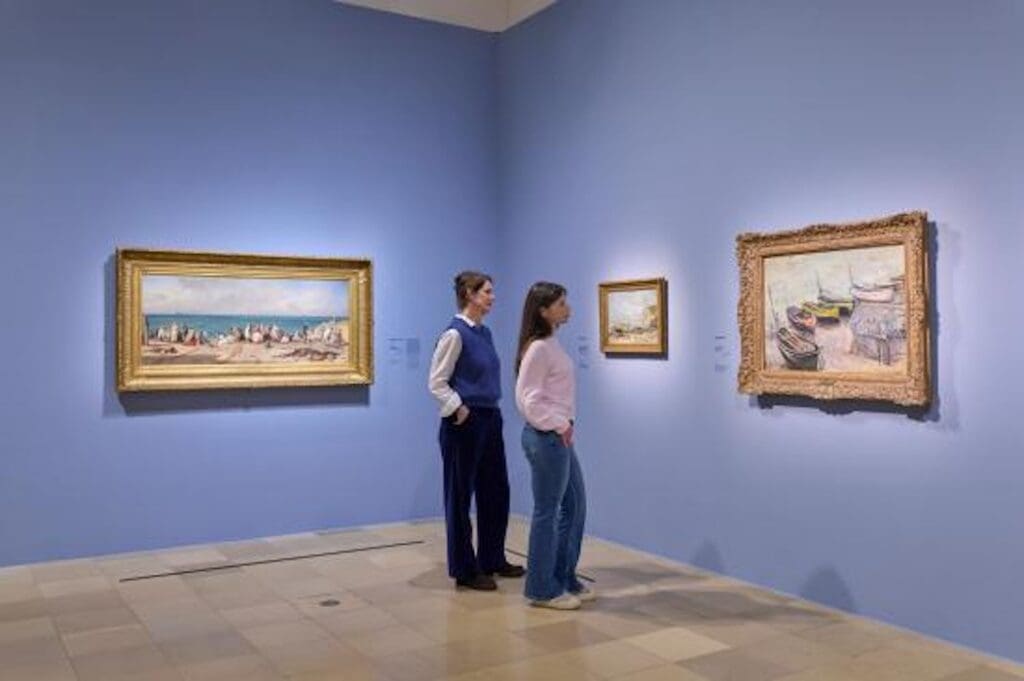
At the same time, richly illustrated travel guides helped make Étretat widely known, and the coast became a popular tourist destination. Eugène Le Poittevin (1806–1870) depicted early seaside tourism in his panorama Seaside Resort in Étretat (1866) and achieved great success at the Paris Salon, helping to popularize the location especially among urban audiences. He also focused on the daily lives of fishermen, portraying them in romanticized scenes. The abundance of depictions of Étretat, along with contemporary publications, played a key role in the creation of the myth surrounding the coastal town and its growing popularity. Local ways of life and the town’s appearance changed fundamentally, and Étretat became a social and cultural space where fishing village, seaside resort, and artists’ colony overlapped and influenced each other.
Étretat as a subject for pioneers of photography
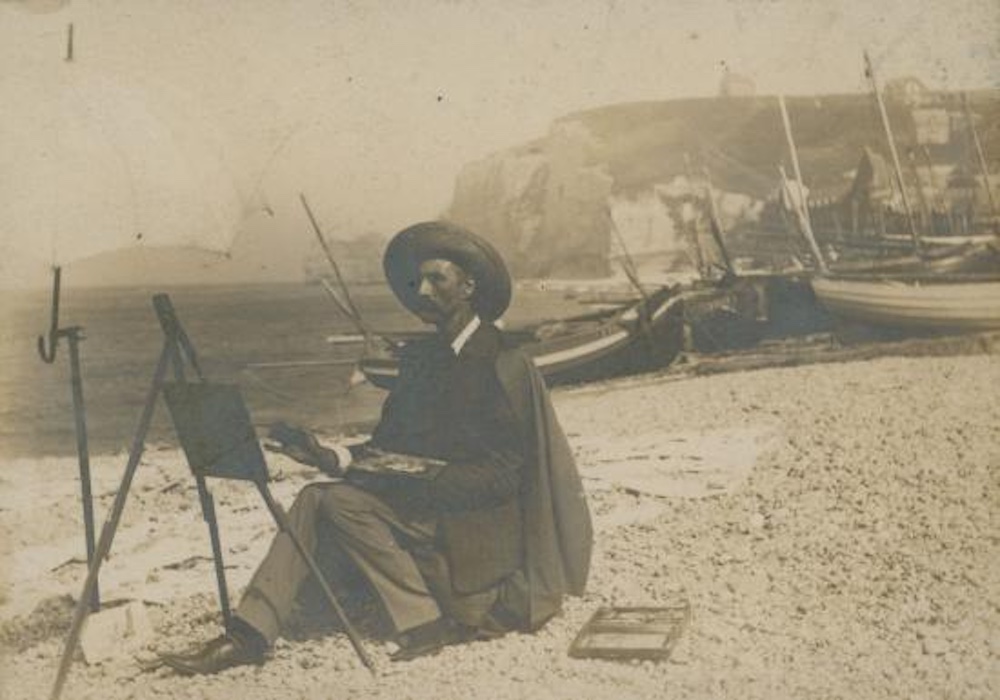
Just a few years after the invention of photography, Étretat became a photographic subject. One of the earliest photo series of Étretat was created in 1852, likely by the chemist Alphonse Davanne (1824–1912). Ten years later, he produced another series, whose large-format prints are notable for their technical perfection. In these rare photographs, Davanne captured both the impressive landscape and the growing town, along with beaches crowded with boats. Around the same time, Paul Gaillard (1832–1890) experimented with shorter exposure times to capture the movement of waves and bathers. Photography also influenced some painters, such as Anselm Feuerbach (1829–1880), who never visited Étretat himself and likely used a photograph as a direct reference for his painting The Rock Arch: Manneporte at Étretat (c. 1860). Conversely, photographers continue to draw inspiration from Étretat paintings to this day: Balthasar Burkhard (1944–2010) followed in Courbet’s footsteps with his wave photographs, while Elger Esser (b. 1967), in works like Étretat (after Schirmer) (2006), references earlier painters such as Schirmer.
INTRODUCTION TO THE EXHIBITION
The exhibition opens with an immersive projection of the cliffs of Étretat, conveying the monumental impact of the coastal landscape. It was created based on a 3D scan of the site by the Paris-based company ICONEM, which specializes in the digital preservation of endangered cultural and natural heritage.
Gustave Courbet’s wave paintings
A dedicated room in the exhibition is devoted to Gustave Courbet’s famous wave paintings (1819–1877). A storm he observed from his studio in Étretat in 1869 served as the starting point for a series of around 20 paintings. In his depictions of cliffs and rough waves, Courbet deliberately avoids narrative elements and representations of local inhabitants. Instead, he constructs an artistic reality by distorting or compressing pictorial space through shifts in perspective.
He applied paint not with a brush but with a palette knife, creating a rough, crust-like surface that broke with the academic painting rules of the time. Two paintings titled The Wave (1869), one from the Städel collection and another from the Musée des Beaux-Arts de Lyon (1869/70), are outstanding examples of this group, complemented by other important loans such as Rocks at Étretat (c. 1869/70) and The Calm Sea (1869). Courbet achieved unprecedented success with these works at the Paris Salon of 1870, and later artists—including Monet—would measure themselves against his achievements.
Monet and Étretat
Between 1864 and 1886, Monet stayed in Étretat at least six times. During this period, he created around 80 paintings, several pastels, and a series of drawings that continue to shape how the site is perceived today. Étretat thus represents a central focus in Monet’s artistic engagement with the Normandy coast. Numerous letters reveal his ambition to distinguish himself from earlier depictions and create something new.
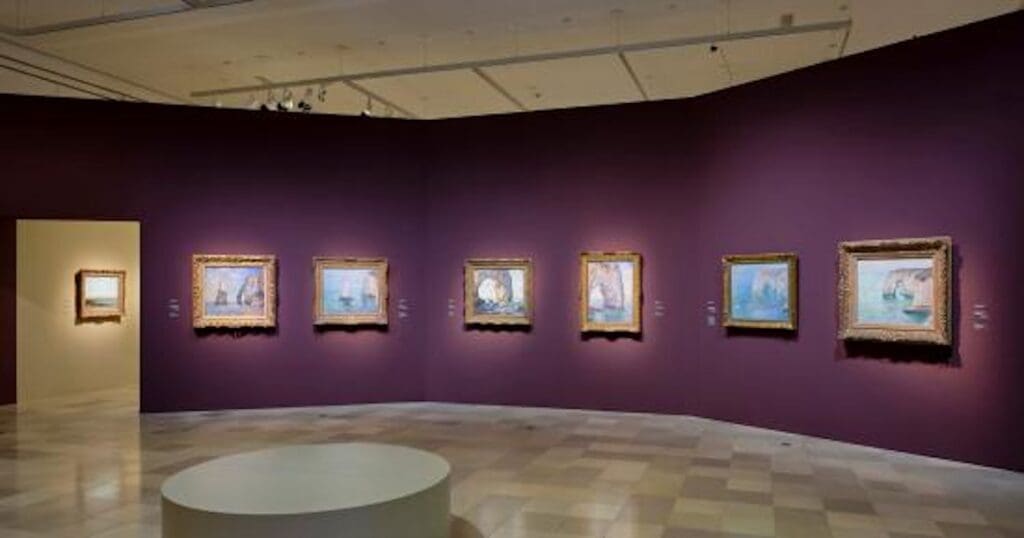
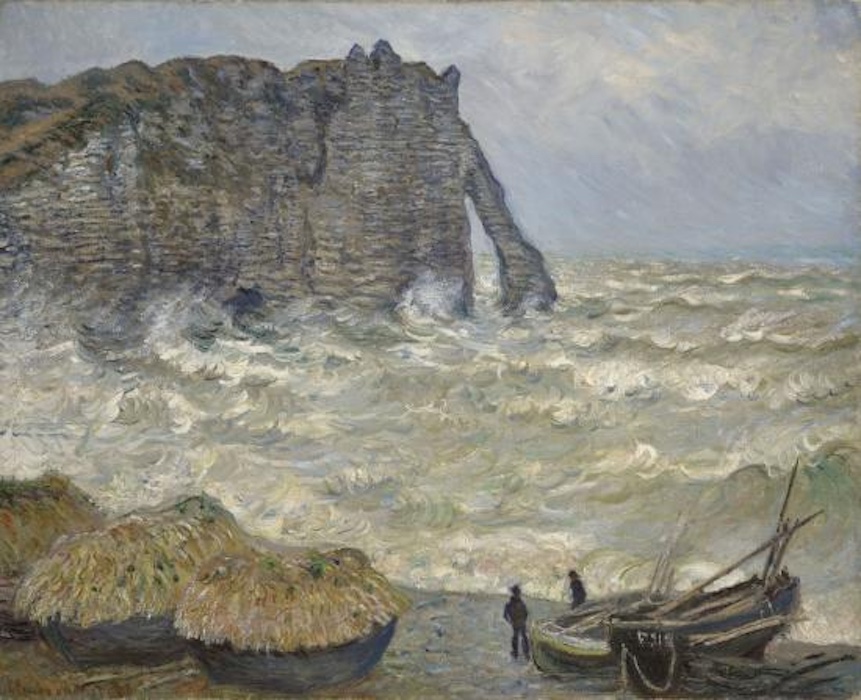
After his initial stays in 1864 and 1868/69—when one of the Städel’s key works, The Luncheon (1868/69), was created—Monet returned several times in the early 1880s, often outside the tourist season, with an eye toward commercially successful subjects. In these later works, he consciously avoided the fashionable image of the resort and instead focused on directly capturing his impressions of nature while painting outdoors. His seemingly spontaneous, rhythmic brushstrokes and subtle modulation of color values exemplify Impressionist painting. To capture different weather and lighting effects, Monet worked on several canvases simultaneously. Étretat is therefore closely linked to the serial working method that became a hallmark of his art and played a decisive role in the development of modern painting. Works from this period, such as Stormy Sea at Étretat (1883), Étretat: The Needle and the Porte d’Aval (1885), Cliff of Aval (1885), and Étretat: The Manneporte (1885/86), are featured in the exhibition. Monet’s Étretat motifs appealed to a broad audience of buyers, contributing significantly to his success and further strengthening the myth of Étretat.
Monet and the aftermath
The growing popularity of Étretat among affluent tourists created a large market for Étretat-themed artworks. By the late 19th century, such works were regularly featured in exhibitions and galleries in France, attracting even more artists to the coast. Eugène Boudin (1824–1898) incorporated scenes from everyday local life into his landscapes, offering a perspective that Monet often excluded. Many artists who followed Monet also focused on the dramatic cliff landscape, though their styles varied widely—from the Impressionist dissolution of form in Émile Schuffenecker (1851–1934) to precise natural renderings by Paul Leroy and large-scale, Japanese woodblock-inspired works by Jean Francis Auburtin (1866–1930). Gustave Caillebotte (1848–1894) also visited Étretat, though in his painting Man in a Work Smock (1884), he avoided including recognizable features of the location.
In the summer of 1920, Henri Matisse (1869–1954) created more than 40 paintings and numerous drawings during two stays in Étretat. Many of these works were exhibited in Paris the same year, underscoring the continued popularity of Étretat motifs. Engaging consciously with Courbet and Monet, Matisse explored the coast from different perspectives, often depicting it without people. With just a few lines and a reduced color palette, he captured the characteristic elements of the beach in works like Étretat: The Barrels (1920).
For over 150 years, Étretat has been a vacation destination and an international tourist hotspot. However, visitor traffic now threatens the cliffs, alongside erosion and climate change. Examining the myth of Étretat reveals, almost like under a magnifying glass, the ambivalent effects of a place’s growing popularity and the role art plays in that process. With “Monet’s Coast: The Discovery of Étretat,” the Städel Museum invites visitors to rediscover the enduring fascination of Étretat.
Philipp Demandt, Director of the Städel Museum, emphasizes:
“Our major special exhibition in spring 2026 is the first to focus on the emergence of the Étretat myth. This coastal town, with its striking rock arches and unique light, has fascinated artists since the 19th century and has lost none of its appeal to this day. It was in Étretat that Claude Monet developed his famous series of motifs, which played a decisive role in shaping Impressionism. We are especially proud that two outstanding works from the Städel collection, created in Étretat, form the starting point of the exhibition: Monet’s The Luncheon and Gustave Courbet’s The Wave. These are complemented by high-caliber international loans, including 24 works by Monet alone. Our sincere thanks go to all lenders and supporters for their generous assistance. We look forward to exploring the enduring fascination of Étretat together with our visitors.”
“Claude Monet and the artists in this exhibition were travelers who captured the uniqueness of the coastal region around Étretat in their art. Travel and art connect, inspire, and strengthen the international exchange of knowledge and innovation. Bringing people together around the world is an important goal for us at Fraport AG. Our long-standing partnership with the Städel Museum reflects this commitment and our aim to promote cultural dialogue. We see these goals especially fulfilled in this exhibition and are therefore very pleased to support the Städel Museum,” explains Stefan Schulte, CEO of Fraport AG.
“It is a great asset for our city that we are able to present the exhibition ‘Monet’s Coast: The Discovery of Étretat’ in Frankfurt. The Städel Museum stands for outstanding scholarly work, which is communicated to a broad public through diverse educational programs. This exhibition is the result of successful German-French collaboration: together with museum colleagues from our partner city Lyon, the Städel curators have developed an art-historical and cultural exhibition that makes the diverse—and in some cases far-reaching—effects of a place’s popularization understandable. This spring, Frankfurt is once again a cultural attraction for visitors from the region and far beyond,” says Ina Hartwig, Head of Cultural Affairs and Science for the City of Frankfurt am Main.
Stephan Scherer, CEO of the Fontana Foundation, on supporting the exhibition: “Étretat is much more than just a fascinating place in Normandy. With its chalk cliffs and its role in modern painting, Étretat is both an indispensable natural landscape and a historically developed cultural site. We are very pleased to support this outstanding exhibition project of the Städel Museum and thereby help communicate the cultural significance of the location. We wish the public an enriching visit to the exhibition.”
Sylvia von Metzler, Chair of the Board of the Städelscher Museums-Verein, on the exhibition: “With Gustave Courbet’s painting The Wave, an early and groundbreaking acquisition of the Städelscher Museums-Verein takes center stage in this comprehensive special exhibition. To this day, we are grateful and delighted to have one of Courbet’s most important wave paintings in the Städel Museum’s collection. It stands as an example of the extraordinary commitment of our more than 10,000 members to the museum. We are therefore all the more pleased to support the exhibition and to revisit Étretat as a place of artistic discovery.”
“Over the roughly hundred years from Romanticism to Classical Modernism, a multifaceted transformation can be seen in the artistic view of the impressive coastal landscape around the small town of Étretat. The range extends from atmospheric watercolor and oil studies to early photographs and Claude Monet’s famous paintings of the imposing cliffs. With its unique coastal scenery, Étretat attracted artists from several generations. In collaboration with the Musée des Beaux-Arts de Lyon, it was a central concern for us to place Courbet’s epochal wave paintings and Monet’s serial landscapes into a broader context and to highlight Étretat’s importance for modern art,” say Alexander Eiling and Eva Mongi-Vollmer, curators of the exhibition at the Städel Museum.
When?
Exhibition dates: Thursday, March 19 to Friday, June 19, 2026
Where?
Städel Museum Frankfurt
Schaumainkai 63
60596 Frankfurt am Main