




The exhibition “Canaletto & Bellotto” at the Kunsthistorisches Museum in Vienna (March 24–September 6, 2026) is dedicated to two of the most important veduta painters of the 18th century: Canaletto and his nephew Bernardo Bellotto. Using selected works, it traces the development of the Venetian cityscape and its dissemination throughout Europe. The exhibition illuminates not only the artistic techniques and stylistic features of both painters, but also how they staged various cities such as Venice, London, Dresden, and Vienna as idealized stages. It becomes clear how closely art, politics, and society are intertwined in their paintings.
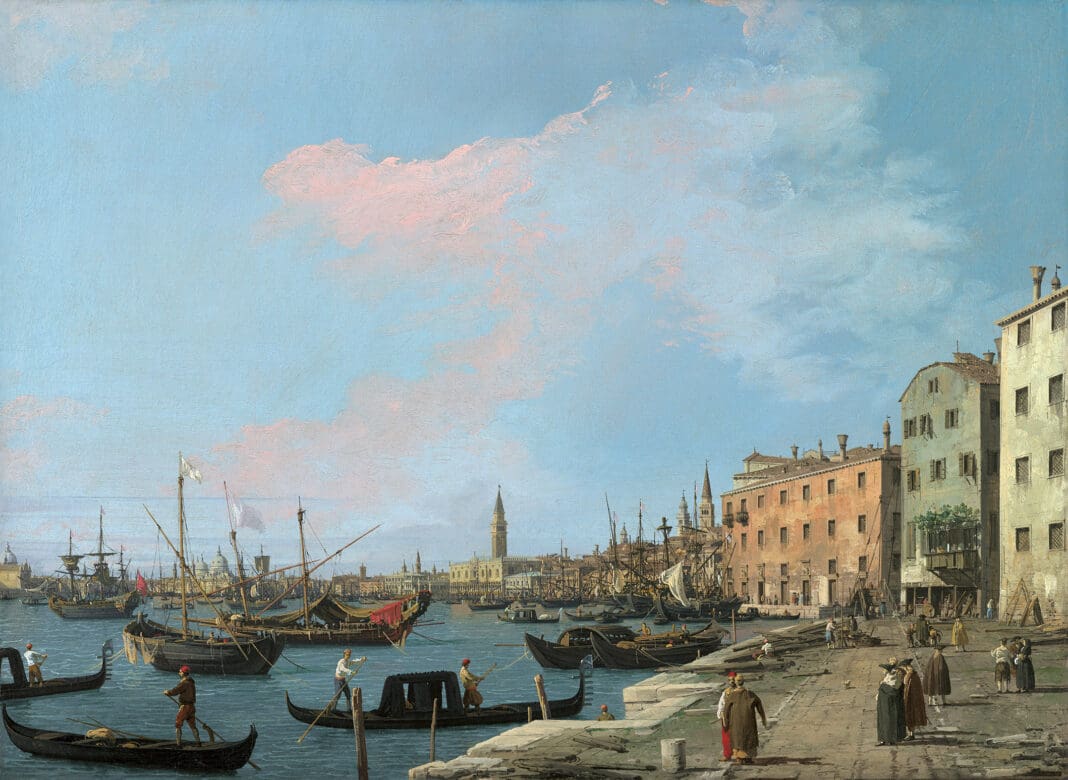
Image Caption: Die Riva degli Schiavoni in Venedig, Canaletto (1697–1768) um 1730 Öl auf Leinwand, 46 × 63 cm Kunsthistorisches Museum, Wien, Gemäldegalerie © KHM-Museumsverband
Venetian beginnings
In 18th-century Europe, painted cityscapes (in Italian, “vedute”) enjoyed immense popularity. British aristocracy, in particular, sought pictorial souvenirs of important destinations, especially Venice, during their Grand Tours. Among the Venetian painters who catered to this market, Antonio Canal (1697–1768), known as Canaletto, shaped the image of the city like few others. The son of a theater set designer, he combined optical accuracy with painterly imagination to transform Venice’s unique urban environment into an idealized stage. Whether depicting bustling quays and canals or the Doge’s ceremonial barge—the Bucintoro—during its annual procession to the Adriatic, his paintings present Venice as a cultural ideal of republican virtue, naval power, and ceremonial splendor. His compositions were highly sought after, and contemporaries remarked that they possessed such luminosity that it seemed as if sunlight itself emanated from them.

Canal’s nephew, Bernardo Bellotto (1722–1780), began his career in this Venetian context, training in his uncle’s workshop. He, too, adopted the name “Canaletto” to signal his artistic lineage from his famous relative and to enhance his own market appeal. To avoid confusion, this exhibition refers to Antonio Canal as Canaletto and his nephew as Bellotto, as it traces how both artists spread the idealizing genre of the veduta from Venice throughout Europe: Canaletto to London, and Bellotto via Dresden to Vienna.
Venedig: Camera obscura
To achieve precision, veduta painters used optical devices such as the camera obscura, which projected a view through a lens onto a flat surface, thus enabling tracing. In the 18th century, interest in optics steadily increased, fueled by writings that compared the human eye to a camera—including those of the English physicist Isaac Newton. Canaletto may have owned the box camera shown here (on which his name is inscribed), although he probably worked more often with booth- or tent-shaped cameras, such as those depicted in Denis Diderot’s Encyclopédie. Despite such aids, Canaletto always refined his tracings with his own inventiveness: he moved buildings, adjusted proportions, and combined multiple viewpoints to create a harmonious scene.
Venice: a stage
In his paintings, Canaletto transforms Venice into a grand theater. One example is the large view taken from the island of San Giorgio Maggiore: a triangular quay rises into the foreground like a stage, populated by lawyers, priests, and merchants. Behind it, ships flying Venetian, British, and Dutch flags fill the lagoon against the spectacular city skyline. In The Bucintoro, the Doge’s journey to the symbolic “marriage to the sea” becomes a procession of civic pride, while The Dogana in Venice reveals Canaletto’s optical precision and his ability to merge multiple perspectives into a cohesive whole. His paintings appear to depict reality, yet are meticulously staged.
Venice: Bellotto learns from Canaletto
Bellotto trained in his uncle’s workshop, adopting his methods of meticulous observation and creative transformation. In this room, we see how he adopted Canaletto’s precision, perspective construction, and interest in everyday life. We also recognize, however, that his style is already characterized by deeper hues and sharper chiaroscuro contrasts. It is believed that the large painting of the Grand Canal depicts Prince Frederick Christian of Saxony, who visited Venice in 1739–1740 (the figure accompanied by two companions in the lower right). If this is true, it could be an early indication of Bellotto’s interest in Central European patrons—in contrast to the British clients on whom his uncle focused.
Canaletto & London
While Canaletto’s workshop flourished in the 1730s, the War of the Austrian Succession (1740–1748) interrupted the influx of visitors to Venice. Canaletto therefore decided to travel to his British clients if they could no longer come to him. He arrived in London in 1746 and stayed for nine years. He encountered a metropolis that was presenting itself as a new Rome: the modern political and economic capital of a global empire. He adapted his urban approach to this environment and was one of the first to depict London’s architecture, parks, and ceremonies as symbols of national identity. In The Thames on Lord Mayor’s Day, he shows the Lord Mayor’s gilded barge below St. Paul’s Cathedral—the Protestant rival of St. Peter’s Basilica in Rome. The bustling river is reminiscent of Venice, yet the rebuilt city—reconstructed after the Great Fire of 1666—heralds the modernity of Great Britain. Of course, Canaletto’s views obscure social tensions that English contemporaries like William Hogarth exposed with biting cynicism.

London: old & new.
Canaletto studierte das sich wandelnde Stadtbild Londons genau. Mit Old London Bridge hielt er eine berüchtigte Engstelle aus mittelalterlichen Gebäuden kurz vor ihrem Abriss fest. Er wusste wohl, wie diese veraltete Brücke die Pläne für die Westminster Bridge befeuerte, die 1739 bis 1750 weiter flussaufwärts gebaut wurde. Klassizistisch mit imposanten Bögen geformt, war sie die erste neue Brücke über die Themse seit 600 Jahren – eine Meisterleistung moderner Ingenieurskunst, die Canaletto ebenfalls in einer Zeichnung würdigte. Der Dialog zwischen Vergangenheit und Fortschritt prägt auch seine Ansicht der Westminster Abbey, der Krönungs- und Begräbniskirche englischer Könige und Königinnen. Erst kürzlich mit neugotischen Türmen geschmückt, bildet die Kirche eine Kulisse für die Prozession des Bath-Ordens, eines 1725 wiederbelebten Ritterordens.
London: Entertainment venues.
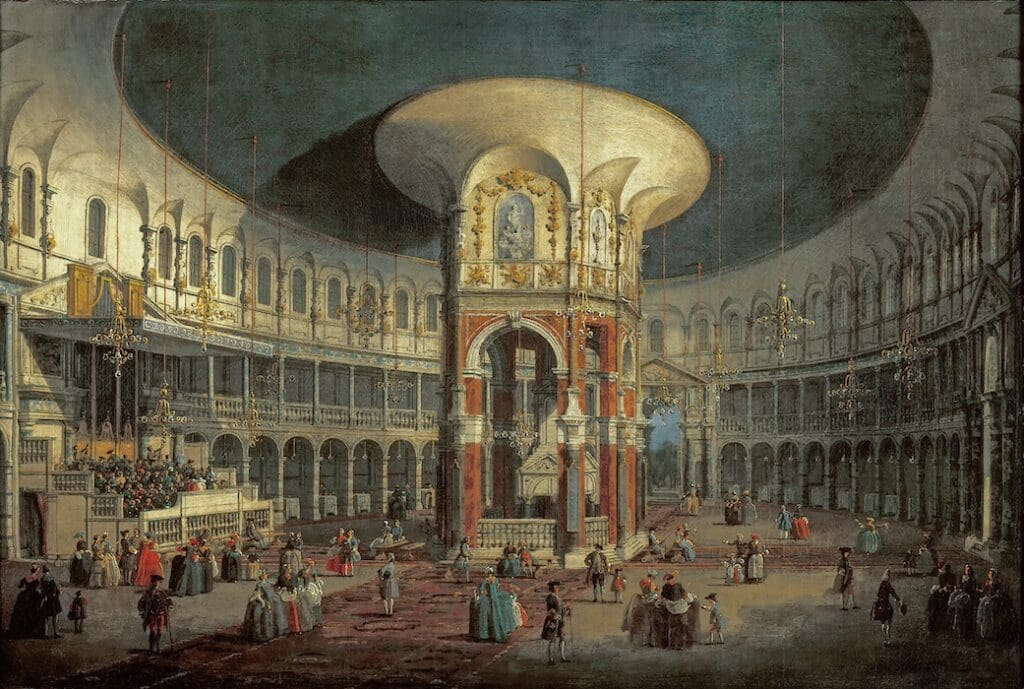
In his views of St. James’s Park, Vauxhall Gardens, and the Ranelagh Rotunda, Canaletto celebrates London’s new leisure culture, shaped by music, conversation, and fashion. In his depiction of St. James’s Park, modern facades cluster around the dilapidated Horse Guards (the headquarters of the British Army), forming the backdrop for a microcosm of London society: from soldiers on drill to servants, citizens, and children. In Vauxhall, spacious walkways, dining boxes, and orchestra pavilions provide the setting for a game of seeing and being seen, while in Ranelagh, the rotunda, built for concerts, glows with light and attracts fashionable crowds. Here, too, Canaletto idealizes his scenes, portraying bustling city life as orderly, elegant, and harmonious.
English castles
In England, Canaletto primarily painted London, but also turned his attention to country estates such as Warwick Castle. In 1748, Lord Brooke commissioned him to depict his ancestral home during renovations. Canaletto shows the castle with new windows, redesigned gardens, and the River Avon transformed into a canal – complete with a gondola. By transferring Venetian styles to the English landscape, he transformed a medieval castle into a vision of modern elegance. Despite such prominent commissions, however, Canaletto struggled with financial difficulties. In 1755, he returned to Venice, where he died impoverished in 1768. His life differed from that of his nephew Bellotto, whose court career provided him (at least temporarily) with a regular income.
Bellotto & Dresden
In 1747, Bellotto moved from Venice to Dresden—a year after his uncle left for England. He became court painter to Augustus III, Elector of Saxony and King of Poland. Bellotto received a generous salary and created celebrated cityscapes for the royal collection. He also produced smaller versions for private clients, two of which are shown here. They depict the Baroque silhouette of Dresden with the Augustus Bridge, the Lutheran Frauenkirche, and the newly built Catholic Hofkirche. Like Canaletto, Bellotto refined his paintings into ideal compositions: he manipulated the proportions of the Frauenkirche to suit his needs and depicted the Hofkirche with its tower, even though it was still under construction. Bellotto’s flourishing decade came to an abrupt end when Prussian troops marched into Dresden in 1756. The artist left for Vienna in early 1759, accompanied by his son, to seek new patrons, leaving his wife and daughters behind in war-torn Dresden.
Bellotto & Vienna
Bellotto arrived in Vienna in January 1759. He remained for two years, until early 1761. At that time, Vienna was the political and cultural center of the Habsburg Monarchy, where Emperor Francis I Stephen and Empress Maria Theresa sought to consolidate the dynasty’s power amidst the turmoil of war. Here, Bellotto painted palaces, squares, and religious and scientific institutions. His views of Schönbrunn Palace depict the imperial suburban residence at the height of its splendor. Courtiers and servants gather in the courtyard as Count Kinsky arrives in his carriage to deliver the news of Austria’s victory over Prussia at Kunersdorf in 1759. Bellotto combines veduta and history painting here, transforming the canvas into a political spectacle. Created at a time when the Seven Years’ War (1756–1763) was severely impacting the Viennese court and Bellotto’s family was enduring the siege of Dresden, this painting is among his most important works from Vienna. Undoubtedly, he hoped to be appointed court painter in the capital city, but without success.
Vienna: well-ordered gardens
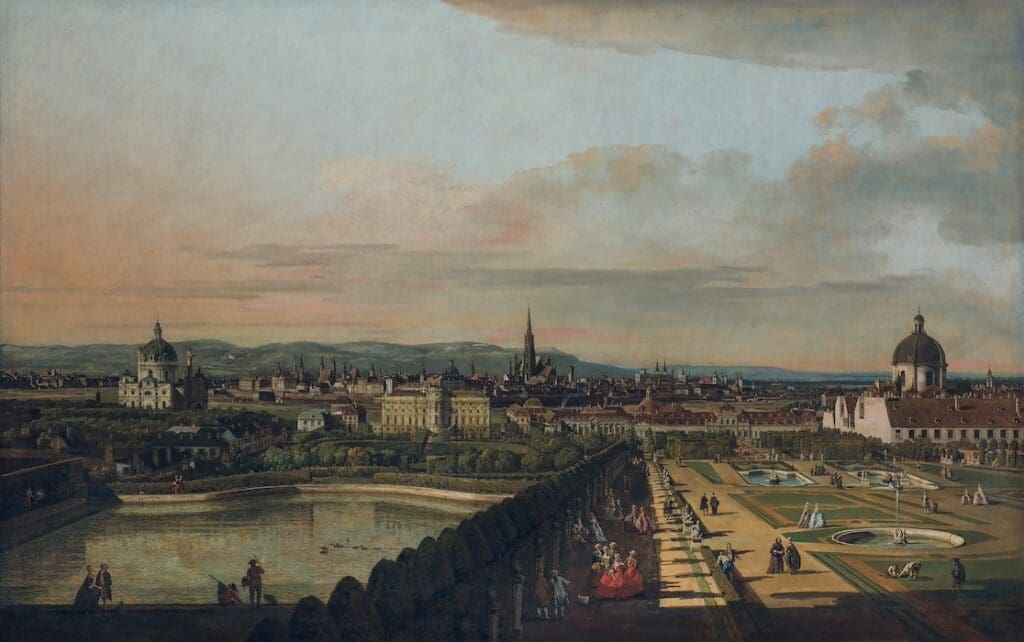
In this view, Bellotto turns his attention to the palace gardens, which had been redesigned in the 1750s under Emperor Franz Stephan. The expansive parterre unfolds in geometric order. Vienna is visible on the distant horizon. The scene conveys an image of imperial harmony: gardeners, servants, and aristocrats suggest the dynamism that characterized court life. The figures, perhaps including members of the imperial family, enliven the well-ordered grounds with courteous gestures. At the same time, the interplay of light and shadow reflects social hierarchies. Nobles bask in the sun, while laborers often remain in darkness. The result is an allegory of absolutist rule: geometry, gardening, and imperial authority combine to form a vision of an ordered society.
Vienna: empirical realism
Bellotto’s Viennese vedute combine precise observation, measured perspective, and deliberate topographical adaptation. In his famous view of Vienna from the Belvedere Palace, Bellotto captures the city’s silhouette with cartographic precision, yet simultaneously condenses the individual elements into a monumental whole. He brings St. Charles’ Church (left) and the Salesian Church (right) closer together and makes the city’s church towers appear steeper to direct the gaze inward and upward. In contrast to later, Romantic depictions of the city—such as Josef Heideloff’s view, which emphasizes pastoral leisure and allows the city to fade into the distance—Bellotto’s clarity reflects the Enlightenment, that intellectual movement which championed reason, science, and precise vision.
Vienna: Surveying
The Enlightenment fostered the accurate surveying of the world. Bellotto’s views also reflect this ambition. Like contemporary surveyors and cartographers, Bellotto used elevated vantage points, leveling instruments, and geometric projections to precisely document the modern city. Joseph Liesganig’s triangulated map of the area surrounding Vienna demonstrates that cartographers, too, translated space into visual knowledge. They used instruments such as the graphometer shown here, or sighting boards, as depicted by the imperial cartographer Giovanni Jacopo de Marinoni in De re ichnographica (1751). Although not strictly topographical, Bellotto’s paintings nevertheless belong to the same world of observation and calibration.
Vienna: University Quarter
Bellotto’s empirical observation began in Venice, where glassmakers crafted lenses for microscopes, telescopes, and camera obscurae. By 1760, Vienna, too, had developed into a scientific center. The reformed university, the Jesuits’ astronomy, and medical innovations under the imperial physician Gerard van Swieten fostered an environment in which optical instruments and empirical methods were widely valued. Bellotto paid tribute to the university district in two views depicting the Jesuit college and the new Aula (Great Hall) with its observatories. He emphasized precise observation, thus following Francesco Algarotti—a Venetian polymath and acquaintance of Canaletto—who advised painters to study nature like scientists.
Vienna: aristocratic self-presentation
After the Ottoman siege of 1683, Vienna experienced a construction boom. While fortifications still constricted the city center, new palaces and gardens sprang up in the suburbs – including the Liechtenstein Garden Palace, which Bellotto portrayed as a stage for aristocratic self-presentation. With its terraces, sculptures, and gardens, the palace provides a backdrop for distinguished figures whose elegant gestures embody contemporary ideals of discipline and grace. This ostentatious refinement, however, was marked by inequality. The Black pageboy in one of the paintings is a reminder of the presence of Africans in Viennese elite circles – among them the learned Angelo Soliman, in the service of Prince Liechtenstein. Aristocratic representation, therefore, was based not only on refinement but also on subjugation.
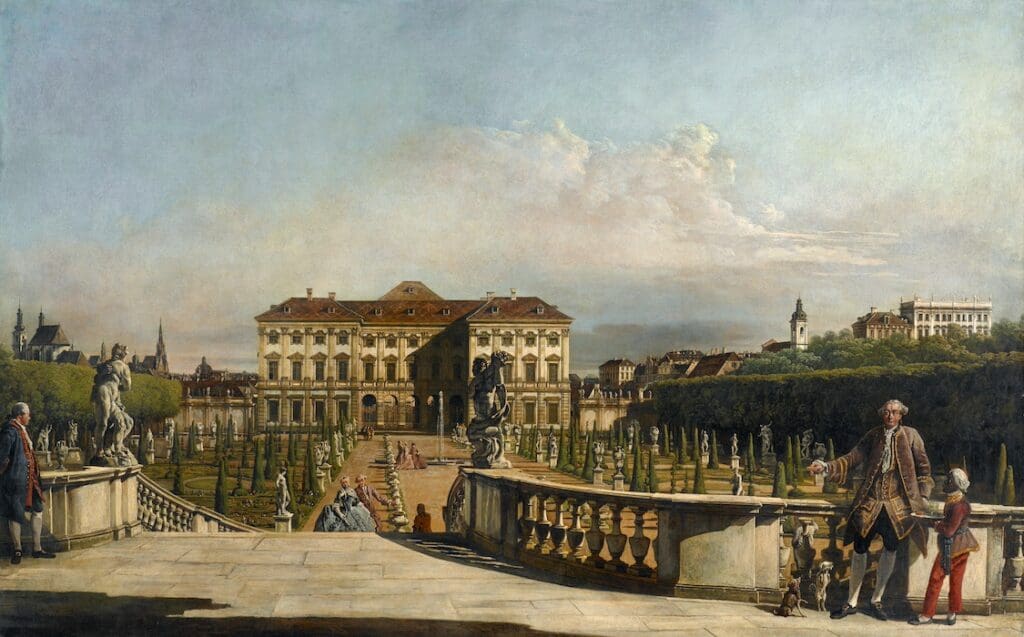
Das Gartenpalais Liechtenstein in Wien vom Belvedere
1759/60
Öl auf Leinwand
GE889
The Liechtenstein summer palace in Vienna, seen from the Belvedere
Il “palazzo in villa” Liechtenstein a Vienna visto dal Belvedere
Le palais-jardin Liechtenstein de Vienne vu du Belvédère
Vienna: a stage
Like his uncle Canaletto, Bellotto transformed the city into a stage. He blended different perspectives, arranging buildings like stage sets and figures like actors. His only Viennese engraving, depicting the ballet-pantomime Le Turc Généreux, reveals how skillfully he translated spectacle into pictorial form. His seemingly scientific precision, therefore, always contains deliberate omissions. Like all major cities, Vienna was plagued by crime and social tensions. Maria Theresa’s judicial reforms—especially the codification of torture in the Constitutio Criminalis—point to the harsher realities of the era. While engravers like Salomon Kleiner occasionally depicted brawls, Bellotto’s views omit such conflicts. His paintings present an ideal that the Habsburg court sought to convey.
Vienna: Religion and trade
In his views of the Freyung, Bellotto depicts the religious and commercial life of Vienna. In front of the Schottenkirche, he shows a procession, often interpreted as a Corpus Christi procession, for which a monstrance like the one exhibited here would be required. However, the priest in the center appears to be carrying a reliquary—presumably from one of the abbey’s confraternities. Whatever the ritual, the choreography of the bowing aristocrats, monks, and citizens draws our attention to the procession. The second view focuses on the bustling market life. The meticulous depiction of the street vendors anticipates Johann Christian Brand’s Wiener Kaufruf (1775), with which Bellotto shares an almost ethnographic approach to documenting the Viennese population.
Vienna: Splendor and misery
In Bellotto’s view of the Flour Market, a figure writhes under the weight of a sack of flour—a reminder that Vienna’s splendor was based on physical labor. The square is framed by Baroque facades, the Capuchin Church, and the “Mehlgrube” (flour pit), whose cellars served as grain stores and whose upper floors were used for balls. Work, piety, and festive revelry thus converge. The second painting also plays with contrasts: the Palais Lobkowitz appears in sunlight; the Bürgerspital—a home for the poor and sick—lies in shadow. In between, the Capuchin mission cross and St. Stephen’s Cathedral serve as reminders of piety and mortality. To the right, in shadow, Bellotto depicts a girl with a crutch. Poverty and misery become visible, but remain on the periphery, lost in a composition that normalizes rather than criticizes social hierarchy.
Hof Castle
Bellotto’s views of Schloss Hof continue his reflections on splendor and misery. From 1725 to 1729, Prince Eugene of Savoy had this 17th-century fortified building remodeled. Hundreds of workers, gardeners, and craftsmen were employed, including many of Eugene’s returning soldiers. The estate later passed to his niece and was purchased by Francis Stephen and Maria Theresa in 1755. Bellotto’s three large paintings of the palace depict the garden, the courtyard of honor, and the north side. In the garden view, aristocrats, gardeners, and impoverished figures appear in a geometrically ordered landscape of rhythmically raised terraces, water features, and topiary trees. In the view of the courtyard of honor, nobles, servants, and vagrants blend courtly magnificence and everyday life, while the view of the north side emphasizes the fortified structure of the palace, whose terraces are reminiscent of a border fortress perched above the river plain.
Ruins
Bellotto depicts the fortress of Theben/Devín at the confluence of the Morava and Danube rivers, which marked the border with Hungary—once contested during the Ottoman Wars. A diagonal line draws the eye upwards to the left; the plain to the right reveals Schloss Hof on the horizon. In the foreground, an impoverished family waits in a tent—a picture of hardship rather than Arcadian charm. The man’s shortened arm suggests he is a wounded veteran—perhaps a reference to Prince Eugene’s efforts to provide work for soldiers wounded in the war. As in almost no other work, Bellotto addresses ruin and vulnerability here; possibly also a reflection of his own precarious situation. Having fled Dresden, separated from his family, and without a court position, he—like his uncle Canaletto—faced financial difficulties.
Reality & Utopia
In early 1761, Bellotto left Vienna for Munich, carrying with him the letter of recommendation shown here. Maria Theresa addressed it to her cousin, the Princess of Bavaria, but mentioned the painter only briefly. Bellotto did not stay long and soon returned to Dresden, where he found the city and his property devastated by the war. In “The Ruins of the Pirna Suburb,” he depicts this destruction, with grazing sheep, a shepherd, and overgrown vegetation suggesting resilience. Back in Dresden, Bellotto faced professional setbacks: the former court painter was demoted to “teacher of perspective” at the Academy and struggled to make ends meet. Amidst this hardship, he painted the architectural fantasy shown here, which underscores the importance of perspective as the foundation of artistic invention. The figure in red—often interpreted as a self-portrait—reaffirms this creative freedom. Likewise, the quote from the Roman poet Horace on the column behind it reads: “Painters and poets have always had the same freedom to dare what they please.” Taken together, these two paintings oscillate between harsh reality and imagined utopia. In 1767, Bellotto left Dresden again, this time for Warsaw, where he once more secured the position of court painter and henceforth placed his powers of observation and composition at the service of the Polish king.
WHEN?
Exhibition dates: Friday 24. April until Sunday 6. September 2026.
WHERE?
Kunsthistorisches Museum, Gemäldegalerie
Maria-Theresien-Platz
1010 Wien
Austria




 is dedicated to two of the most important veduta painters of the 18th century: Canaletto and his nephew Bernardo Bellotto. Using selected works, it traces the development of the Venetian cityscape and its dissemination throughout Europe. The exhibition illuminates not only the artistic techniques and stylistic features of both painters, but also how they staged various cities such as Venice, London, Dresden, and Vienna as idealized stages. It becomes clear how closely art, politics, and society are intertwined in their paintings. Cultural news, art exhibitions+ art events to discover.)