

The University of Europe for Applied Sciences has analyzed museum prices in the 16 German state capitals and in 26 European capitals. Adults pay an average of €8.26 in the German cities—compared to €11.97 across Europe. On average, reduced-price tickets in Europe are around 50 percent more expensive than in Germany.
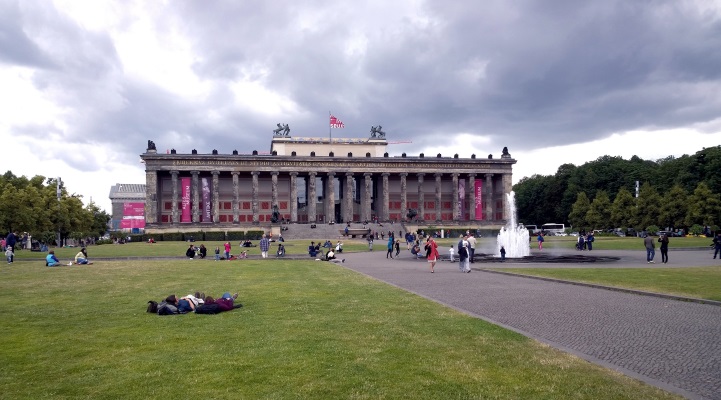
Image Caption: Altes Museum Berlin, Foto: Stephanie Schneider
What is the cost of cultural participation, and who can afford it? These questions are central when it comes to education, creativity, and societal development. A recent analysis by the University of Europe for Applied Sciences (UE)—which compared admission prices at art museums in 16 German cities with those in 26 European capitals and major cities—reveals that visiting a museum is more affordable in Germany’s state capitals than in other European countries. On average, adults here pay an admission fee of €8.26, whereas the average in other European metropolises stands at €11.97.
Prof. Johannes Kiessler, Dean of the Department of Art & Design at the University of Europe, comments on the study as follows: “Museums complement the educational system and serve as places of encounter and identity formation. In doing so, they foster social cohesion. Low admission fees at museums lower the financial barrier for lower-income groups, thereby promoting inclusion. Consequently, cultural heritage is experienced not as an exclusive privilege, but as a shared public good.”
How Much a Museum Visit Costs in Germany
The highest average admission prices for adults at art museums are charged in Dresden (€15.20), Berlin (€11.20), and Düsseldorf (€9.75). These are followed by cities such as Hamburg and Hanover, with average admission prices of €9.00 and €8.80. In smaller cities, however, a museum visit is more affordable: in Saarbrücken, adults pay an average of just €4.25, and in Erfurt, €5.20. Admission to museums in Kiel is free.
For young people between the ages of 14 and 18, access to art and education is particularly low-threshold: in eight German cities, admission for teenagers is completely free of charge. These include major institutions such as the Alte Nationalgalerie in Berlin, the Hamburger Kunsthalle, and the Alte Pinakothek in Munich. Overall, teenagers pay an average of just 52 cents for a museum visit.
Major Differences in Museum Admission Prices
Museum visits are particularly expensive for adult visitors in cities such as Amsterdam (€23.19), Helsinki (€22.20), and Vienna (€20.20). These are followed by Rome (€16.50) and Stockholm (€15.63). At the lower end of the ranking are cities like Nicosia, Sofia, and Bucharest, with average adult ticket prices of €3.33, €4.77, and €6.08, respectively.
For reduced-rate tickets as well, the price range extends from €16.78 in Vienna down to €1.50 in Nicosia. On average, reduced-rate tickets in Europe cost €8.11—compared to €5.39 in Germany—making them, on average, 50 percent more expensive than in Germany. For young people, the museum admission price in European metropolitan areas stands at €1.11—more than double the cost in Germany. In ten European cities, young people are granted free admission to museums. Dublin constitutes an exception: here, admission to museums is free for all visitors—including institutions such as the Hugh Lane Gallery, the Irish Museum of Modern Art (IMMA), and Photo Museum Ireland.
“When experiencing art, people often react intuitively with compassion or curiosity. This hones their ability to empathize with others,” says Prof. Johannes Kiessler, Dean of the Department of Art & Design at the University of Europe for Applied Sciences. “In contrast to rapid social media stimuli, a physical work of art often compels us to pause. This ‘slowing down’ gives the brain time to shift from a quick, judgmental reaction into a deeper, reflective mode. One begins not to immediately reject the ‘other,’ but rather to simply perceive it first.”
About the Study
For the analysis, regular admission prices, reduced rates, and prices for children and adolescents (approx. 14–18 years old) were collected from over 200 art museums in the 16 German state capitals as well as 26 European capitals. The selection of the art museums examined was based on various review platforms as well as the ranking of Google search results for the respective city.
The analysis included institutions with a clear focus on the visual arts—including painting, sculpture, and photography—as well as selected areas of applied and contemporary art. In addition to traditional art museums, curated exhibition venues and institutionally established art spaces were also included, provided they maintain a permanent exhibition program. Municipal museums featuring art exhibitions were likewise taken into account. The number of institutions included varies by city; in some instances, fewer than five comparable institutions could be identified. Special exhibitions, combination tickets, and limited-time promotional offers were excluded from the analysis. The analysis was based on the most current, publicly available pricing information listed on the institutions’ websites (as of Q1 2026). Average values were calculated for each city based on the collected data.
About the University of Europe for Applied Sciences (UE)
The UE offers Bachelor’s and Master’s degree programs, as well as dual Bachelor’s and MBA programs. It has been institutionally accredited by the German Science Council for the maximum term of ten years and holds system accreditation from FIBAA. The university has twice been awarded the German Education Award; furthermore, its practice-oriented dual study programs are recognized as being among the “Best Providers of Dual Study Programs” (STERN Seal). The UE is part of GUS Germany GmbH (GGG), a network of educational institutions comprising more than 18,000 students across locations in Germany, Europe, and beyond. Currently, approximately 7,800 students from 143 nations are enrolled at the UE.