

The Mongolia Pavilion at the 2026 Venice Biennale will present Entanglements: Connectivities Across Borders, an exhibition of multimedia works by four leading Mongolian contemporary artists. Departing from their contemporary artistic practices against a backdrop of intertwined histories, this exhibition explores the historical and cultural entanglements across Eurasia, with a particular focus on the Mongols as agents of connectivities and Venice as a symbolic gateway between East and West.
The pavilion reimagines Mongolia not as a fixed geography but as a dynamic space of exchange, tolerance, and transformation.
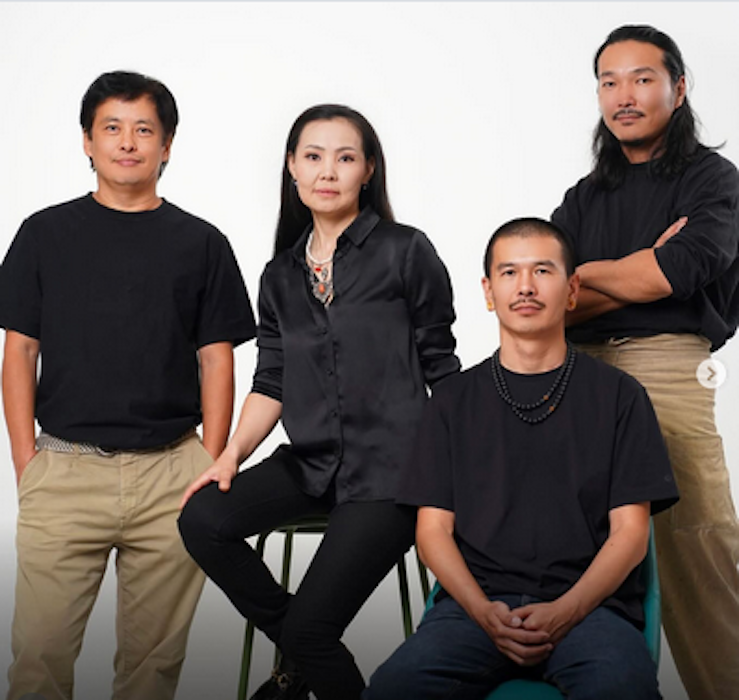
Image Caption: Tuguldur Yondonjamts, Nomin Bold, Gerelkhuu Ganbold, Dorjderem Davaa
Dorjderem Davaa is a multidisciplinary contemporary artist based in Ulaanbaatar profoundly steeped in Tengrism, Mongolia´s shamanic metaphysical heritage. Important contributions to international exhibitions at Hanart TZ, Hong Kong (2011); Changwon Sculpture Biennale South Korea (2014); Zanabazar Museum, Ulaanbaatar (2023). His works were collected by The National Art Gallery of Mongolia, Fukuoka Asian Art Muserum Japan; Singapore Art Museum.
Nomin Bold is one of the most internationally renowned Mongolian artists with participations in the 8th Asia Pacific Triennial of Contemporary Art (2015) ; China Art Museum, Shanghai; Aichi Triennale, Nagoya (2016); documenta 14 (2017); Bangkok Art Biennale (2020); Cairo Biennial (2023); Shenzhen Biennale (2025). In 2015 she received a grant by the Pollock-Krasner Foundation. Her work is in important international collections: Imago Mundi Collection; MARKK, Hamburg; Dallas Art Museum, Texas; UCCA Lab, Beijing; Sigg Collection, Switzerland.
Gerelkhuu Ganbold is an accomplished painter who is well versed in the Mongol Zurag traditions and draws deep inspiration from its pictorial richness. He has been participation in the Fukuoka Triennial (2014); The 8th Asia Pacific Triennial of Contemporary Art (2015); REACTOR, Rongyi international art exhibition, China (2019); The Post-Nomadic Experience, Germany (2024) and the Ulaanbaatar Biennale (2025). His works are collections worldwide: Dioecesan Museum, Bamberg, Germany; Sigg, Switzerland; Fukuoka Asian Art Museum, Japan; QAGOMA, Australia; Jean-Jacques de Dardel, Switzerland; William Lim, Hong Kong; Gu Zhenqing, China
Tuguldur Yondonjamts (b. 1977, Ulaanbaatar, Mongolia) lives and works in Ulaanbaatar. He has participated in major international exhibitions including the Ulaanbaatar Biennale (2025); Thailand Biennale Chiang Rai (2023), the 13th Gwangju Biennale (2021), and exhibitions at the Singapore Art Museum (2024), Kunsthalle Düsseldorf (2024), Konsthall Trondheim (2019); green grassi gallery London, (2018); Para Site Hong Kong (2017), The Drawing Center New York (2016), and Sculpture Center, New York. His work is included in the collections of the Whitney Museum of American Art and the Francis J. Greenburger Collection.
Mongolia has always been a mythical place that many in the West desire to experience, yet very little is known about the long history and intricate complexities of Mongolian heritage. Audiences from Europe or the Americas, as well as parts of Asia have experienced a profound disconnect from their historical roots through the shocks of modernity. Mongolian people however are still deeply immersed with in their heritages experienced in tengrism, Mongolian Buddhism, and the legacy of Chinggis Khaan. This spirituality and diversity is what gives Mongolian artists strength. Yet, at the same time they are radically contemporary as well. In other words, Mongolian contemporary culture is connected to its roots, like no other major culture in the world today.
Historically, Venice and the Mongol Empire had important channels of connectivities through trade, commerce, diplomatic relations and artistic influences, where the Mongols were important mediators. Through diplomacy, trade, and cultural exchange, the Mongols facilitated unprecedented interactions across vast territories. Venice, as a maritime republic and a key node in the Silk Road network, was deeply intertwined with Mongol cultures – most famously through the travels of Marco Polo (1254 – 1324), who spent 17 years at the court of Khubilai Khan (1216 – 1294) . This exhibition revisits these historical intersections to reflect on contemporary issues of migration, identity, and coexistence.
In an era marked by political divisions, ecological crises, and reinforced borders, Entanglements seeks to illuminate how cultures connect, share, and compromise. The exhibition foregrounds themes of religious tolerance, material interplay, and human–nonhuman relationships, offering a vision of Mongolia as a place of pluralism and resilience.
Commissioner:
Baigali Ochkhuu is a Senior Advisor at the Minstry of Culture of Mongolia. As a trained violinist, she has a keen sense of the importance of arts and culture in society. She continued her studies in the Young Leadership in the Arts program and finally adding a PhD of Business Management at the University of Finance and Economica of Mongolia.
From 2018-2019 she has Board Member to the Mongolain State University of Arts and Culture. She has been a founding member and leader in the development of several businesses in Mongolia since, becomind the President of the Mongolian branch International Women´s Federationof Commerce and Industry (IWFCI) in 2016.
Curator:
Uranchimeg Tsultem is a scholar of Mongolian art and currently Edgar and Dorothy Fehnel Chair in International Studies and Associate Professor at Indiana University’s Herron School of Art and Design.
She received her Ph.D. from University of California, Berkeley (2009), she taught at Berkeley, and universities in Mongolia, South Korea and Iceland.
She is the foremost Mongolian curator active internationally since 1993. Her recent monograph “A Monastery on the Move: Art and Politics in Later Buddhist Mongolia (Hawaii UP) received an Art Book award from Leiden, the Netherlands.
Uranchimeg Tsultem curated the first ever Mongolian Pavilion of the Venice Biennale (2015).
Her career started with the exhibition “Eternal Sky: Reviving the Art of Mongol Zurag” at the Institute of East Asian Studies, UC Berkeley (2009). “Modern Mongolia: From Steppe to Urban Dynamics.” Hanart TZ Gallery in Hong Kong (2011); Ulaanbaatar City Pavilion, 9th Shanghai Biennale, Museum of Contemporary Art, Shanghai (2012); “Mongol Zurag: The Art of Everyday,” SAPAR Contemporary, New York (2019); “Mongol Zurag: The Art of Resistance,” Garibaldi Gallery in conjunction with the Venice Biennale (2024).
WHEN?
Exhibition date: Saturday, 9. May until Sunday, 22. November 2026
WHERE?
THE BIENNALE FOUNDATION OF MONGOLIA
Salizada Streta 368
30122 Venice