
PROLOGUE | PERSONAL
Andreas, imagine you would welcome us in your studio or home. Where do we talk together, where do we meet you?
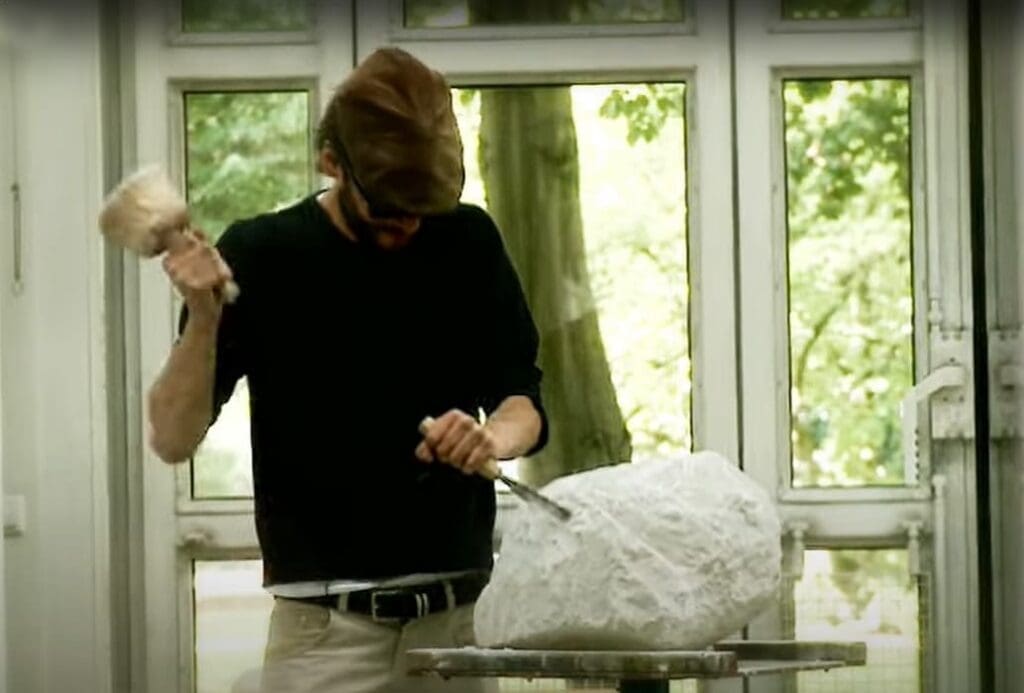
I have been working in three different studios or workshops for some time now. One workshop in the countryside in Bavaria on an old farm house, a studio space in the sculpture workshop in Berlin Wedding, and a small weekend studio on a sculpture yard in Berlin Weißensee.
In the countryside, where I’ve created a large archive of stones that I’ve collected from various parts of the world, I develop my ideas and select the stone pieces.
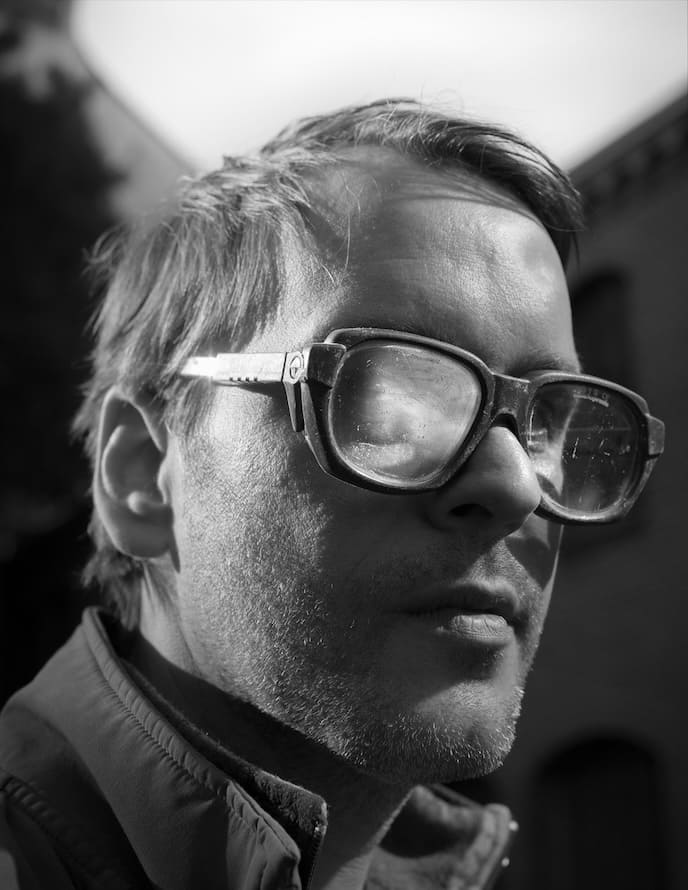
Image above: Portrait Andreas Blank, photo: Oliver Mark
Perhaps we are sitting in your favourite place?
Yes, I would invite you to my rooftop terrace for a coffee; that’s where I can sometimes think best.
Which stages and people have been particularly formative in your life so far?
After graduating from school, I did an apprenticeship with the sculptor Fred Grimm, who comes from a very traditional family of sculptors. He and his brother taught me wood- and stone carving.
During my two courses of study at the Academy in Karlsruhe with the concept artist Harald Klingelhöller, and at the Royal College of Art in London with the sculptor Glynn Williams, my research in the field of sculpture was greatly supported.
Which writers do you find exciting at the moment and which books can be found on your bookshelf?
One book I’m currently reading is “This Is Not a Pipe“ by Michel Foucault. It’s a philosophical work dealing with theories of image and representation, examined through the perspective of the artist René Magritte.
Books currently on my shelf include “Negative Space“ by the theorist Peter Weibel and “1913“ by Florian Illies.
Which books have influenced or shaped you?
A book that has particularly influenced me is “The Cultivated Wilderness, or What Is Landscape?“ by Paul Shepheard. The book explores the processes of human civilization and describes how people remove stones from the landscape and use them to build churches and houses.
The upcoming exhibition will likely feature a text-based work that refers to this book.
What are you currently reading, and where do you keep the book within reach?
–
What music do you listen to and when?
In the studio, I sometimes listen to the radio to bring in a bit of public life into the studio, or often old-school guitar music (like Velvet Underground or Cake……).
If you were to cook something for us, what would it be?
–
What is your favourite food?
–
And what do you think about breakfast?
–
What kind of sport or balance to your artistic work do you pursue?
–
Do you have any special passions (hobbies) that you are passionate about, and if so, which ones?
One of my passions is also playing guitar and making music myself. I used to work actively as a musician with various bands, years ago. At the moment, unfortunately, I don’t have much time for it.
What personality trait particularly defines you?
A personality trait that is particularly pronounced in me is perhaps patience, or persistence, as well as a strong belief in ideas.
Hast Du ein Anliegen, das Du mit uns teilen möchtest? Oder eine Antwort auf eine (nicht von uns gestellte) Frage, die Dich aktuell bewegt?
–
INTERVIEW | ARTIST + POSITION
You were born in Ansbach in 1976 and studied sculpture at the State Academy of Fine Arts in Karlsruhe under Professor Harald Klingelhöller from 2001 to 2006. In 2007, your studies took you to Hamburg to work with Andreas Slominski, before you completed your Master’s degree at the Royal College of Art in London. Today you live and work between Berlin, London, and Aurach. Which stages or people in your artistic career have influenced you and your art?
How did you get into art? Or in short: Why art?
Even as a teenager, I was very interested in art and music. My best friend and I simply picked up a stone from the countryside and worked on it with a hammer and screwdriver… that’s how I made my first sculptures back then, even without any formal art training.
My first job was as a church painter and in Restauration, which is how I eventually came to the visual arts.
I came to art mainly because I never wanted to rely on existing structures and paths in life, but always intended to develop my own path in life.
Do you believe that art has a social responsibility? And what do you think it can achieve?
A work of art creates a physical counterpart for the viewer, something that reflects them back onto themselves, questioning their own perception and existence, and thus prompting them to reflect on their own being.
In the past, this role was partly taken on by religion or the churches; the more important it is today that art assumes this task.
What characterises your art? What is your work about – what are the central themes?
see below
INTERVIEW | CENTRAL WORK
THE DEED | DAS WERK: Andreas Blank

Please describe the core theme and central message of your work.

A central theme of my work ist o analyse relations of time, movement, and consolidation.
My work investigates changing relationships in the transformation of material, transforming landscape into stylized images of culture and reflecting cultural forms and processes.
Stereotype, iconographic images of everyday life are transferred into art, as in Pop Art, and reveal the semantic meaning of visual worlds within a cultural and historical context.

Introduce to us the work that you feel exemplifies or best embodies the message of your work. What is the goal of your art, of your work - what is it supposed to do for the viewer?

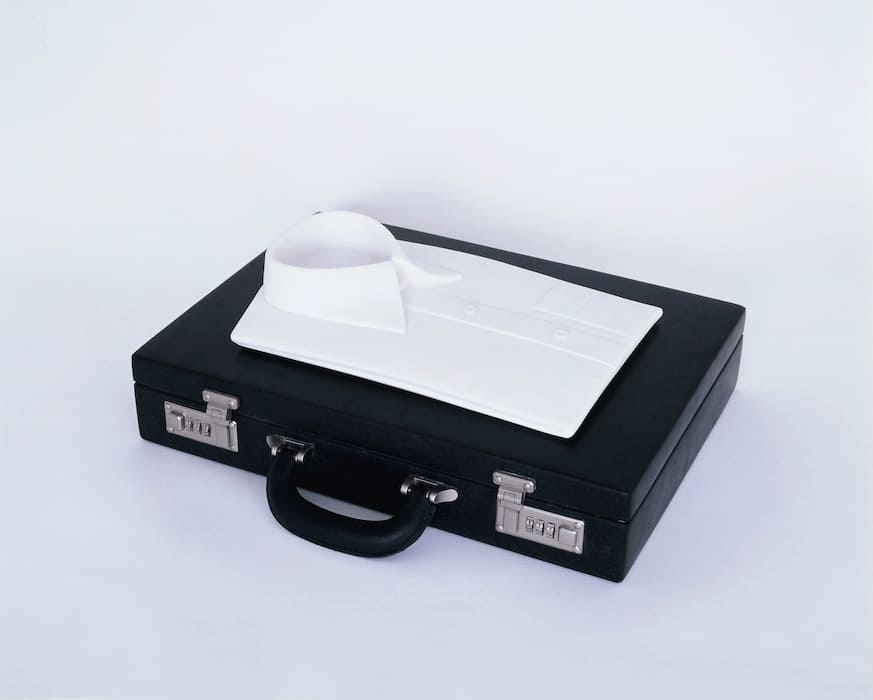
A work that stands as exemplary of my practice is “Monument” (shirt with briefcase). It presents the attributes of the anonymous, capitalist worker. Through its material and its title, the sculpture is placed within the context of historical representation, while at the same time aiming to reflect on the present on a temporally reflective level. One could also view the work as a kind of archaeology of the future.
Through the question of image and representation, my work seeks to liberate the object from its function, allowing it to be perceived and reflected upon by the viewer on a new, purely visual level.
I have been inspired and encouraged by artists such as Thomas Demand, Jeff Wall, René Magritte, as well as Gerhard Richter, particularly by the diverse aesthetic fields and directions within his work.
A Dutch curator once captured my work very succinctly in a single sentence:
“From a distance, Andreas Blank’s work could be viewed as a pun on modernist nihilism, but up close, it reveals a material sensibility that goes beyond a simple juxtaposition of abstraction and reality.”
(by Laurie Cluitmans, Gallery Fons Welters, *“The Scene Changes to an Empty Room”*, 2013, De Fabriek, Eindhoven)

--------------------------------------------------------------
The question regarding THE DEED | DAS WERK is a supplementary and separately presented part of THE INTERVIEW IN|DEEDS with Andreas Blank
How do you protect yourself from too much inspiration in today’s times?
In fact, the flood of images and music via Instagram and Spotify sometimes ends up blocking me a bit in my process of developing ideas. When I want to come up with my own ideas, I often , I often don´t listen to music or look at images of art for a few days.
How much of your work is planned in advance – how much arises intuitively?
My work is usually preceded by a concrete idea, and I often begin by creating a model, which is almost unavoidable when you are working with stone. However, during my travels to quarries or places where I find stones, I also partly develop intuitive ideas, allowing myself to be inspired by the shapes and colors of the stones.
Which project would you still like to realise if a lack of time, courage or financial resources did not play a role?
I would like to publish several books about my work. One would be a comprehensive overview of my sculptural practice, since most people are only familiar with my realistic sculptures. My spatial installations, as well as my text-based, abstract and graphic works, are less well known.
I have also want to publish a small book, since quite some time, featuring texts, notes, and sketches that I have collected in the studio over the years.
Is one born as an artist? Or is studying art compulsory?
Some are certainly born artists, or grow up with artist parents and manage to create brilliant works even without formal training. But in general, an art education is definitely helpful in understanding what kind of art already exists and what still needs to be created.
Wie viel in Deinen Arbeiten ist vorher geplant – wie viel entsteht intuitiv?
Fifty-fifty vielleicht? Ich weiß es wirklich nicht. Es kommt drauf an wie man was bewertet. Im besten Fall sind Idee, Konzept und Arbeitsprozess eins. Mein Bildkonzept ist auch mein Arbeitskonzept und das beinhaltet heute, anders als früher, ein hohes Maß an Improvisationsmöglichkeiten. Aber auch das ordnet sich der Vision eines bestimmten Bildtypen unter. Intuitiv Handeln können nur diejenigen, die sich eine gewisse, auch handwerkliche, Kompetenz angeeignet haben; Improvisieren ohne die Mittel dazu ist nicht möglich. Und entsteht nicht auch eine Idee und ein Arbeitskonzept bereits aus einer Intuition heraus?
How do you see the future of art in the age of AI?
Perhaps in the future, a distinction will have to be made between artists who skillfully use AI merely as a tool for their own ideas, and those who let an AI develop ideas for them.
What is your opinion on the topic of NFT?
For certain media, NFTs are certainly useful or even necessary, but in the field of sculpture, for example, there isn’t really a suitable format yet…
In the age of the Internet of Things, are galleries still necessary? If so, why and for what?
I think galleries are absolutely necessary because artworks must be physically displayed and experienced. Painting, sculpture, and installation are things that are meant to engage with a physical, spatial perception process and therefore absolutely must be made spatially experienced. Only through the physical presence of an object that intervenes in the ordinary perception process can the artwork truly unfold.
Social media – blessing or curse?
Social media is very good because it informs you e.g. about which exhibitions are currently running. On the other hand, you lose a lot of time and spend much time in an illusory world and less time in the real one.
EPILOGUE | CURRENT
Is there currently a solo exhibition of your work or is one planned for the near future? When and where?
A solo exhibition of my work is planned for this year at the “Art Affair Gallery“ in Munich; the exact date is still to be set.
Editor’s note: From 24 April to 30 May 2026, sculptures by Andreas Blank will be on view in the exhibition REAL?! at CSR.ART, Budapester Str. 38–50, 10787 Berlin. The opening will take place on 23 April 2026 from 6 to 9 pm.
Website: www.andreasblank.com
Instagram: Andreas Blank
DEEDS interviews are not edited or shortened by our editorial team and are always published in their original wording. We therefore do not provide translations into English or German unless they are submitted by the interviewee or we are specifically commissioned to translate them. In this case, the German and the English version of the interview were provided by the artist.