

A dark past, a troubled present: hardly anyone captured the situation in Berlin between its oppressive attempts to come to terms with its history and the growing pains of reunification as vividly as Wolfgang Peuker. To mark the 25th anniversary of his death, the Berliner Volksbank Art Forum Foundation is dedicating the exhibition KLASSE IN WEIßENSEE! Wolfgang Peuker and his students to the painter from 11 February 2026. It honours his artistic legacy and shows how his teaching at the Weißensee Kunsthochschule Berlin continues to have an impact in a wide variety of contexts. The exhibition is being organised in collaboration with the Weißensee Kunsthochschule Berlin, which will celebrate its 80th anniversary in 2026.
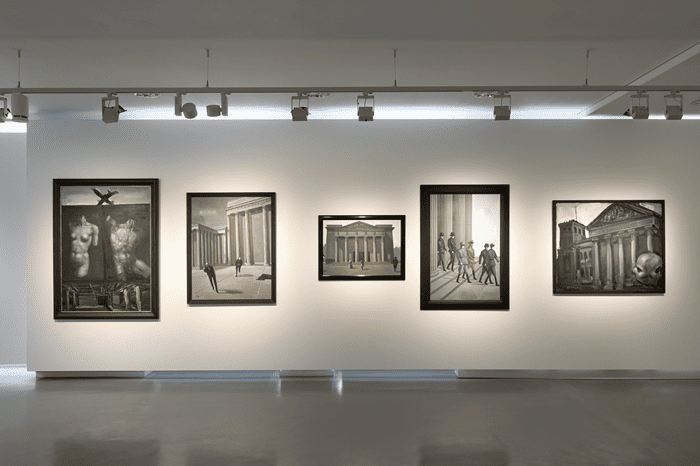
Image above: Exhibition view ‘KLASSE IN WEIßENSEE! Wolfgang Peuker and his students’, Stiftung Kunstforum Berliner Volksbank @ VG Bild-Kunst, Bonn 2026 (Wolfgang Peuker) Photo: Natalia Carstens Photography
Influenced by the great masters of the Leipzig School, Wolfgang Peuker analyzed current events with critical precision and provocative symbolic power in his dark-toned, often surreal paintings.
In 1989, he accepted a teaching position at the Berlin-Weißensee School of Art (now Weißensee Academy of Art Berlin) after being denied a professorship at the Leipzig Academy of Visual Arts. He was appointed professor in Weißensee in 1993.
The paintings created during Peuker’s time in Berlin comment on the uncertainties in dealing with the past as well as on disturbing social developments of the 1990s, such as the newly emerging nationalism.
Berlin’s historic architecture becomes a stage where figures from different eras meet: rulers, soldiers, fools, and contemporaries. These are complemented by characteristically ambiguous (self-)portraits, which were central to Peuker’s work. The figures act with a sober grandeur against this symbolically rich backdrop.
With these subjects, Peuker’s work fits into the profile of the Berliner Volksbank’s art collection, with its guiding themes of “Images of People – Images for People” and “Berlin Cityscapes.” His paintings were acquired early on for the collection, which focuses on representational German post-war art, particularly by artists from the GDR.
The exhibition at the Kunstforum Berliner Volksbank Foundation presents the late works of the painter, who died in 2001, and also introduces four of his most famous students: Stefanie Hillich, Sibylle Prange, Philipp Schack and Christian Thoelke.
Her works impressively demonstrate how independent visual languages developed from Peuker’s teachings of technical mastery, painterly traditions, and the critical-analytical perspective of the Leipzig School.
Stefanie Hillich creates fantastical worlds in muted colors that seem to emanate from the subconscious. In fragmented scenes and surreal constellations, dreams become reality and reality becomes dreams.
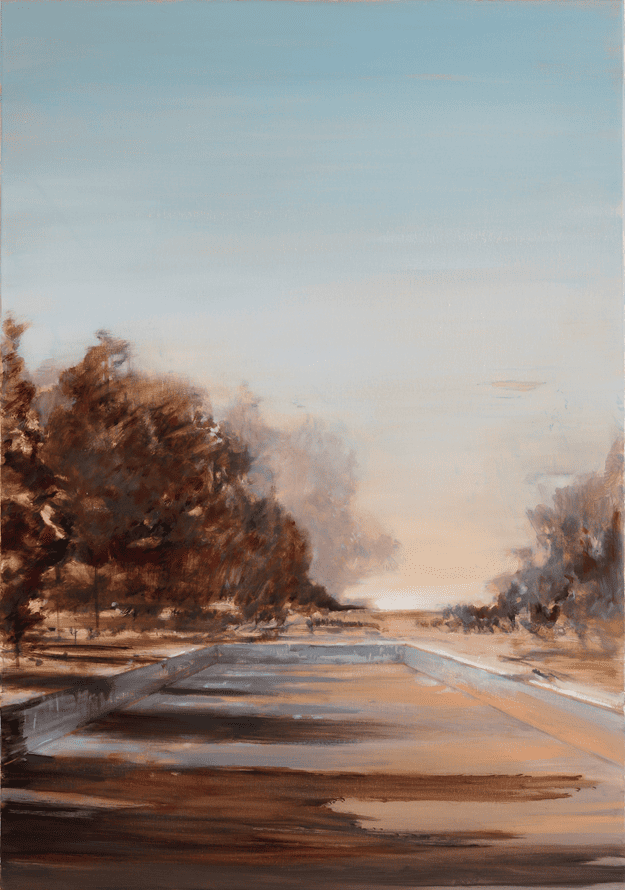
Sibylle Prange has long focused on landscapes that often bear traces of civilization. They sharpen our perception of what humans leave behind in these peaceful expanses.
Philipp Schack, who died in 2006 at the age of only 39, developed a powerful, color-intensive style even during his studies. His abstract-expressive figures are embedded in dense geometric structures – scenes of human interaction that make tension, intimacy, and conflict visible.
Christian Thoelke’s figures, as detached portraits or turned away from the observer, negotiate private moods, but also the effects of social upheavals on collective experience.
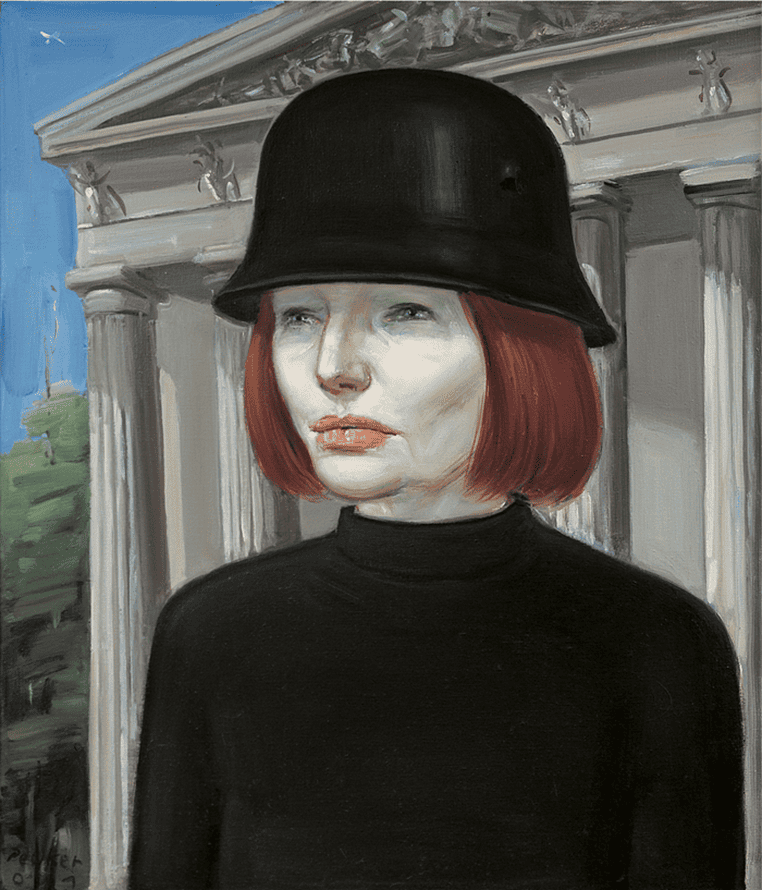
Thuringen @ VG Bild-Kunst, Bonn 2026, Foto: Galerie Hebecker Weimar
In her text accompanying the exhibition, art historian and curator Dr. Elke Neumann writes:
The students describe Wolfgang Peuker as approachable and communicative. A teacher who, in addition to providing technical guidance, also understood life outside the studio as an integral part of an artist’s existence. For him, teaching encompassed film, music, and popular culture—both highbrow and mainstream. He discussed films like “Das Boot” alongside the television series “Kir Royal,” held conversations about music, and sometimes even held lessons in pubs. Peuker incorporated portraits of some of his students into his own artistic work. Sibylle Prange, Stefanie Hillich, and Philipp Schack sat for him.
The exhibition invites visitors to discover not only the obvious points of reference between master and student, but also those that only become apparent upon closer inspection.
WHEN?
Wednesday, February 11 to Sunday, July 5, 2026
WHERE?
Stiftung Kunstforum Berliner Volksbank
Kaiserdamm 105
14057 Berlin