



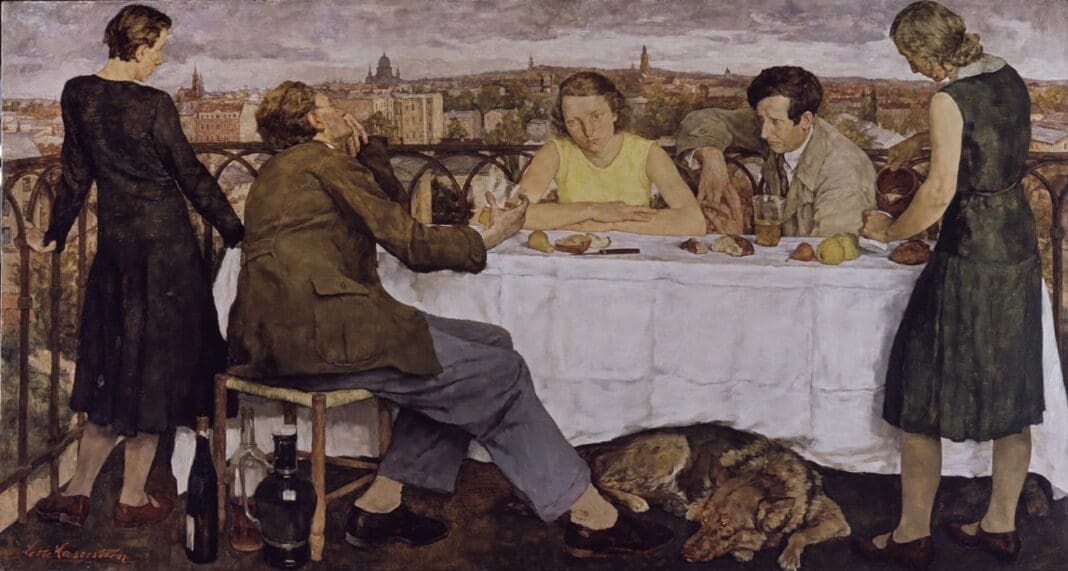

With ‘Ruin and Rausch’ (Ruin and Intoxication), the Neue Nationalgalerie will be focusing on selected works from its outstanding collection of classical modern art that deal with Berlin in the 1910s and 1920s, starting on 25 April 2026. These decades – marked by the First World War and the Weimar Republic – oscillated constantly between opposites: excess and poverty, emancipation and extremism went hand in hand in the rapidly growing, cosmopolitan metropolis. With around 45 works of different styles, the exhibition brings to life the ambivalence of glamour and misery, rise and fall in Berlin at that time.
Image above: Lotte Laserstein, Abend über Potsdam, 1930; Neue Nationalgalerie. Foto: Roman März © VG Bild-Kunst Bonn, 2026.
At the beginning of the 20th century, Berlin developed not only into an economic centre but above all into a political and cultural hub in the wake of industrialisation. With the founding of Greater Berlin in 1920, the population skyrocketed to around 4 million people; Berlin became the second largest city in the world in terms of area after London. In addition to numerous innovations in the fields of construction and transport, social upheavals such as democratisation and women’s emancipation took place. The traumas of the First World War and the rise of National Socialism overshadowed the so-called ‘Golden Twenties’. The metropolis, already mystified by contemporary voices as ‘Babylon’, was in turmoil on many levels: commercial abundance and excess contrasted with growing poverty and unemployment.
The exhibition on the collection floor of the Neue Nationalgalerie comprises three sections that illustrate the contrasting aspects of urban life in Berlin between 1910 and 1930. After initially focusing on the dynamism of the growing metropolis in terms of architecture, transport and the extravagant nightlife, the second section is devoted to the social abysses that characterised the lives of the working class. The final chapter of the exhibition focuses on urban women, reflecting on their desire for freedom, self-determination and queer life, as well as prostitution. The exhibition explores the diversity of voices in interwar Berlin through works in various styles, such as Expressionism, Dadaism and New Objectivity.
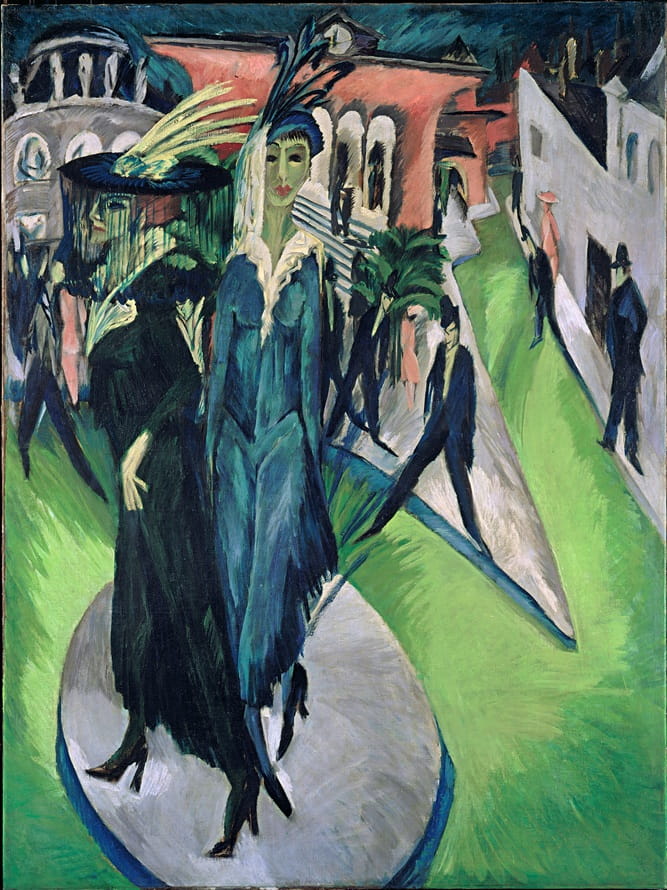
All of the works on display have an explicit connection to the city of Berlin, both in terms of their subject matter and the artists’ biographical ties to the city. Around 45 exhibits are on display, including important major works from the National Gallery collection such as Ernst Ludwig Kirchner’s Potsdamer Platz (1914), George Grosz’s ‘Grauer Tag’ (Grey Day, 1921) and Lotte Laserstein’s ‘Abend über Potsdam’ (Evening over Potsdam, 1930). An outstanding key work from the 1920s, on loan from the Landesbank Baden-Württemberg collection at the Kunstmuseum Stuttgart, complements the exhibition: Otto Dix’s ‘Bildnis der Tänzerin Anita Berber’ (Portrait of the Dancer Anita Berber, 1925).
The collection’s focus on paintings and sculptures is enriched by prints and objects from neighbouring institutions at Berlin’s Kulturforum, the Kupferstichkabinett, the Kunstbibliothek and the Kunstgewerbemuseum. In addition, excerpts from Fritz Lang’s silent film classic ‘Metropolis’ (1927) and Walther Ruttmann’s experimental documentary film ‘Berlin – Die Sinfonie der Großstadt’ (1927) will be shown. In addition to in-depth texts, each section will feature audio stations playing poems by protagonists of the time (Anita Berber, Mascha Kaléko and Erich Kästner) that are thematically related to the content.
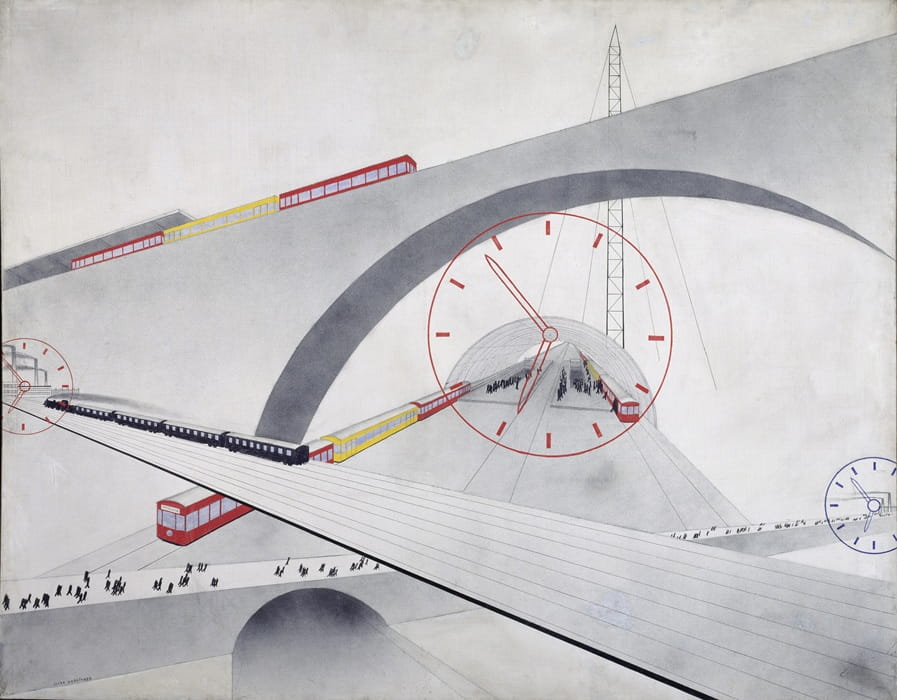
Artists featured in the exhibition: Otto Dix, Heinrich Ehmsen, Paul Fuhrmann, George Grosz, Hans Grundig, Karl Hofer, Hannah Höch, Ernst Ludwig Kirchner, Oskar Kokoschka, Georg Kolbe, Will Lammert, Lotte Laserstein, Tamara de Lempicka, Jeanne Mammen, Carlo Mense, Otto Nagel, Oskar Nerlinger, Ernest Neuschul, Renée Sintenis, Jakob Steinhardt, Georg Tappert, Lesser Ury, Gustav Wunderwald.
The exhibition is accompanied by a diverse educational programme with guided tours and workshops for families, schoolchildren and adults, as well as a programme of events including concerts and lectures.
‘Ruin und Rausch. Berlin 1910–1930’ is curated by Uta Caspary and Irina Hiebert Grun, research assistants at the Neue Nationalgalerie. Curatorial assistance: Noor van Rooijen.
WHEN?
Exhibition dates: Saturday, 25 April 2026 – Sunday, 3 January 2027
Opening: Friday, 24 April 2026, 7 p.m.
Opening hours: Tuesday – Wednesday, 10 a.m. – 6 p.m., Thursday, 10 a.m. – 8 p.m., Friday – Sunday, 10 a.m. – 6 p.m.
WHERE?
Neue Nationalgalerie
Potsdamer Straße 50
10785 Berlin




, the Neue Nationalgalerie will be focusing ... DEEDS. Culture news, art exhibitions + art events.)