

In spring 2026, the Gropius Bau presents Balkan Erotic Epic. The Exhibition by Marina Abramović, one of the most influential contemporary artists. The exhibition spans ten rooms on the ground floor, as well as the atrium and the Beba restaurant, and showcases what the performance artist herself describes as “the most ambitious work of my career.”
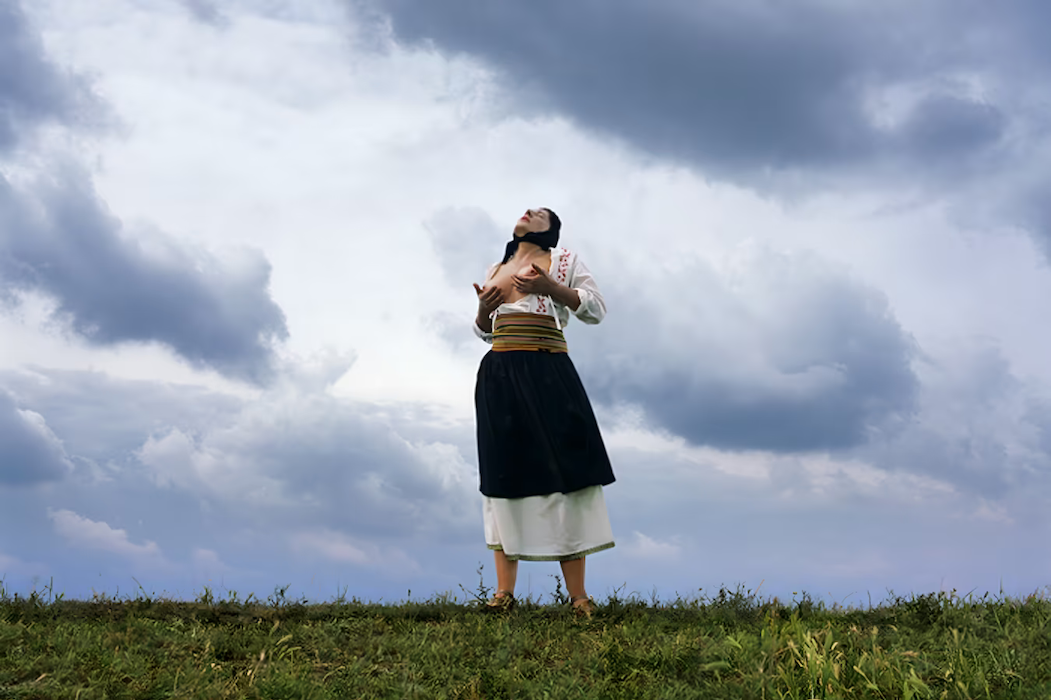
Image Caption: Marina Abramović, Women Massaging Breasts I aus der Serie Balkan Erotic Epic, C-Print, 2005, Serbien © Marina Abramović, Courtesy der Marina Abramović Archives / VG Bild-Kunst, Bonn 2026
Created to mark the 75th anniversary of the Berliner Festspiele, this interdisciplinary project consists of two parts: the exhibition at the Gropius Bau and a four-hour stage production that will open the Performing Arts Season in October.
Balkan Erotic Epic. The Exhibition is Marina Abramović’s first major solo exhibition in Berlin since the 1990s. It juxtaposes historical works with new video installations and explores how the artist uses the body as a powerful resource to engage with political structures, historical narratives, and the mythologies of the Balkans. The exhibition includes works from the 1970s to the present and highlights central themes in her oeuvre: rituals, historical narratives of the Balkans, and the complex relationship between eroticism and death.
“It’s really simple. All energy we have in our bodies is sexual energy. We can use it for creativity, for spiritual matters. Or we can repress it, and then it becomes aggression, war, anger and torture. It’s so interesting to see how such transformations were organized in a different society based on rituals.”
— Marina Abramović
Since 2005, the artist has been working on the extensive body of work Balkan Erotic Epic, which gives the exhibition its name. She originally filmed a series of videos with porn performers in Serbia. The work is inspired by regional folktales and songs; the rituals they preserve are based on the belief that human sexual organs and bodily fluids can positively influence everyday life. Since the beginning of her career, Abramović has been fascinated by nature-based religious rituals—especially the idea that the human body is not a private or purely sexual object, but a collective resource: a medium through which people confront death together, ensure fertility, and restore the balance of nature.
Two decades later, in 2025, she decided to revisit Balkan Erotic Epic and bring it back to life in different forms. In Berlin, alongside the exhibition at the Gropius Bau, a four-hour stage version will be presented in October 2026 at the Haus der Berliner Festspiele. In this project, Abramović plays ironically and provocatively with Balkan myths.
Balkan Erotic Epic. The Exhibition also reveals the often-overlooked humorous aspects of Abramović’s work while offering new perspectives on her recurring themes. It specifically examines the role of eroticism in her work and its relationship to political resistance, ecological cycles, and the inevitability of death.
The exhibition opens with the new video work Tito’s Funeral (2025), installed in the freely accessible atrium of the Gropius Bau. Projected onto a large screen, the piece draws on the funeral of Josip Broz Tito—the partisan leader who resisted Nazi occupation during World War II and later ruled socialist Yugoslavia for over three decades. His funeral in 1980 was one of the largest public mourning events of the 20th century and was broadcast worldwide. The footage showed crowds filling the streets of Belgrade, expressing collective loss and fear of an uncertain future.
Tito’s Funeral combines these iconic images with Southeastern European funeral practices in which grief is publicly expressed through the rhythmic movements and lamentations of women hired for this purpose. The video shows rows of women dressed in black striking their chests; the rhythm of their collective movements creates a trance-like state and a growing sexual tension. In Abramović’s work, the body becomes a site of social and political ecstasy; its erotic energy serves as a means of processing collective loss and connecting a specific historical moment to local customs.
“Rituals help you to get access to a certain kind of energy. Some of them go on for days and hours on end, so you get into a state of trance. The moment your brain stops thinking, the body can have its own wisdom.”
— Marina Abramović
Also located in the atrium is the installation Kafana (2025), which resembles a traditional tavern common in many Balkan countries. Especially during Yugoslav socialism, kafanas provided a temporary escape from everyday routines and pressures, becoming important social spaces. The installation invites visitors to sit at tables with checkered tablecloths beneath a portrait of Tito.
The first object in the exhibition rooms is a small figure on loan from the Archaeological Museum of the Republic of North Macedonia. Excavated in 2021, the ceramic sculpture dates back to the late 6th millennium BCE. In the Balkan region, figures of this kind—representing a lower body resembling a vulva—were used in various belief systems as part of polytheistic ritual practices. The sexual organ was central to cosmology. Placed in the first room, the figure introduces the exhibition’s themes and embodies a key concern in Abramović’s work: translating ancient beliefs and rituals into a contemporary context.
In the video Magic Potions (2025), a supposed scientist presents these rituals. Surrounded by a forest of oversized phallic mushrooms, she explains her research and illustrates sexually charged practices from the Balkan region through animated sequences: men copulating with the earth to increase crop yields; women exposing their vulvas to stop the rain; the preparation of love potions from bodily fluids. These gestures, now interpreted purely as sexual, recall a time when sexual organs symbolized cosmic energy and expressed the connection between human desire, fertility, and natural cycles. By introducing the figure of the scientist, Abramović also satirizes the Western ethnographic gaze that long constructed Balkan populations as Europe’s “less developed Others.” In doing so, she reclaims the spiritual and ecological potential of embodied knowledge—knowledge that Western science has historically devalued.
The exhibition includes several live performances, including a re-performance of Nude with Skeleton (2002/2026), originally performed by Abramović herself. It takes place daily between 2:00 PM and 6:00 PM. In this work, the breathing of a nude performer moves a skeleton, emphasizing the intimate physical proximity between life and death. The exhibition opening will also feature a scene from the stage version of Balkan Erotic Epic: a lament performed by Serbian singer Svetlana Spajić, activating the central video installation in the atrium, Tito’s Funeral.
The exhibition places new works in dialogue with earlier pieces such as Rhythm 5 (1974), Lips of Thomas (1975/2005), and Spirit Cooking (1996), allowing viewers to trace the development of recurring themes throughout Abramović’s career: her ongoing exploration of eroticism as a spiritual, communal, and socially critical force, as well as perspectives on the contradictions of Yugoslav socialism and the region’s social history, folklore, and mythology.
“Even though it’s dark and deals with death, the new work is very life-affirming,” says Jenny Schlenzka, director of the Gropius Bau. “And it contains many ironic elements. Humor has always been part of her work, but now it’s more pronounced. She turns 80 this year and is still reinventing her performance art.”
WHEN?
Exhibition dates: Wednesday, April 15 through Sunday, August 23, 2026
WHERE?
Gropius Bau
Niederkirchnerstrasse 7
10693 Berlin.