
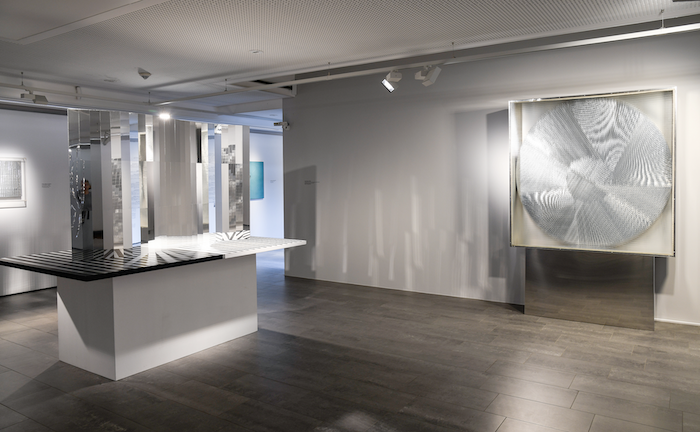

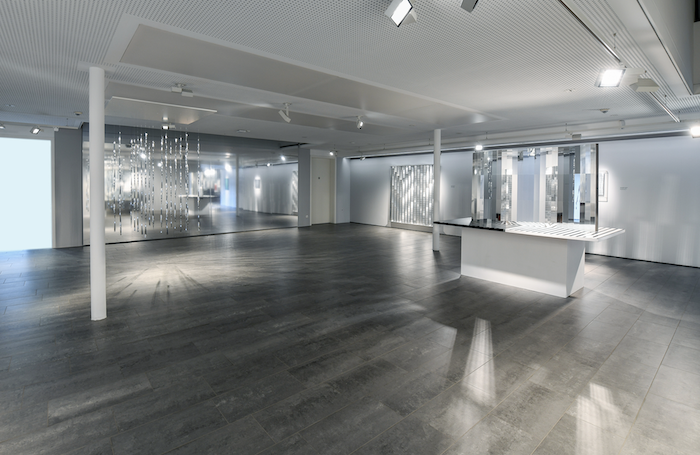
From March 1 to September 6, 2026, the Olaf Gulbransson Museum presents the exhibition “ZERO. An International Art Movement. 1957–1966,” a group exhibition featuring works by the artist Heinz Mack.
Image above: Photo: Regine Hackenberg
ZERO – A New Beginning at Zero
In the late 1950s, young artists in Düsseldorf and other European cities sought a radical new beginning for art. After war and dictatorship, they wanted to break free from pathos, ideology, and the subjectively charged postwar painting and rethink art “at zero.” It was an open zone where structure took precedence over composition, light over narrative motif, and movement over rigid form. ZERO was never a closed collective, but rather a loose network of artists connected through exhibitions, magazines, and personal contacts. ZERO was never a closed collective, but a loose network of artists linked by exhibitions, magazines, and personal connections.
Düsseldorf Burns for Light: The Birth of ZERO
In Düsseldorf, the ZERO ideas found a concrete location: the studios of Heinz Mack and Otto Piene on Gladbacher Straße. There, they organized the so-called evening exhibitions, short, intense presentations accessible only on opening night. For this, the artists cleared out their studios, only to set everything up again the next day and continue working. Günther Uecker soon joined them, and a vibrant meeting place emerged for artists searching for new forms of expression. At the same time, Mack and Piene published the magazine “ZERO” (1958–1961), which coined the name for the movement and spread it internationally.
Light, Movement, and Immateriality
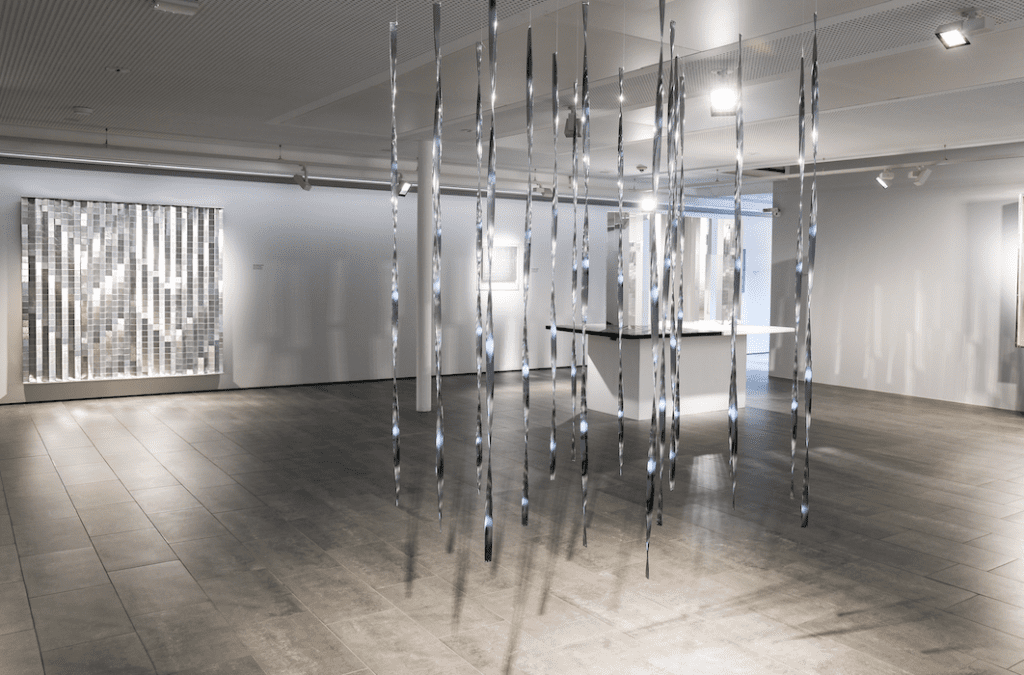
Many works break away from traditional painting and instead focus on light, reflections, shadows, movement, and chance. A central theme of ZERO is the question: How can light itself be transformed into art?
Heinz Mack, Otto Piene, and Günther Uecker developed light reliefs, rotors, nail reliefs, mirror objects, and light ballets in which light can be experienced as an immaterial, constantly changing phenomenon. The movement often lies less in the object itself than in perception: When viewers move in front of the works, optical vibrations and virtual movements are created.
Heinz Mack – The Biographer of Light
Heinz Mack creates the poetry of immateriality. For him, light is not just a subject, but a lifelong artistic obsession. Shaped by early experiences of light during the war—bombing raids over Krefeld, a narrow beam of light in a darkened hallway, dancing dust particles in the air—he developed a strong awareness of immateriality and the magic of minimal light sources. Later, a trip to the Sahara deepened this interest: the dazzling mirage reflections, the almost intangible horizon, and the silence of the desert became key experiences for him. In his work, he attempts to translate these elusive phenomena into abstract, autonomous constellations of light and space – using aluminum, stainless steel, glass, acrylic glass, marble, and reflective surfaces. Silver, in particular, plays a central role because it intensely reflects light and, for Mack, is symbolically associated with inwardness, night, and consciousness.
Europe in Network Mode: ZERO and Its Sparkling Satellites
From the outset, ZERO was conceived as an international endeavor. In Milan, Paris, Brussels, Amsterdam, and other cities, artists grappled with similar questions: How can art be freed from object, narrative, and ideology, and instead focus on light, space, time, and perception?
In Italy, the Azimuth group formed, in the Netherlands the NUL group, and in Belgium the ZERO network around Jef Verheyen. Closely related positions also emerged in France, Switzerland, and Croatia. Key figures in the ZERO movement include Dadamaino, Lucio Fontana, Yves Klein, Yayoi Kusama, Piero Manzoni, Jef Verheyen, and Nanda Vigo. Through publications, joint exhibitions, and reciprocal studio visits, a dense European network developed, paving the way for the art of the information age.
In Italy, the Azimuth group formed the circle of artists; in the Netherlands, the NUL group; and in Belgium, the ZERO network around Jef Verheyen.
Women in the ZERO Cosmos: Much Shadow, but also Light
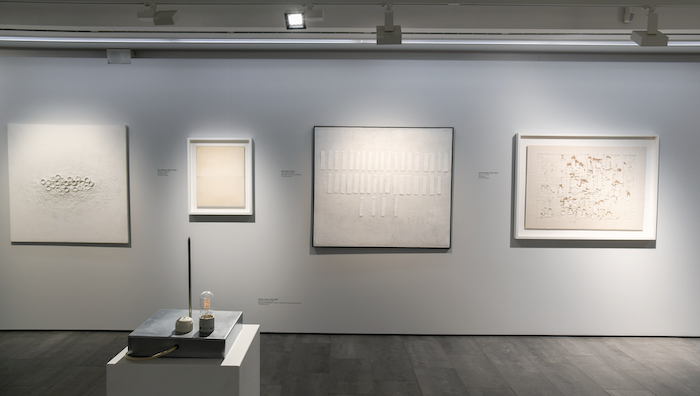
For a long time, the ZERO discourse focused primarily on male protagonists, but female artists played a central role. Hal Busse, Hanne Brenken, and Herta Junghanns-Grulich were already present at the early evening exhibitions in Düsseldorf and experimented with new materials such as nails on monochrome color fields.
In Italy, Dadamaino belonged early to the circle around Piero Manzoni and Enrico Castellani; she developed radical perforated and volumetric paintings that brought space and movement into play. With her “Cronotopi,” Nanda Vigo created light-flooded objects at the intersection of architecture and art. Yayoi Kusama, with her dot grids and spatial installations, brought a strong body- and psycho-related dimension into the ZERO context, which also exhibits thematic proximity to questions of repetition, infinity, and space.
Why ZERO’s Influence Remains Today
In 1966, the ZERO network officially dissolved, but the movement’s ideas continued to resonate far beyond that decade. In the 1960s, ZERO was recognized—particularly in the USA—as the first German post-war movement of international standing after Brücke and Bauhaus. Today, ZERO is considered a key movement in the development of light art, kinetic art, minimalism, conceptual art, and site-specific installations. Major retrospectives at the Guggenheim Museum in New York, the Stedelijk Museum in Amsterdam, and the Gropius Bau in Berlin have underscored ZERO’s international significance in recent years. The exhibition at the Olaf Gulbransson Museum builds on this legacy, placing ZERO in a contemporary context as a movement that has profoundly shaped our understanding of perception, material, and space.
WHEN?
Exhibition dates: Sunday, 1. March until Sunday, 6. September 2026
WHERE?
Olaf Gulbransson Museum
Kurgarten 5
83684 Tegernsee