

Text: Constanze Kleiner, Stephan von Wiese (in German language)
German photographer Angelika Platen is known for her portraits of artists. Born in Heidelberg in 1942, Platen studied art history in Berlin and then photography in Hamburg. In 1968, she began working as a photographer and photojournalist. In 1969, she exhibited her photos for the first time at the art gallery ‘Die Insel’ under the title ‘Künstler sind auch nur Menschen’ (Artists are only human). From 1970 to 1972, she worked as a journalist for the business section ‘Kunst als Ware’ (Art as Commodity) of the weekly newspaper Die Zeit. During this period, namely in Cologne in 1970, she also took her photographs of the artist Michael Buthe. The Berlin gallery KLEINERVONWIESE is showing an exhibition of works by and about Michael Buthe until the end of February 2021.
25, 8 x 38,8 cm, Archival Pigment Fine Art Print / Baryta
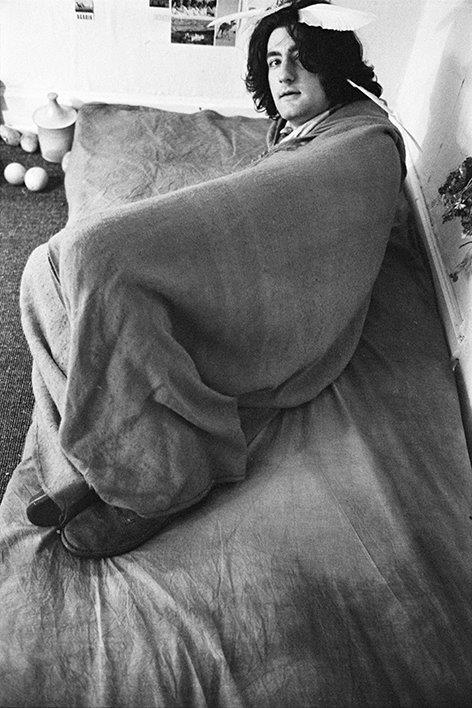
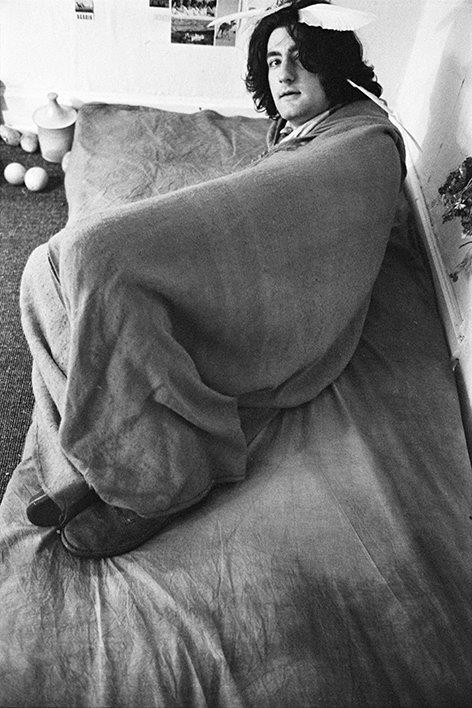
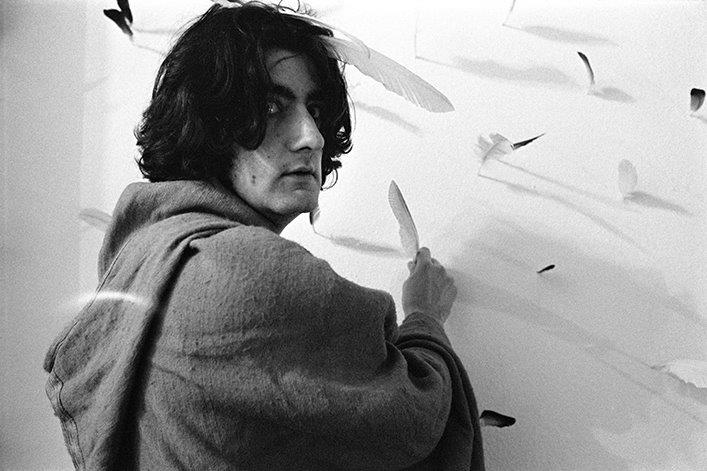
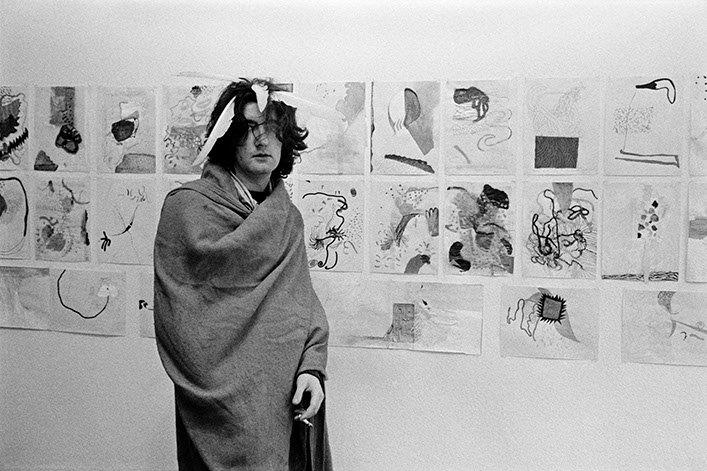
Angelika Platen’s photos of Michael Buthe, shown here in a grey sleeveless burnous with feathers pinned in his hair, capture a performance that the artist staged for the photographer Angelika Platen. The location was the Möllenhoff Gallery in Cologne during the 4th Cologne Art Market in October 1970, where a sensational scandal occurred – also captured by Angelika Platen – when Beuys, Staeck, Vostell and Rywelski staged a spectacular protest in front of closed glass doors, loudly protesting ‘against the cementing of a sales monopoly’.
Michael Buthe’s internalised action at the Möllenhoff Gallery on the occasion of the joint exhibition with Arnulf Rainer was quite different. It shows the artist’s astonishing metamorphosis as a direct consequence of his first trip to Morocco in the same year. In his early days, when he was still inspired by Minimal Art, Buthe was known for his bourgeois artist’s outlook, wearing a tie and collar. In the summer of 1970, he had already staged a veiling action in an open field in his hometown of Höxter, using sewn and dyed cloths. Now, in Cologne at Möllenhoff, Michael Buthe had wrapped himself in a sleeveless grey burnous, the traditional garment of the Berbers. The feathers in his hair resemble a halo, appearing like sensitive sensors. Angelika Platen’s photos show Buthe using a feather to draw more feathers on the wall, presenting new drawings inspired by Moroccan ornamentation, and smiling mischievously at the camera as he lounges casually on the sofa. With this photo series, Angelika Platen has captured a significant moment in Buthe’s artistic life.
Buthe first met the photographer a year earlier in Düsseldorf, when she documented the epoch-making group exhibition ‘Prospekt’ at the Düsseldorf Kunsthalle. Since 1968, in the ‘Phase 1’ of her career, Angelika Platen has devoted herself entirely to portraying her own generation of artists, after studying Oriental studies, art history and photography. She worked as a freelance photographer for Stern and Zeit. A famous example of her work was her photographs of the ‘jumping Polke’ against the backdrop of Düsseldorf’s Rhine harbour. Platen: ‘I was fascinated by the art scene. The avant-garde of ’68, my contemporaries, not yet famous, were accessible to my lens.’ During the Cologne Art Market in 1970, she also met Swiss curator Harald Szeemann, who helped Michael Buthe make his big debut at documenta V in 1972 with his room ‘Homage to the Sun’. Since then, the work has been subsumed as ‘Individual Mythology’.
25, 8 x 38,8 cm, Archival Pigment Fine Art Print / Baryta
Angelika Platen lived in Paris from 1976 to 1999, where she worked in industrial marketing. In 1997, she resumed her artistic photography, marking the beginning of ‘Phase 2.’ In 1998, she published the volume ‘Platen Artists’ with Edition Stemmle, Zurich and New York, and her photographs were exhibited in museums and institutions. In ‘Phase 3,’ beginning in 2012, she turned her attention to digital photography.
In spring 2021, Angelika Platen’s new photo book ‘Meine Frauen’ (My Women) – 100 female artists from 50 years – will be published by Hatje Cantz.
25, 8 x 38,8 cm, Archival Pigment Fine Art Print / Baryta
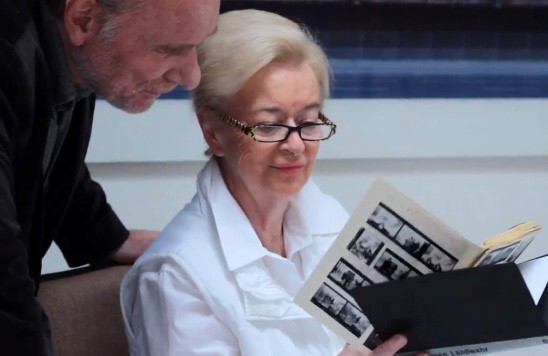
The following film sequence from Angelika Platen’s Berlin studio is full of light, Michael Buthe’s face glows with new radiance, and one can almost hear the artist laughing. The photographer wrote to gallery owner Constanze Kleiner with words of appreciation for filmmaker Jana Goldbach: “It’s not so easy to capture old faces on film, but the beautiful, smiling Michael outshines everything.
Video of the studio visit to Angelika Platen
Text: Constanze Kleiner, Stephan von Wiese