



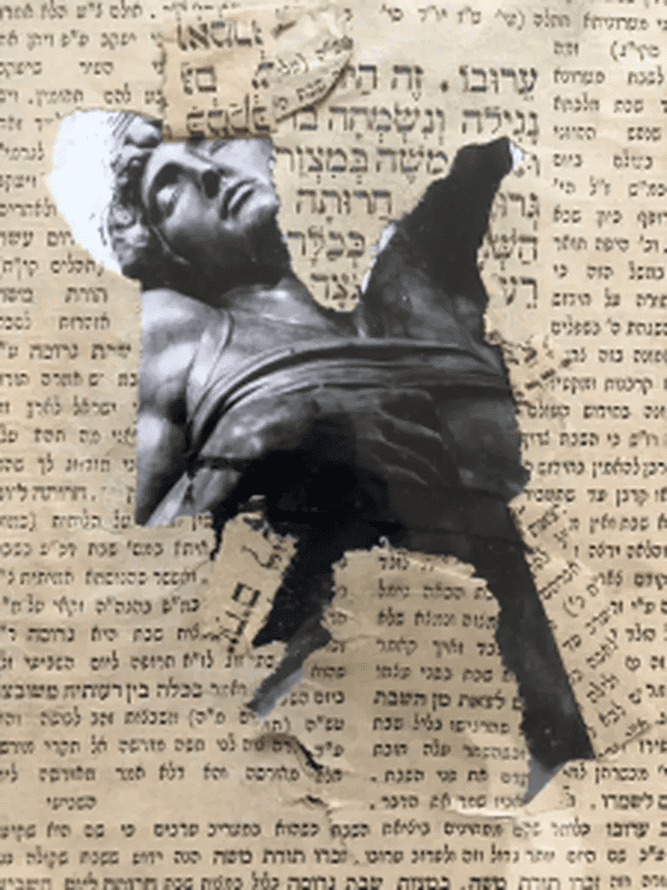

The exhibition focuses on the work of the Jewish artist Benyamin Reich. Running from February 19 to April 3, 2026, the exhibition presents the “Talmud Curtain” (Parochet), a multifaceted installation that places Jewish, Christian, and Hellenistic-classical traditions in dialogue with one another. In his artistic work, Reich combines photography, text, and religious symbolism into a dense visual language that explores questions of holiness and profanity, physicality and transcendence. His works open up an interreligious and contemporary space for discourse, intertwining past and present.
Image above: Photo: Benyamin Reich
At the heart of the exhibition by the Jewish artist Benyamin Reich is a large installation: the Talmud curtain (Hebrew: “Parochet”). During Lent, it veils the altar of St. Matthew’s Church.
In its discursive structure, image and text, writing and visuality, intertwine – like a text that enters the world and raises questions. The artist’s tapestry of Talmudic texts, Kabbalistic symbols, and images is reminiscent of the finely embroidered curtain of the Temple in Jerusalem, as well as the curtains of all subsequent synagogues, which, according to rabbinic understanding, trace their origins back to a metaphysical curtain in heaven. At the same time, it evokes Christian Lenten veils, which traditionally cover the altar of a church during Lent, thus temporarily questioning the connection between God and humanity – a Jewish-Christian dialogue of traditions.
“The synagogues of my childhood, unlike churches and the sanctuaries of antiquity, were unadorned—no images, nothing for the eye to linger on. Only the velvet curtain covering the holy shrine with its hidden Torah scrolls was decorated, sometimes with depictions, even animal figures. In the time of the ancient Jewish Temple, this textile partition was made by women who also depicted the cherubim on the fabric. They covered the sacred, thus separating the inner sacred from the outer sacred as well as from the profane. My parochet attempts to create something similar: I take the sacred pages from the Jewish bookcase and weave them together with images of classical sculptures—seemingly secular—which, through their proximity, themselves become sacred.” – Benyamin Reich
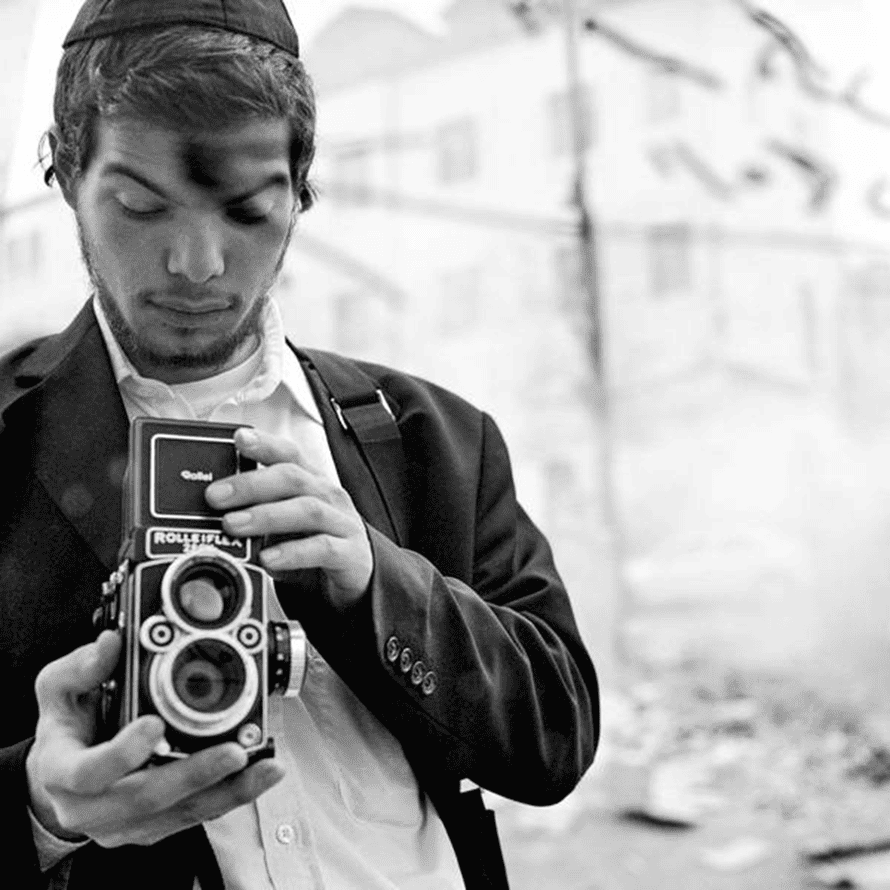
On the Talmud curtain are displayed Hebrew and Aramaic texts from the 3,500-year-old Jewish literary canon, collected from the Genisot, the traditional repository of unused sacred texts. These texts are interspersed with small photographic works and drawings by the artist Benyamin Reich. On the church’s gallery, the curtain is mirrored by further collage works in display cases and free-hanging photographs on the walls. The visual language of these works echoes the curtain’s basic design, enriching it with interreligious connections to Christian iconographic motifs and Hellenistic-classical ideals of beauty.
The three areas form a triangle of complementary thematic worlds, held together by subtle allusions to the Sefirot – the divine attributes of Jewish mysticism. A central motif is an aesthetic of vulnerability, from which traces of Reich’s life story emerge: traces of a search for the sacred and the profane, for beauty, seduction, and transcendence. For example, the embodied ideals of masculinity in classical heroic statues enter into an art-historical dialogue with the vulnerable physicality of Jesus. Within this field of tension, a dialectic of reconciling contrasts arises – between modern Berlin and the weighty contradictions of a pan-Abrahamic Jerusalem.
The exhibition thus combines images from three traditions that converge during the Christian Passiontide: the Jewish-Talmudic heritage, the Christian tradition of Jesus, and Hellenistic-Roman paganism. Their diverse, sometimes complementary, sometimes contradictory conceptions of spirituality and physicality encompass existential themes such as suffering, martyrdom, and persecution, as well as reflections of universal motifs like the loss of paradise against the backdrop of the Kabbalistic Etz Chaim (“Tree of Life” of the divine inner world) and Adam Hakadmon (“Primordial Man,” the anthropomorphic-metaphysical archetype of all creation). These traditions are symbolically represented in the figure of Jesus, the Jew who lived between the worlds.
The exhibition is curated by the artist Benyamin Reich. Christian theological consultation was provided by Pastor Hannes Langbein, Director of the St. Matthew Foundation, and rabbinical consultation by Netanel Olhoeft, Community Rabbi of Oldenburg. The Talmud curtain is complemented by drawings by Dana Gazit.
Accompanying program for the exhibition
Thu, 26.02.2026, 7:00 pm
Artist talk
with Benyamin Reich, Rabbi Netanel Olhoeft and Pastor Hannes Langbein, Director of the St. Matthew Foundation
Sun, 01.03.2026, 11:30 am
Family art service hORA+
with Cantor Avitall Gerstetter and Pastor Hannes Langbein, Liturgy
Thu, 05.03.2026, 7 pm
Concert
with Ben Osborn, piano and electronic folk music
Sun, 22.03.2026, 6 pm
LABORa church service
with Pastor Hannes Langbein, sermon and liturgy, Dietrich Sagert, reading, and Lothar Knappe, organ
Thu, 02.04.2026, 7 pm
tempel@hof
Passover performance, curated by Giovanni Vinciguerra and Lucas Shiller
WHEN?
Opening for the artists’ Ash Wednesday:
Wednsday, 18. February 2026, 6 pm
Exhibition dates: Thursday , 19. February – Friday, 3. April 2026
WHERE?
St. Matthäus-Kirche
Kulturforum Berlin
Matthäikirchplatz
10785 Berlin



, a multifaceted installation that places Jewish, Christian, and Hellenistic-classical traditions in dialogue with one another. In his artistic work, Reich combines photography, text, and religious symbolism into a dense visual language that explores questions of holiness and profanity, physicality and transcendence. His works open up an interreligious and contemporary space for discourse, intertwining past and present.)