



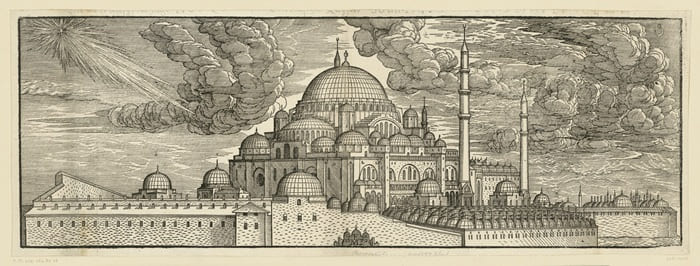

The exhibition “Bosporus Beats. Views of Istanbul from 1500 to 1800” at the Kupferstichkabinett (Museum of Prints and Drawings) in the Kulturforum Berlin presents a multifaceted pictorial history between Europe and the Ottoman Empire from February 13 to May 31, 2026. The focus is on Istanbul, the vibrant metropolis on the Bosporus, which, since its founding as Byzantium in the 7th century BC and later under the name Constantinople, has been a cultural and political crossroads between continents. The exhibition brings together works by European artists from the 15th to the 18th centuries, which bear witness to encounters, curiosity, and fascination, but also to conflicts and projections. Through drawings, prints, and historical images, the exhibition reveals perspectives on the Ottoman Empire that oscillate between admiration, stereotyping, and political propaganda. It invites visitors to critically examine these historical visual worlds and to reconsider questions of collective identity, cultural perception, and the “Western gaze.”
Image above: Melchior Lorck, Süleymaniye Mosque seen from the northeast, c. 1570, woodcut on paper, 19.4 x 53.5 cm. Photo: Staatliche Museen zu Berlin, Kupferstichkabinett/Dietmar Katz
Introduction
The Kupferstichkabinett’s collection also preserves an Ottoman-Turkish visual world in works by German, French, Italian, and Dutch artists from the 15th to the 18th centuries. It bears witness to encounters, conflicts, curiosity, and admiration.
The exhibition focuses on Istanbul, the vibrant metropolis on the Bosporus. Situated at a major intercontinental crossroads, it is home to a multi-ethnic society. Founded in 660 BC as Byzantium, the city was known as Constantinople until well into the 20th century.
She consistently provided impetus for artistic exploration through images, some stemming from personal observation, others from imagination. Images also circulated that were marked by misunderstanding, resentment, or ignorance.
The exhibition showcases these works in order to jointly deconstruct stereotypes and raise questions about collective and individual identity.
Perspective
The German-French artist Antoine Ignace Melling (1763–1831) arrived on the Bosporus with an embassy in 1784 and lived in Istanbul for eighteen years. There he worked as court architect and designer for Sultan Selim III (1761–1808).
Letters attest to the friendship between his half-sister Hatice Sultan (1768–1822) and the artist. In Paris, Melling published 48 copperplate engravings of Istanbul under the title Voyage pittoresque de Constantinople et des rives du Bosphore – a selection of which can be seen here.
According to Orhan Pamuk, the 2006 Nobel laureate in Literature, Melling offers perhaps the most beautiful view of Istanbul because his views combine inside and outside perspectives.
Melling prefaced his copperplate engravings with a topographical map on which he meticulously marked his viewpoints and the respective radius of his field of vision. This allows for questions about the relationship between perspective and reality.

First touch
The so-called “Fall” of Constantinople in 1453 is considered a profound turning point in shared history. With the conquest of the city by the Ottoman Empire, the Eastern Roman Empire (also known as Byzantium) came to an end. At the same time, the newly revived capital experienced a cultural renaissance.
Sultan Mehmed II, the Conqueror Fatih (1432–1481), also brought Italian artists to his court, including the famous Venetian Gentile Bellini (c. 1429–1507), who lived in Istanbul from 1479 to 1481.
With the establishment of diplomatic and economic relations between various countries and the Ottoman Empire, diverse contacts developed. From around 1470 onward, numerous figures in European art can be interpreted as Ottoman or Muslim. They testify to admiration and reverence for these newly perceived neighbors.
Travel
In the 16th century, many Europeans traveled to the Bosporus. For example, the Antwerp artist Pieter Coecke van Aelst (1502–1550) spent a year in Istanbul. The French geographer Nicolas de Nicolay (1517–1583) and the Danish artist Melchior Lorck (c. 1526/27–1583) also participated in diplomatic missions there.
During diplomatic trips, it was common practice for artists to create drawings based on personal observation or firsthand accounts. The world and society of women were largely closed to them; their depictions are likely partly fabricated.
The resulting images are not free of stereotypes. Nevertheless, in many cases they can be considered valuable sources for understanding life, architecture, and fashion in Istanbul and the surrounding area.
War

The expansion of the Ottoman Empire was accompanied by centuries of conflict. Key events remain firmly established terms to this day. The “First Siege of Vienna 1529,” the “Siege of Buda 1541,” and the “Battle of Lepanto 1571” have not only been artistically documented and interpreted.
The armed conflicts also led to innovations in artistic practice and thus to altered visual habits. It is assumed that the development of the graphic technique of etching was linked to the spread of cannons, since the necessary corrosive acid could be obtained as a byproduct of gunpowder production.
Also striking is the bird’s-eye view effective in connection with battle depictions: it presents war as a system of order and shows the fighting from above in almost ornamental views.

Propaganda
From the mid-15th century onwards, the first German-language political and religious propaganda writings and pamphlets against the expanding Ottoman Empire appeared. In this context, defamatory images were also disseminated.
The woodblock shown here was originally printed together with a verse about the atrocities committed during the war. The text block for the section in the upper right is lost; the title “Turkish atrocities” remained, based on the work “Thurcorum terror…” (1498) by the legal scholar Sebastian Brant (1457/58–1521), even though it was never actually legible on the sheet.
We are deliberately not showing a print of the image here because we do not want to reproduce images of hate and incitement.
Orientalism
From the 17th century onwards, orientalist images became popular in Europe. Rembrandt van Rijn (1606–1669) included generally “oriental”-looking figures or accessories in numerous biblical scenes to make the world of the Old Testament more vivid. At the same time, he documented his knowledge of other cultures and his cosmopolitan sophistication.
The particularly pronounced “Turquerie” fashion in 18th-century France also reflected a cosmopolitan outlook. Conversely, during this period, French customs were sometimes adopted in Istanbul.
The incorporation or appropriation of Turkish elements by Western European art reinforced clichés and stereotypes within societies and fueled what is now critiqued as Orientalism: the “Western gaze” on the Middle East, which ultimately also reflects colonial power structures.

The first Ottoman embassy in Berlin
In November 1763, the first Ottoman diplomatic delegation from Sultan Mustafa III (1717–1774) visited the Prussian court of King Frederick II in Berlin. It was led by the state official Ahmed İbrahim Resmî Efendi (c. 1700–1783).
The members of the delegation stayed in Berlin for six months and appeared in previously unseen garments and customs. The embassy report, translated into German and published at the time by Friedrich Nicolai, noted:
“The Prussians, who had never seen a Muslim in their lives and had never even heard of the splendor and pomp of an envoy by name, a people fond of curiosities, came with their families three to five days’ journey (…).”
WHEN?
Exhibition: Friday, 13. February – Sunday, 31. May 2026
Opening: Thursday, 12. February 2026, 6 pm
WHERE?
Johanna-und-Eduard-Arnhold-Platz
Matthäikirchplatz
10785 Berlín




 in the Kulturforum Berlin Cultural news, art exhibitions + art events to discover.)