



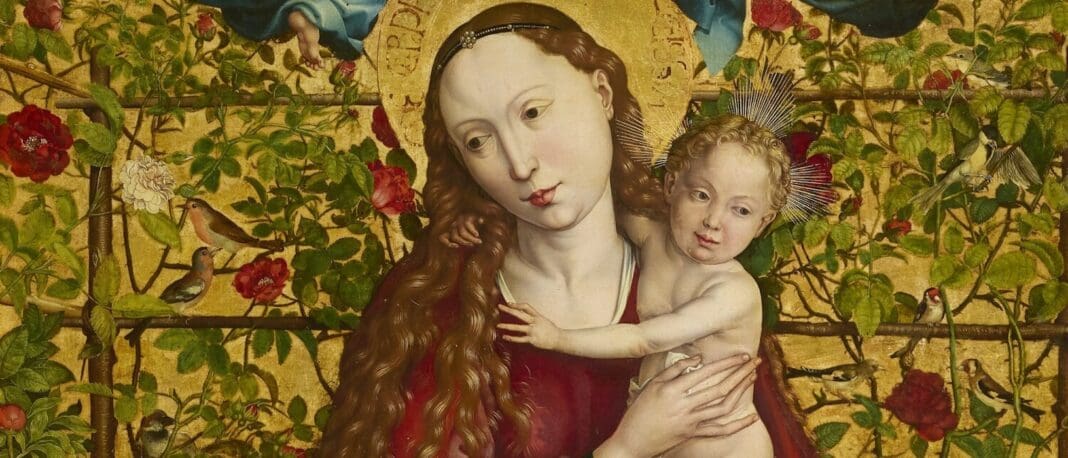

Nicknamed “Beautiful Martin” by Albrecht Dürer, Martin Schongauer was an outstanding painter, draftsman, and engraver who remains relatively little known outside a small circle of specialists and enthusiasts. Nevertheless, he was one of the most popular artists of the late Middle Ages and a defining figure of the period. The exhibition brings together around one hundred works to highlight Schongauer’s oeuvre and his impact across borders and time. It features a selection of his rare drawings, a wide range of the engravings that made him famous throughout Europe, and presented together for the first time an almost complete group of paintings attributed to him (altarpieces and panel paintings), including the exceptional Madonna of the Rose Bower (1473), the only dated panel painting by his hand. The exhibition is structured in two main sections: the first traces the life and work of Martin Schongauer, while the second examines the far-reaching influence of his engravings on European visual culture.
Image Caption: Martin Schongauer, La Vierge au buisson des roses, 1473. Daté 1473 au revers. Huile et tempera sur bois de résineux, H. 200,2; L. 114,4; Ép. 2,9 cm. Colmar, église des Dominicains © Région Grand Est – Inventaire général / Bastien Garnier, avec l’aimable autorisation du Conseil de Fabrique de la Collégiale Saint-Martin à Colmar
Due to the limited availability of sources, relatively little is still known about Martin Schongauer’s life. He was born in Colmar around 1445 and died in Alt-Breisach in 1491. As the son and brother of goldsmiths in Colmar, he mastered the delicate technique of engraving at an early age and developed remarkable precision and a clear understanding of spatial depth in his prints, surpassing his predecessor, Master ES. His early works demonstrate his knowledge of the great painters of the Southern Netherlands, such as Rogier van der Weyden, as well as artists from Nuremberg, a city he likely visited during a journey between around 1465 and 1470.
Only a few paintings by Martin Schongauer have survived to the present day. They reveal his strong sense of aesthetics, both in his depiction of the human figure and in his treatment of space and background, as well as his preference for ornamental detail and naturalism. His small scale panel paintings illustrate a new, more intimate understanding of the relationship between the Virgin and Child, the serenity of scenes of adoration, and the growing importance of Mary’s role. The exhibition presents these works, intended for private devotion, alongside large scale pieces commissioned by religious institutions, which are still largely located in Alsace today, for example in the churches of Colmar and the commandery in Isenheim.
Above all, however, his engravings represent the pinnacle of his captivating style. In them, exceptional technical skill is combined with extensive knowledge of apocryphal texts and saints’ legends. They reveal a well read artist with a talent for detailed, imaginative storytelling and a keen eye for nature. His wide range of subjects allowed him to reach a broad audience: alongside religious imagery, he incorporated animal motifs, fantastical elements, and decorative forms.
The second part of the exhibition is devoted to Schongauer’s impact across time and space. His art, particularly his engravings, continued to fascinate artists long after his death. Numerous drawings, paintings, prints, sculptures, and art objects from the late 15th to the 17th century, from Spain, France, Bohemia, and Italy, by both renowned and anonymous artists, were inspired by his works, sometimes closely following the original, sometimes freely interpreted. From a corpus of over a thousand works, a selection has been made to illustrate this far reaching iconographic dissemination, which extended far beyond the boundaries of the Holy Roman Empire. This extraordinary legacy has earned Schongauer the epithet “immortal”.
WHEN?
Exhibition date: Wednesday, 8. April until Monday, 20. July 2026
WHERE?
Louvre
75001 Paris
France




 was an outstanding painter, draftsman, and engraver who remains relatively little known outside a small circle of specialists and enthusiasts. Nevertheless, he was one of the most popular artists of the late Middle Ages and a defining figure of the period. The exhibition brings together around one hundred works to highlight Schongauer’s oeuvre and his impact across borders and time. It features a selection of his rare drawings, a wide range of the engravings that made him famous throughout Europe, and presented together for the first time an almost complete group of paintings attributed to him (altarpieces and panel paintings), including the exceptional Madonna of the Rose Bower (1473), the only dated panel painting by his hand. The exhibition is structured in two main sections: the first traces the life and work of Martin Schongauer, while the second examines the far-reaching influence of his engravings on European visual culture. Cultural news, art exhibitions + art events to discover.)