

PROLOGUE | PERSONAL
Hinrich, imagine you would welcome us in your studio or home. Where do we talk together, where do we meet you?
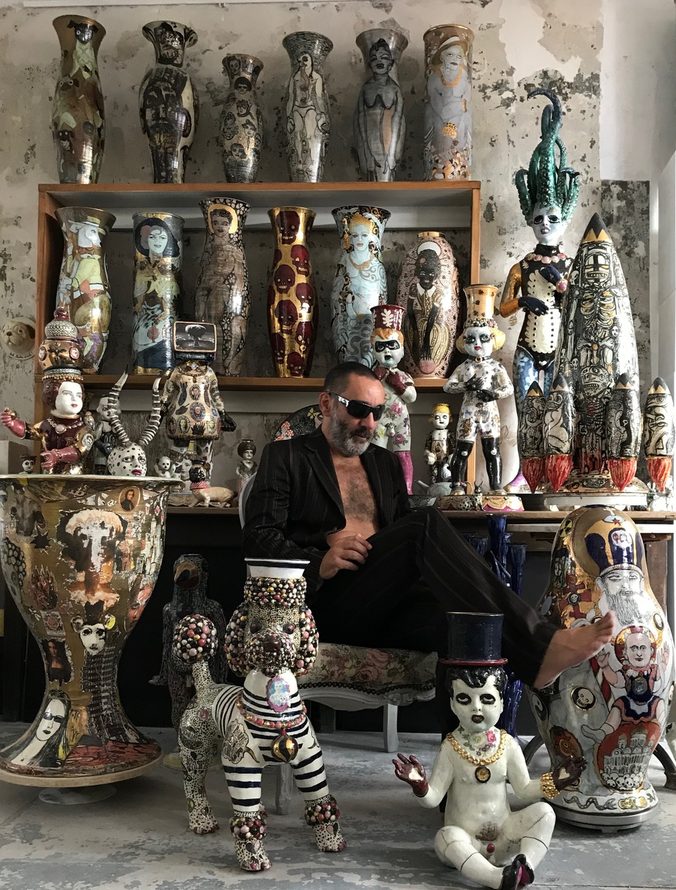
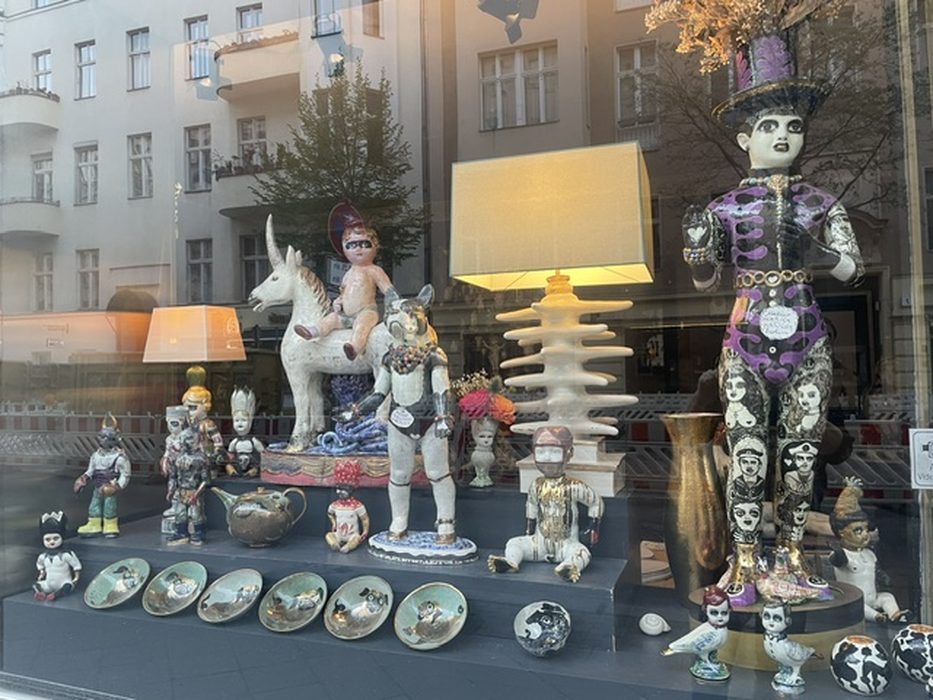
Naturally in my shop at Eisenacher Strasse 114 in Berlin-Schöneberg, where all the painted royal poodles, pugs, greyhounds, gigolos and cats on my vases and sculptures would be looking at you with a purr! A strong coffee would be waiting, steaming and fragrant with Polish forest honey. And to your delight, one or two models from my cups and tea sets would come to life and stroll past in my shop window……after all, we’d be right in the heart of the neighbourhood.
Image above: Portrait Hinrich Kröger-John © the artist
Perhaps we are sitting in your favourite place?
Yes, of course, with a view through the shop window onto the street!
Which stages and people have been particularly formative in your life so far?
Oh, from Mrs Schulz at the nursery school on Wichertstrasse (she had a huge blonde bun on her head and wore crazy, vamp-like make-up – I later realised it was in the style of a French chanson singer, though not in Paris, but more like a smoky Berlin corner pub in a working-class neighbourhood) right up to Johann Sebastian Bach. Prenzlauer Berg naturally shaped me, as did the Baltic Sea, where I spent all my holidays with my grandmother, and later the countryside around Neu-Frauenmark in north-west Mecklenburg, where I moved with my parents, dog and three cats when I was thirteen… and, of course, all the countries and cities I visited…
Which writers do you find exciting at the moment and which books can be found on your bookshelf?
At the moment, I’ve rediscovered the Russian classics for myself to find inner balance and peace, after having read non-stop contemporary political literature—such as Michael Lüders, Ulrike Guérot, Hauke Ritz, Gabriele Krone Schmalz, Richard David Precht and others—in an attempt to understand everything that’s going on in the world right now……
The bookshelf is good. It’s a library of little promotional books – fairy tales from around the world – Bulgarian, Persian and so on – alongside the complete works of Sinn und Form, from Shakespeare to Bertolt Brecht and Heiner Müller, encyclopaedias and magnificent art books ranging from the art of Papua New Guinea and Africa to Picasso and Matisse.
Which books have influenced or shaped you?
Every stage of life has its own discovery of literature. My earliest memories are of *Max and Moritz* and *Der Struwelpeter* – they were old books whose illustrations made me so curious that I taught myself to read with little help – haltingly at first, because it took me a while to realise that *Max and Moritz* was printed in old german letters ,Sütterlin, script and *Der Struwelpeter* in Latin characters. By then I was already reading Pippi Longstocking quite fluently. Whilst still at school, I discovered the Romantics such as Bettina von Arnim, Clemens Brentano… and at the same time Franz Fühmann, who led me into the worlds of antiquity – ‘The Battle of the Titans’(Titanenschlacht), for example – and whom I later enjoyed reading time and again. PETER HACKS!!!!… followed by Truman Capote, Harper Lee, Tennessee Williams… and then Russian literature – starting with Bulgakov, it drew me into the spell of Fyodor Mikhailovich Dostoevsky… Vasily Shukshin, Stefan Zweig, Chingiz Aitmatov, Gerhard Hauptmann, Fontane, Heinrich Mann… . I turned 18 and discovered JAMES BALDWIN! Then soon the Latin Americans, Gabriel García Márquez! Ingeborg Bachmann, Christa Wolf’s ‘Kassandra’, though Franz Fühmann had helped me greatly in understanding all those ancient gods… Georg Büchner and yes, Arthur Rimbaud! …In the years before the collapse and the West’s takeover of the GDR, Heiner Müller and Volker Braun were, of course, an absolute must-read – and today more relevant than ever…..
By the way, thanks for the question! It’s really got me reminiscing and I ought to stop here…..
What are you currently reading, and where do you keep the book within reach?
Nikolai Gogol’s *Dead Souls* – marvellous! It lies, if not by my bedside, then open on my lap when I’m on long underground journeys or sitting in my dentist’s waiting room. Alongside that, Alexander Pushkin’s *The Tsar’s Moor*, which came to an abrupt end right at the climax of the story, as I only realised later that it had been preserved for us as an unfinished fragment.
What music do you listen to and when?
The last concert I attended was at the Berlin Philharmonie: Brahms’ First Piano Concerto, performed by the wonderful pianist Hélène Grimaud with the Camerata Salzburg.
If you were to cook something for us, what would it be?
If I’m frying, crispy vegetables topped with Parmesan.
What is your favourite food?
My boyfriend’s lovingly cooked meals.
And what do you think about breakfast?
A great deal, but rarely.
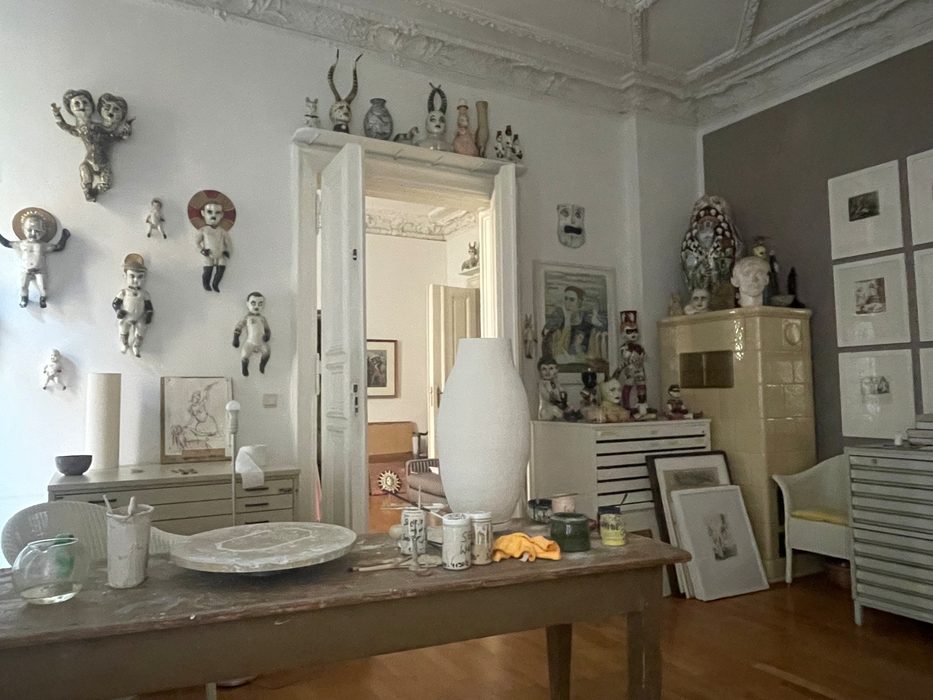
What kind of sport or balance to your artistic work do you pursue?
Working with clay is very physically demanding. If my body is twisted and tense from the work, swimming and diving in Berlin’s lakes in summer or at the Baltic Sea is enough to balance things out for the whole year.
Do you have any special passions (hobbies) that you are passionate about, and if so, which ones?
Looking at the world, working, reading, and spending time with family and friends.
What personality trait particularly defines you?
My cat would say, cuddly.
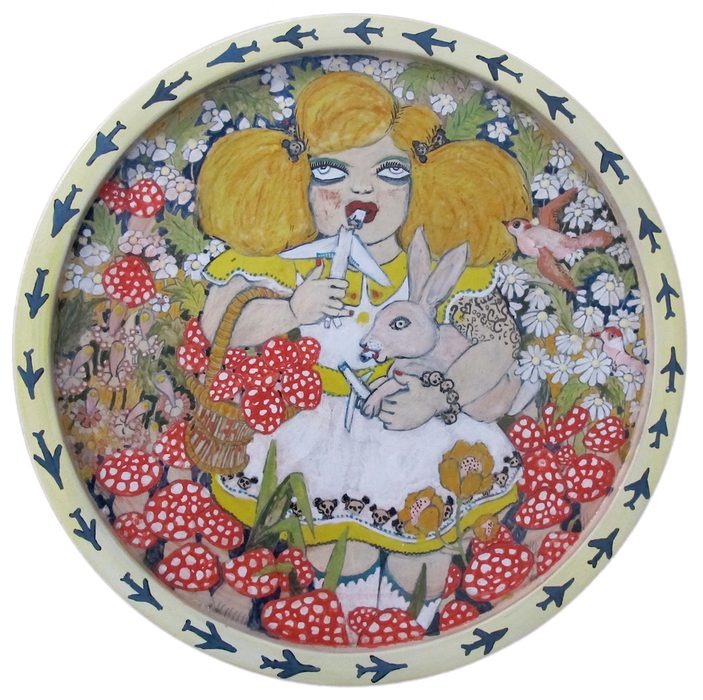
Is there something on your mind that you’d like to share with us? Or an answer to a question (we haven’t asked) that’s currently occupying your thoughts?
Yes, I want a complete turnaround for our country and the EU: disarmament and dialogue……genuine, responsible politicians, like Egon Bahr, Willy Brandt, Helmut Schmidt, instead of parasites, careerists and lobbyists from BlackRock and the arms industries, etc….
INTERVIEW | ARTIST + POSITION
Hinrich, you laid the foundations of your artistic practice in a very traditional way through craftsmanship: from 1982 to 1984, you completed an apprenticeship as a potter, during which you mastered the technical and material fundamentals of ceramics. You then worked as a potter in various Berlin workshops from 1985 to 1995. At the same time, you expanded your artistic vocabulary and studied painting at the Dresden Academy of Fine Arts from 1989 to 1995. In doing so, you complemented your craft with a formal artistic education. You thus very consistently combine the traditional craft of pottery with academic fine art. Please feel free to share further details on this, e.g. the names of relevant lecturers, etc.
Hmm, well, I’d actually leave out the bit about academic art and training altogether. I did meet some great people there, such as Professors Gerhard Kettner, Siegfried Klotz, Elke Hopfe, Manfred Zoller and so on… and we had nude models, but there wasn’t much in the way of a classical academic education at that time, because the country in 1989, when I started studying there, was in turmoil and collapse, and life, actions and thoughts took place on the streets rather than studying and painting dutifully…
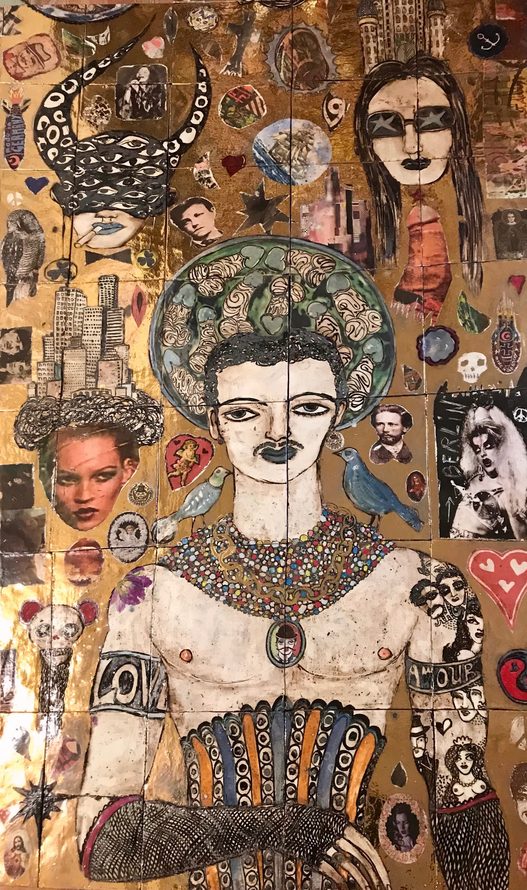
How did you get into art? Or, to put it simply: why art?
…..I don’t even know if what I do is art. But I do know that 95% of it is craftsmanship. Growing up in an artistic household in East Berlin, thr capitol of GDR (my father, the draughtsman, painter and writer JOACHIM JOHN), I was surrounded by all my parents’ artist friends – what people call art was like eating bread and cake to me… it was simply always there, like the air we breathe.
What makes you happy at the moment?
That I managed the big move from my 25-year-long location in Berlin Mitte with my workshop and gallery to larger, brighter premises in Berlin Schöneberg, and have now been able to work in a perfectly equipped workshop again for five years, with additional spaces for exhibitions, gatherings and events.

And what’s worrying you at the moment?
All the wars in the world, right up to genocides, and the role of German governments since the green Ampel-coalition took office, with their arms exports and arms deals with warring states. The brutal arms race and so-called ‘war readiness’. The fact that German politicians shake hands and pose for the world’s cameras, smiling unabashedly alongside mass murderers and war criminals, allowing themselves to be celebrated. The war propaganda and populism in the mainstream German media, the marginalisation of those with differing views, and the massive dismantling of democracy and the welfare state remind me – albeit in a different way, of course – of the times before the respective world wars.
Do you think art has a social responsibility? And what do you think it can achieve?
I would like to respond briefly with a quote from Jane Goodall: “…that we as individuals make a difference.” That we, as individuals, can make a difference! No matter the field, the encounter or the situation!

Another quote, in response to the President of the Academy of Arts’ question to all members: “What is the role of art in the 21st century?”, the old hand, Joachim John, replied very aptly as follows: “It has none. It cannot take the burden of world peace off society’s shoulders. Art must simply be. Like farmland and drinking water.”
‘(…) It cannot take the burden of
world peace
off society’s shoulders.
Art must simply be.
Like farmland
and drinking water.’
What defines your art? What is your work about – what are the central themes?
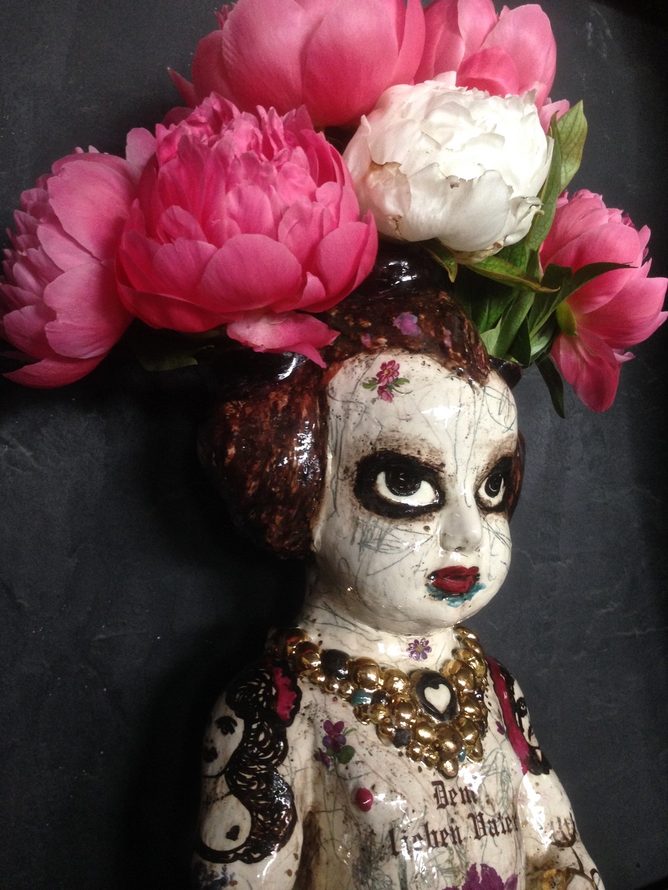
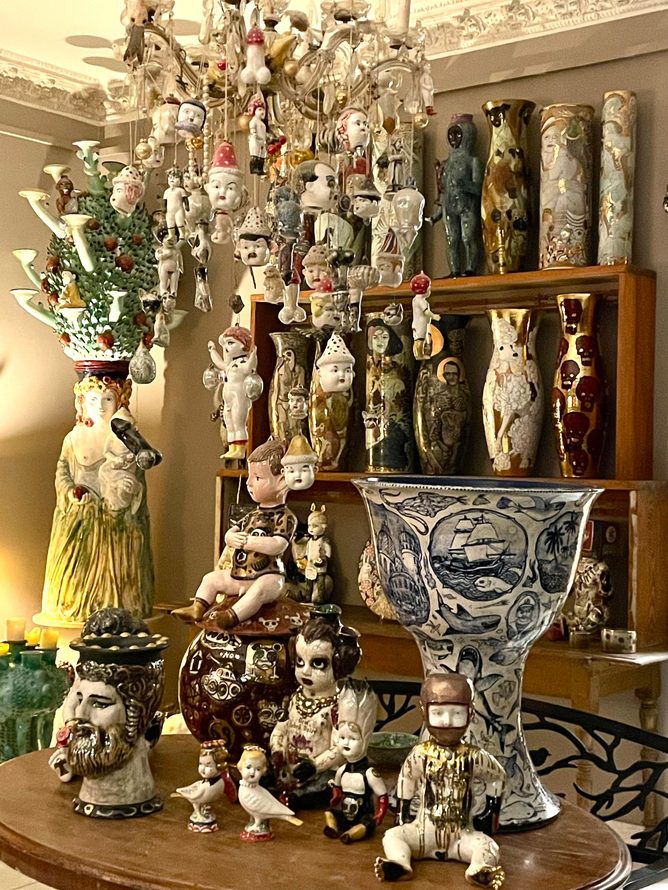
That’s for others to judge… After years of modelling, I returned to working with vessels at the end of last year – simple forms painted with poodles and cats, to give the world something funny and beautiful… but I’m now getting back into sculpture again.
INTERVIEW | CENTRAL WORK
THE DEED | DAS WERK: Hinrich Kröger-John

Please describe the central theme and key message of your artistic work.

“I draw
it, and as
I draw it,
it is more than
I know”
after Volker Braun, linguistically modelled by Joachim John; I couldn’t have put it more succinctly myself.

Tell us about the piece of work that best exemplifies the message of your body of work, or that you feel best embodies it.

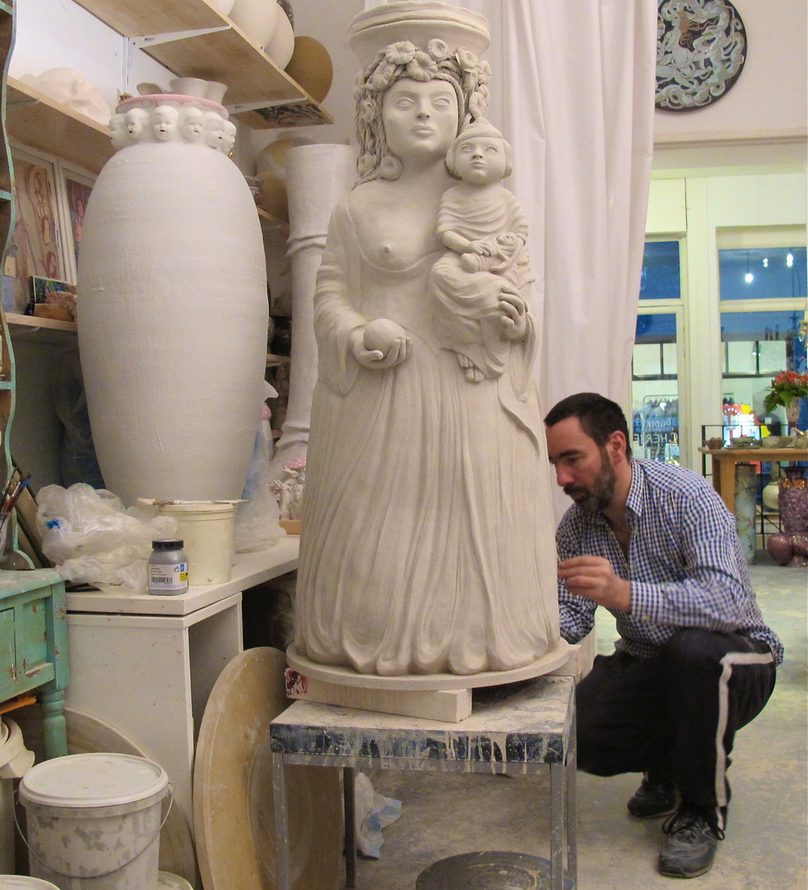
You have questions; how can I answer them? Somehow everything flows in, the excitement and thrills of life… the main materials are terracotta and various porcelains… figures emerge, and as they emerge, everything possible flows into them, always subject to craftsmanship, concentration and patience, between fairy-tale-like elements, dreams and the brutality of the world…

What is the aim of your art, of your artistic work? What effect do you want it to have on the viewer?

Here, too, I would like to answer with a quote. This time with a poem by my father, which answers the question most beautifully and simply, by the draughtsman JOACHIM JOHN :
“ gone
success and fame flee
the vain herd of game
the bow drawn
water at the target quenches no thirst
I release the string calmly
I do not aim, I shoot
to delight myself
in the arrow’s flight. „

--------------------------------------------------------------
The question regarding THE DEED | DAS WERK is a supplementary section of THE INTERVIEW IN|DEEDS with Hinrich Kröger-John, presented separately.
How do you protect yourself from being overwhelmed by inspiration these days?
Oh, I believe and hope that the limits of what can be absorbed naturally protect and guide us.
How much of your work is planned in advance – and how much comes about intuitively?
Here I must again point to the craftsmanship—which necessitates planning… in the end, it is the form—if it is successful, it is the form that, in the best case, intuitively composes and decorates the visual language or design—one should follow it like notes in music. Of course, one always has a theme.
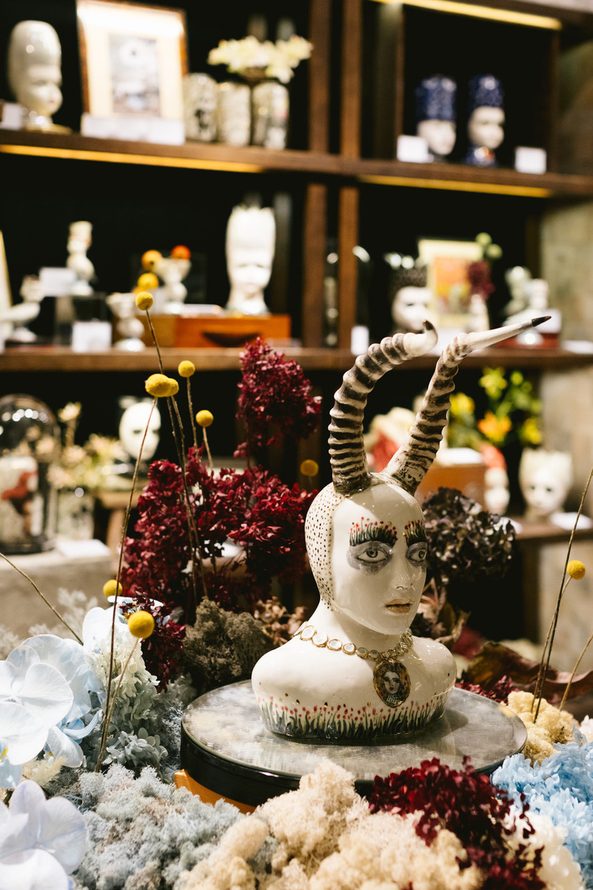
What are your (next) goals?
…stay healthy.
What are your views on faith? Do you have any core beliefs, or is there a motto that guides you?
To continue believing in the good and the strength within us humans, and not to let ourselves be destroyed or worn down by the devastating final throes of capitalism, which appropriates everything through wars and the destruction of cultures and peoples, right down to the scarcely explored wondrous worlds, life in the deep sea, the rainforests and the polar regions…..
What project would you like to carry out if time, courage or financial resources were no obstacle?
So, purely for personal enjoyment? Ooh, I’m not sure if I should reveal that, but well, it’s not as if I’m interviewed very often ……. My dream has always been a place combining a workshop and gallery with a café and our own chocolate production (smaller porcelain objects of my own making, such as bunnies and little figures, would then also be available in chocolate) or with a bar and a small stage for readings, cabaret and the like… with a small collective in which everyone has their own independent role within the ensemble. In the workshop, a reliable assistant who masters and loves the craft and doesn’t feel the urge to express themselves artistically—other places would be more suitable for that. My workshop has expanded and developed so much over the years that I could run a proper workshop… but I don’t even know anymore if I’d still want to… and something like that has to come about naturally, and that never happened – partly due to a lack of financial resources, and partly because I didn’t meet the people who were seriously willing to help shape something like that over the long term, with a lot of hard work and enjoyment.
In your view, what are the hallmarks of good art?
…that the sense of wonder and awe remains even after the hundredth encounter, just as when one heard the music for the first time, saw the painting for the first time, walked around the sculpture for the first time… etc… marvelling anew at a hollyhock, a blossoming tree every year.
Are you born an artist? Or is studying art a must?
These days, studying art is the craziest thing I could possibly recommend. Anyone who is absolutely determined to study something like painting should learn a trade – perhaps by studying restoration, where you can at least learn techniques or how to make paints. However, anyone who has no idea about it, no interest in it, and comes from a wealthy background should definitely study art.
How do you see the future of art in the age of AI?
Interesting.
As for me personally, I wouldn’t have the patience to sit in front of a device and create anything, even though I imagine it must be amazing, though perhaps also soon exhausting, mentally draining (a fear of mine), because it only exists on the screen at first – I can only make changes by clicking the mouse or giving voice commands… I need my hands, material between my fingers, the touch – the dampness of the clay, the temperatures, the ‘dirt’ – simply to shape and model something with my hands through the will of my mind, and if it overwhelms me, I can just throw it onto the workshop floor, smash it to bits and start again…

What’s your view on NFTs?
I don’t have an opinion on that, because I haven’t looked into it and see no reason to get involved in the subject.
On the contrary, the only time I was confronted with this topic was by someone I’ve always found unpleasant, who was desperate to persuade me to somehow put my work on the market as NFTs—she’d get 80%, I’d get 20. I heard those three letters for the first time and looked at her in amazement, whilst she twisted me further and further into confusion. Once she’d finally left me in peace and disappeared, I was briefly more interested in this person than in those three letters, and discovered on Instagram – where we’d been following each other up to that point – that she is a fervent supporter and admirer of the President of the European Commission, Ursula von der Leyen, and diligently adorned every post by this ‘Shotgun Uschi’ with red hearts – yes, bombarded them almost fanatically… That’s when I knew it could only be a dirty business and let the three letters—whatever lies behind them—remain just three letters.
Who do you show your new work to first?
My cat.
What does the first hour of your day look like?
…jumping up like an arrow and out of bed, in my knickers or bathrobe, down to the workshop… doing whatever needs doing – often takes longer than the first hour… back upstairs and then, more or less, into the usual routine of brushing teeth, boiling water, watering the plants, getting dressed…
In the age of the Internet of Things, are galleries still necessary? If so, why and for what purpose?
Yes, absolutely, of course. Seeing the original is quite different from seeing it online. The internet can generate interest and help spread the word – it’s a mutually reinforcing dynamic. But experiencing the original in person is an experience that the coldness of a screen simply cannot provide.
Social-Media – Segen oder Fluch?
Both.
EPILOGUE | CURRENT
Is there currently a solo exhibition of your work, or is one planned in the near future? When and where?
Yes, alongside the wonderful hand-drawn works by JOACHIM JOHN, Diana & Actaeon and drawings based on Niccolò Machiavelli’s Mandragola, gouaches, pastels and other works in the permanent exhibition at the JOACHIM JOHN Museum, located above the local gallery, porcelain and ceramics by Joachim John will be exhibited for the first time during Berlin Art Week from 9 to 13 September 2026, porcelain and ceramics by Joachim John will be exhibited for the first time, alongside the latest works by Hinrich Kröger.
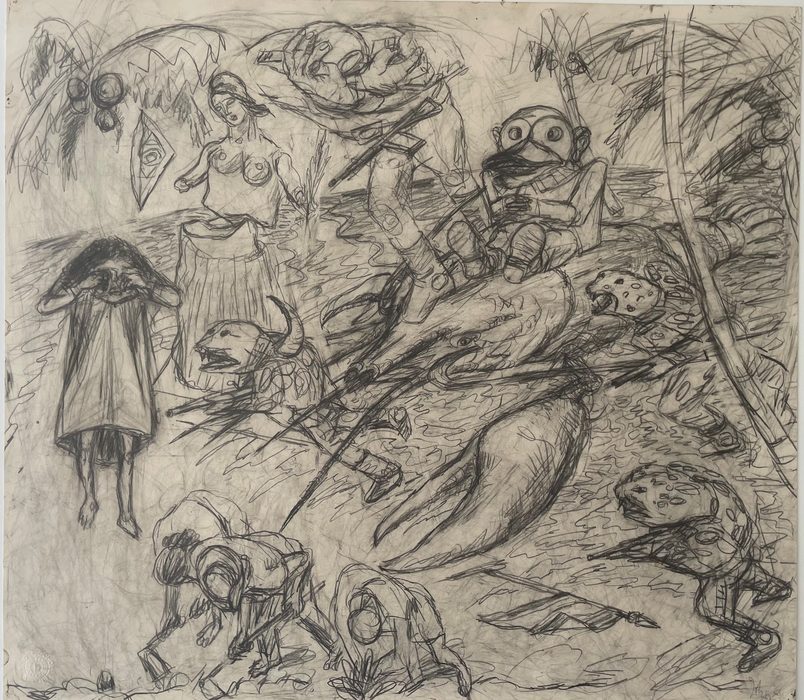
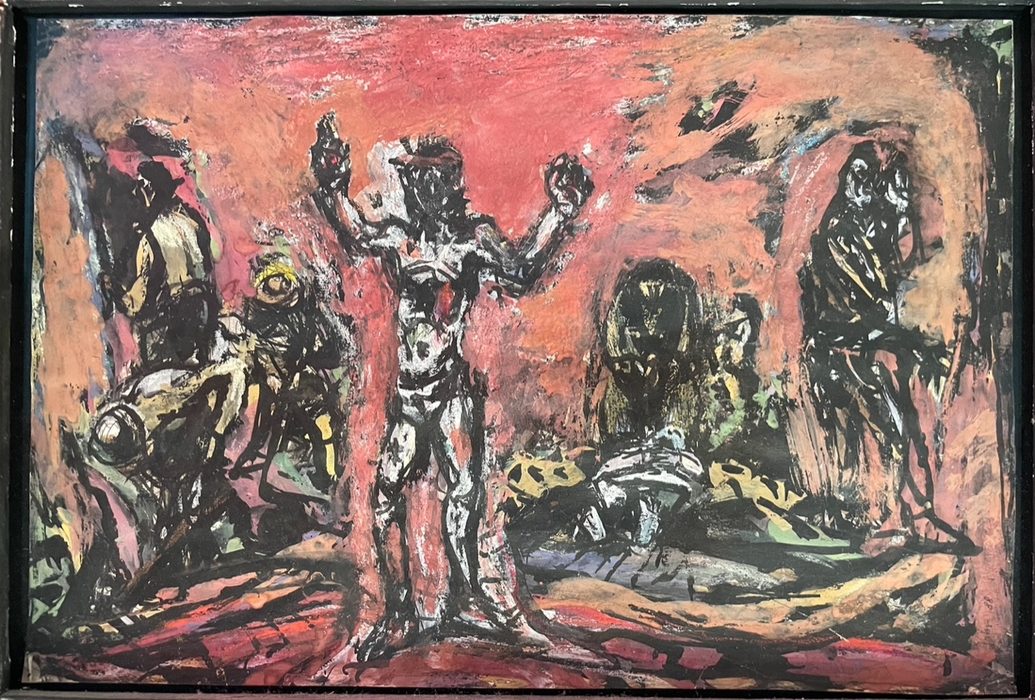
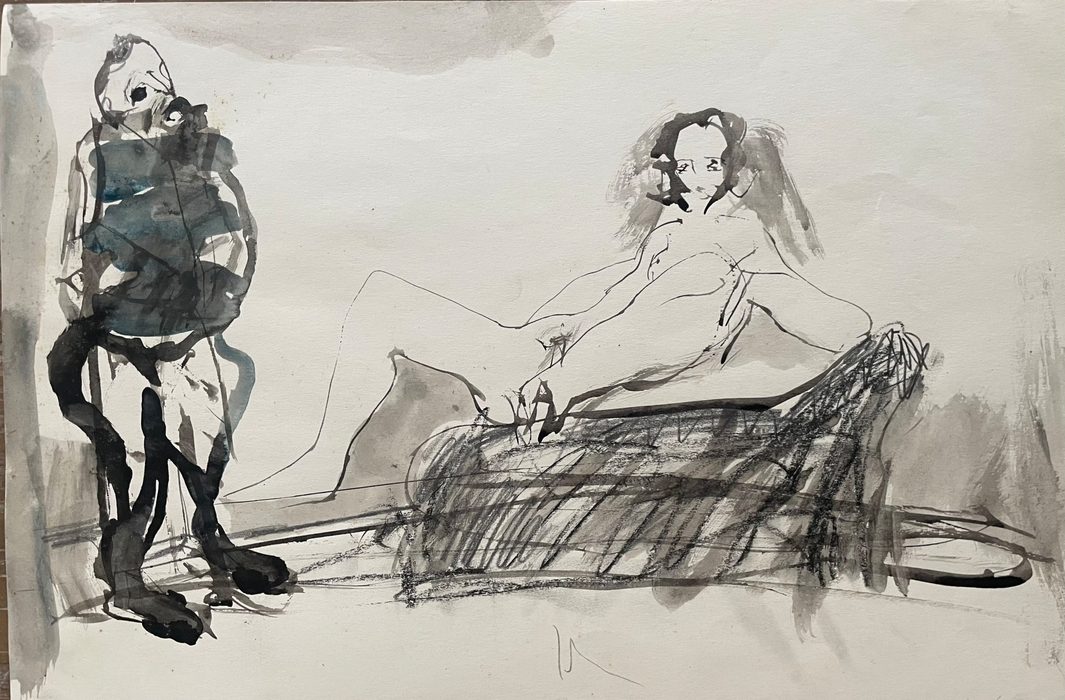
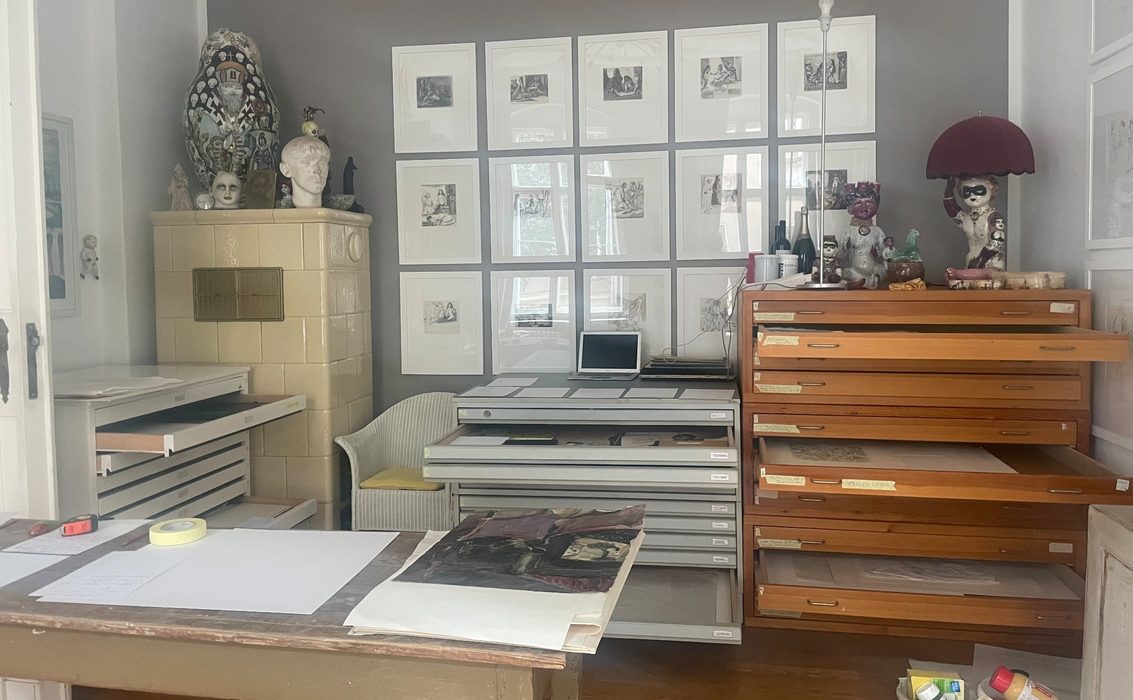
Joachim John Archive, partial view © the artist
And on Saturday 12 September 2026, to mark the 30th anniversary of the Hinrich Kröger-John Gallery & Atelier, the OPENING of the JOACHIM JOHN Archive and Museum in the gallery’s private rooms takes place, featuring an exhibition of his works, including drawings on the French Revolution, Latin America, Franz Kafka, Woyzeck, etc.
www.galerie-hinrich-kroeger.de
www.instagram.com/hinrichkroegerjohn
DEEDS interviews are not edited or abridged by our editorial team and are always reproduced verbatim. We therefore do not provide translations of the interviews into English or German, unless these are submitted by the interviewee(s) or we are commissioned to carry out the translation. In this case, the German and English versions of the interview were submitted by the artist.