

It is one of the peculiarities of art history that the quality of an artist’s work alone does not determine whether they will be remembered or eventually fade from public consciousness. In Berlin during the 1960s, Senta Minzlaff (1909–1999) developed an expressive visual language that anticipated the later Neo-Expressionist movement known as the Neue Wilde. She was a painter whose works were created with a remarkable sense of artistic freedom. It was a freedom she claimed for herself while working as a dentist and raising two daughters. Despite her success in exhibitions, her work gradually faded from public view until a chance discovery in 2019 brought renewed attention to the artist. From 23 October 2026, Galerie Creative Game in Berlin-Lichterfelde will dedicate an exhibition to her work. Her story is that of a woman who only found the freedom to pursue art later in life, raising a broader question: who ultimately decides which artists are remembered?
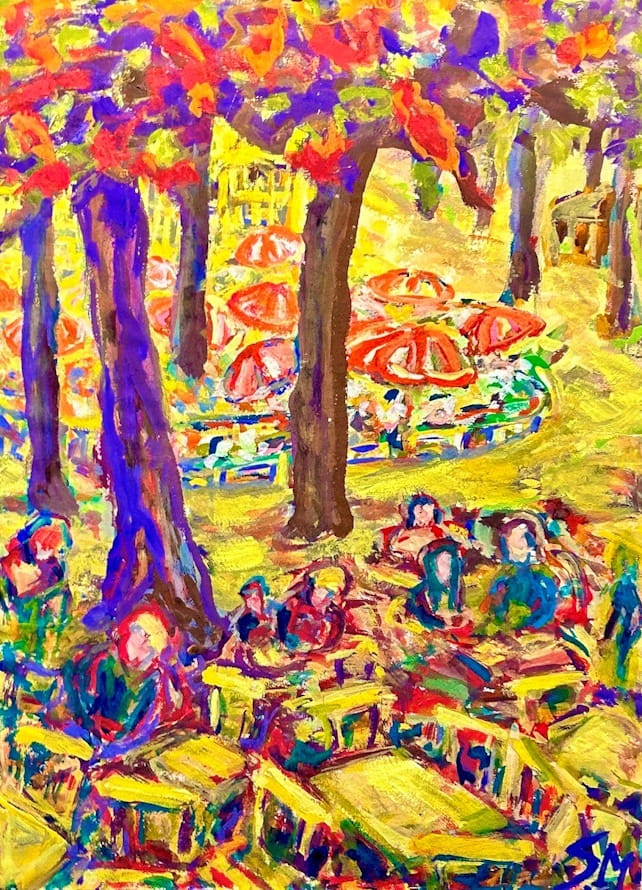
Image above: Senta Minzlaff, Garden Party, gouache on paper, photo: Alexander Rosenbusch
Art history can be rather selective in what it chooses to remember. While some artists are assured a place in posterity during their own lifetimes, others fade into obscurity almost without a trace, even though their work might well have deserved far greater attention. Senta Minzlaff appears to be one of the artists who fell victim to this peculiar mechanism. Yet the Berlin-based painter was by no means unknown. She exhibited her work for decades, belonged to associations of women artists and was even represented in an exhibition at the Martin-Gropius-Bau in 1992. Nevertheless, following her death in 1999, silence gradually settled over an oeuvre whose painterly spontaneity seems all the more remarkable today.
It was only a chance discovery that prompted renewed interest in the artist. When Berlin-based art collector Dr Wolfgang Etterich came across a substantial part of her oeuvre on the estate art market in 2019, he embarked on a process of investigation that gradually brought the story of an extraordinary artistic life to light. Works were documented and biographical connections pieced together. Galerie Creative Game now presents a selection of her paintings, raising a question that extends far beyond Senta Minzlaff’s individual fate: How many distinctive artistic voices have disappeared from our view simply because they were never granted the sustained attention of the art world?
A Dentist Discovers Her Freedom
Senta Edith Emma Margarete Runkel was born in Berlin-Tegel in 1909. Unlike her older sister Gerda, who studied medicine, she chose dentistry and, while studying in Heidelberg and Berlin, met her future husband Friedrich Minzlaff, whom she married in 1938. The couple had two daughters. When her husband was seriously wounded while serving as a military doctor during the Second World War, she initially had to run their dental practice in Berlin-Steglitz on her own after the war. Her parents also lived nearby and depended on her care.
Under these circumstances, art initially occupied the place that bourgeois society traditionally reserved for it in the life of a married woman with children. Minzlaff had been drawing since the 1930s, but for many years she lacked the time to develop her talent systematically. It was not until 1958, when her daughters were becoming increasingly independent and her husband had fully resumed his work at the practice, that she decided to pursue her artistic education more seriously. At the Berlin University of the Arts, she attended Bernhard Wilhelm Borchert’s class for exceptionally gifted students from non-artistic professions.
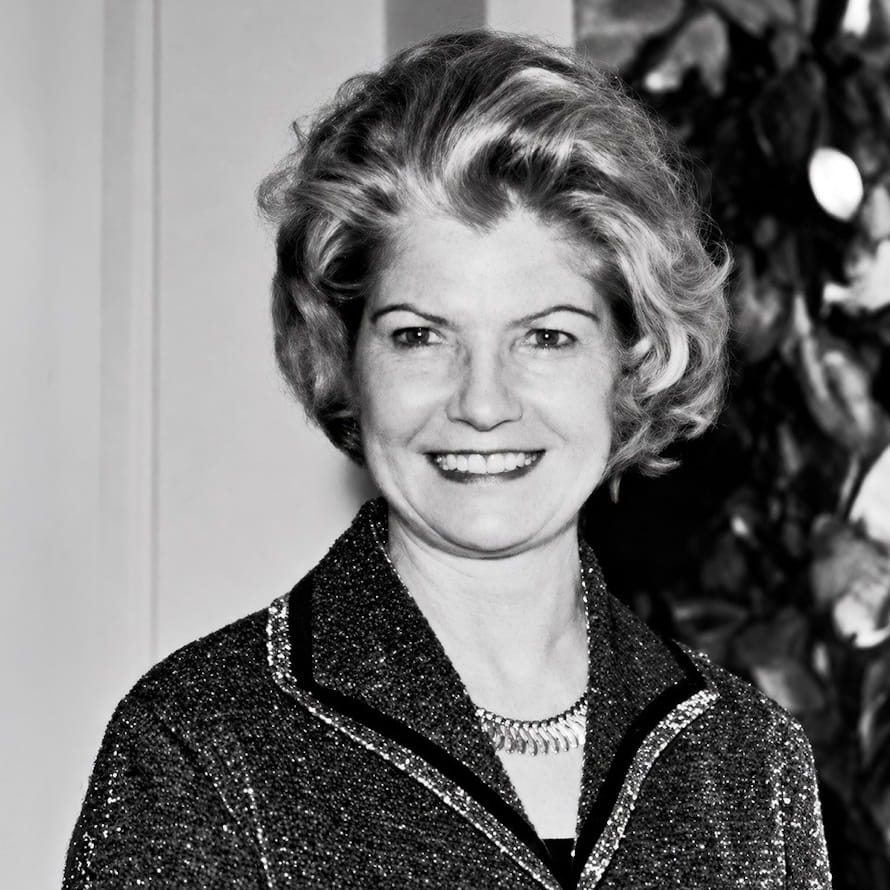
She was forty-nine years old at the time, an age at which some artists can already look back on a substantial body of work. For Minzlaff, however, the most productive phase of her artistic career was only just beginning. One might imagine that she was determined to make up for all those years in which she had been forced to set aside her artistic ambitions. Whatever the case, her paintings reveal little of the hesitancy one might expect from someone who came to art so late in life.
Reality, It Seems, Was Not Colourful Enough for Her
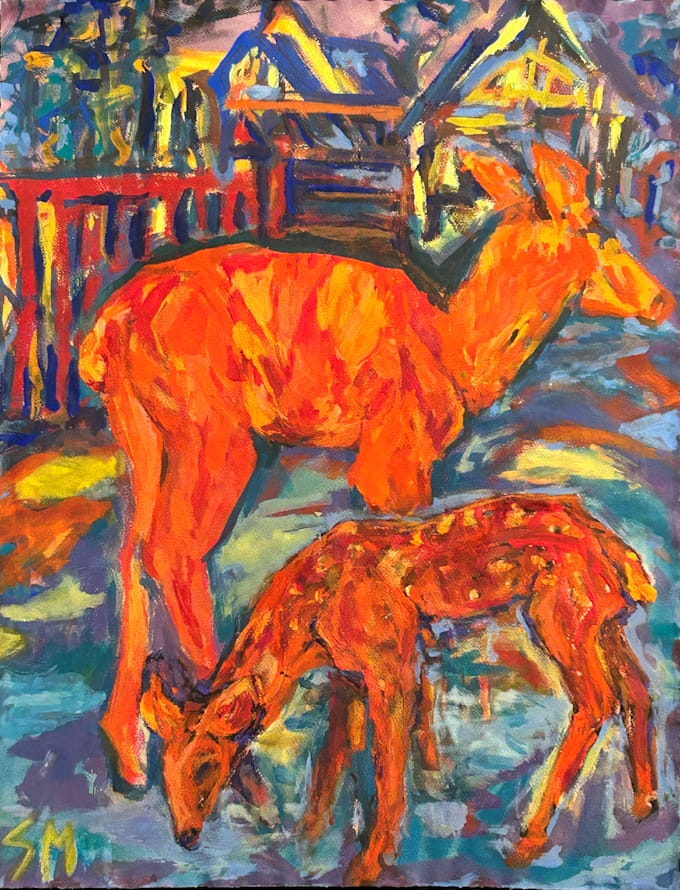
Minzlaff’s paintings reveal an almost extravagant delight in colour. Whatever caught her eye, she transformed into a pictorial world in which objects shed their familiar appearance and even everyday scenes take on a peculiar vitality. Colours assert themselves independently of their natural counterparts, while forms seem to move under the force of her energetic brushstrokes.
In Stuhl, Ausschnitt aus Gartenlokal (Chair, Detail from a Garden Restaurant), for example, a simple garden chair becomes the centre of a veritable riot of colour. Its luminous yellow and orange stand out against a restless background of deep blue and vigorous brushstrokes. The chair hardly seems like an object one would want to sit on; instead, it appears almost ready to get up and make its own escape.
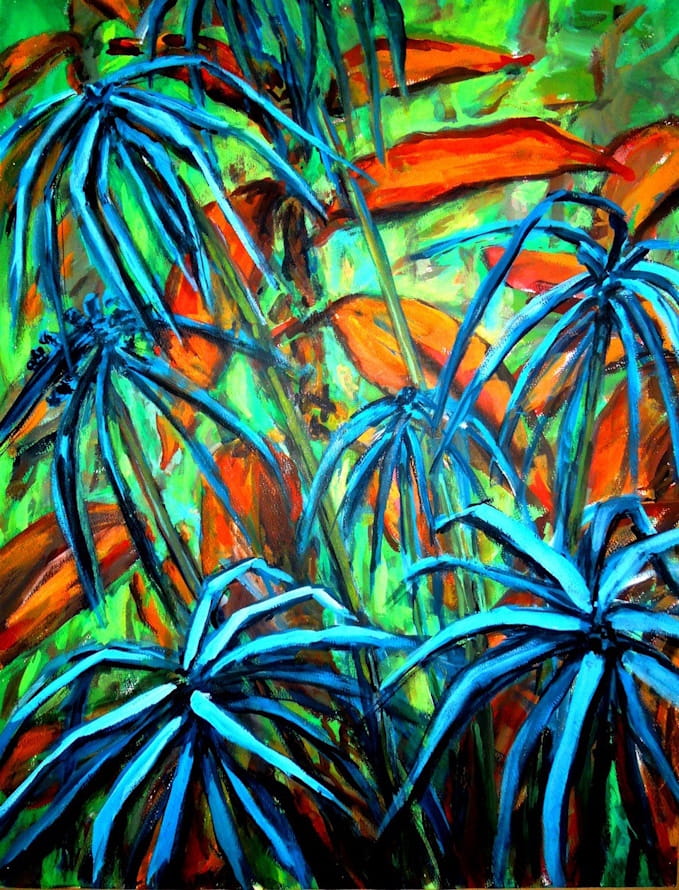
In Gartengesellschaft (Garden Party), the painting featured here as the article’s lead image, nature likewise shows little inclination to submit to the conventional rules of perspective. People and trees merge into a network of vibrant colours that captures the summer atmosphere of a social gathering in a manner as lively as it is idiosyncratic. In Nilgras (Nile Grass), meanwhile, exotic-looking plants unfold in rich shades of blue and green, their leaves developing an almost ornamental sense of movement.
Minzlaff drew inspiration from her immediate surroundings and from journeys that took her to Egypt and Mexico, among other places. Berlin Zoo and the Botanical Garden provided her with a wealth of visual material. Yet what she discovered there rarely found its way directly onto paper. Between observation and the finished painting lay the artistic freedom from which her work derives its distinctive power.
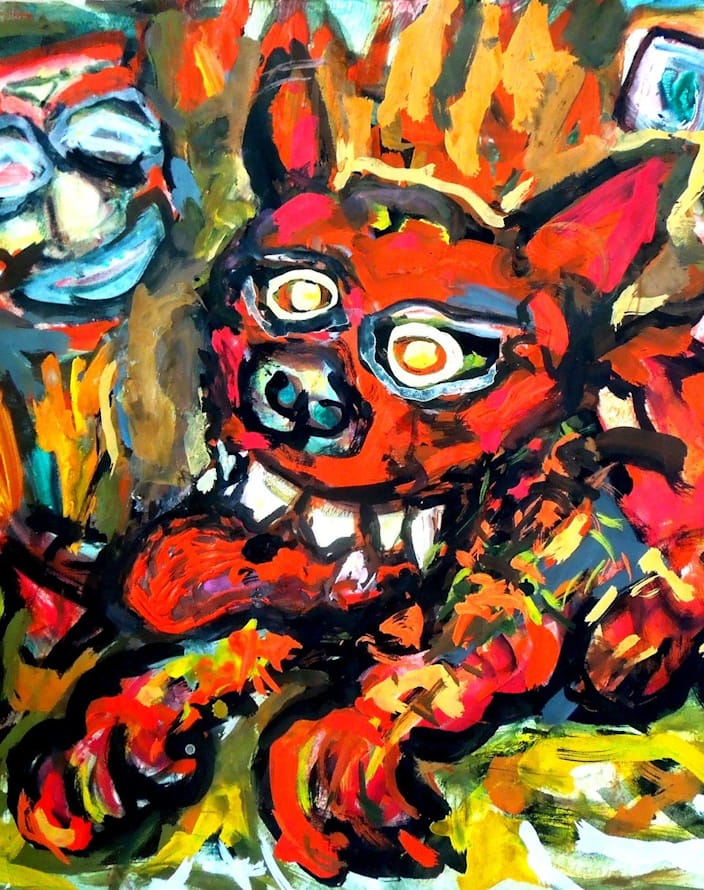
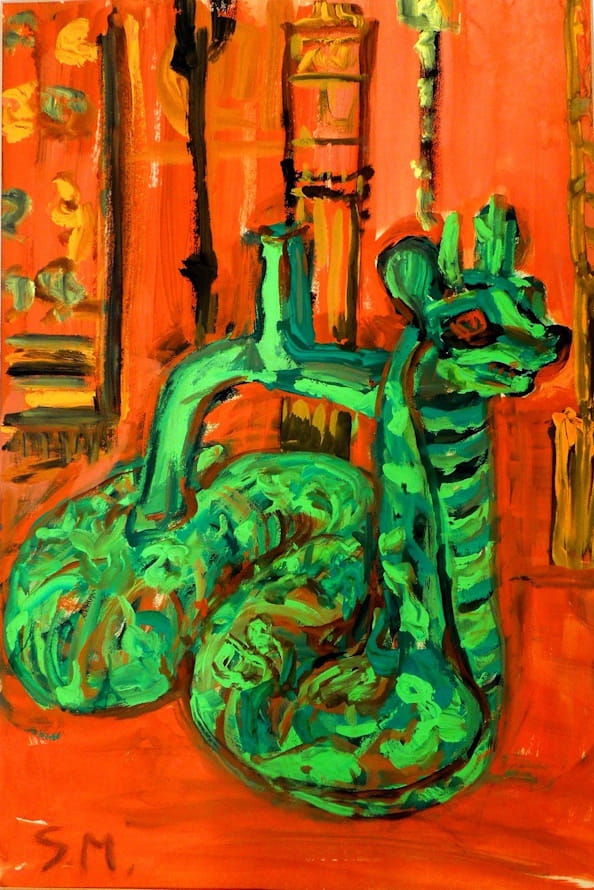
At times, this freedom could give rise to rather unsettling creatures. In Katzengott (Cat God), we encounter a figure with wide, staring eyes and conspicuous teeth, its appearance as grotesque as it is comical. Betrachtende (The Observer) depicts a face that seems to dissolve into vivid expanses of violet and pink. In Dämonikon (Demonicon), grimacing creatures crowd together, their expressions shifting between menace and exuberant fantasy.
Here we encounter an artist whose delight in painterly transformation seems to know virtually no bounds. She discovers the extraordinary in the ordinary, lending even her most sinister creations an almost playful presence.
An “Old Wild One” Before the Neue Wilde?
Galerie Creative Game describes Senta Minzlaff as a Berlin Neo-Expressionist of the 1960s, regarding her paintings as a precursor to the expressive art that would attract international attention some two decades later with the emergence of the Neue Wilde.
Indeed, her richly coloured compositions recall the work of artists who developed a new form of expressive figuration in West Berlin during the late 1970s and early 1980s. In a biographical article published in 2024, Wolfgang Etterich accordingly refers to Minzlaff as an “Alte Wilde” (“Old Wild One”), suggesting that she could be seen as a forerunner of the later Neue Wilde.
The comparison is intriguing, particularly since Minzlaff’s principal body of work dates from the 1960s and early 1970s. Yet whether she can genuinely be regarded as an art-historical precursor to this movement requires further investigation. Formal similarities alone do not establish artistic influence. Perhaps her true significance lies less in having anticipated a movement that would later achieve fame than in the independence with which she pursued her own artistic path.
A House Where Imagination Reigned
A remarkable episode from Minzlaff’s biography reveals that her artistic individuality extended well beyond the studio. According to research by Wolfgang Etterich, published in December 2024 in the Magazin für die Berliner Zahnärzteschaft (Magazine for Berlin Dentists), the family purchased a late nineteenth-century villa on Kantstraße in Berlin-Steglitz in 1960. Over the years, the artist reportedly transformed the house into an extraordinary pictorial world that went far beyond conventional domestic decoration.
Etterich describes large-scale murals that shaped the interior and recounts approximately a dozen elaborately staged parties, for which guests arrived in costumes appropriate to the occasion. These gatherings are said to have continued until around 1990, sometimes taking place during Carnival or on St Nicholas’ Day. In this context, the collector speaks of a Gesamtkunstwerk, or total work of art, incorporating performative elements.
The image is as unusual as it is revealing: a woman who had spent decades practising a demanding medical profession apparently transformed her private home into a place where imagination could have the final say beyond the canvas. The fact that Minzlaff’s art also shaped her social life adds a remarkable dimension to her biography. It seems that the painter ultimately sought to bring the freedom she had discovered in her paintings into her immediate surroundings as well.
Who Is Remembered, Who Is Forgotten?
During her lifetime, Senta Minzlaff was very much a presence in Berlin’s art scene. She joined the Verein der Berliner Künstlerinnen (Association of Berlin Women Artists) in 1965 and later became a member of GEDOK Berlin. As early as 1966, the Kunstkabinett at the Schillertheater presented a solo exhibition featuring 87 of her works. According to Galerie Creative Game, she was also represented in the 1992 anniversary exhibition Profession ohne Tradition. 125 Jahre Verein der Berliner Künstlerinnen (A Profession Without Tradition: 125 Years of the Association of Berlin Women Artists) at the Martin-Gropius-Bau.
Nevertheless, her work apparently failed to secure a lasting place in the awareness of a wider art-loving public. Yet art history is by no means short of women artists whose distinctive achievements received the recognition they deserved only long after their deaths. For women such as Minzlaff, who had to balance their artistic pursuits with professional and family responsibilities, the conditions for sustaining an artistic career were often particularly unfavourable.
Senta Minzlaff was almost entirely forgotten for decades. In 2021, however, the GEDOK Berlin gallery presented a solo exhibition of her work. The current presentation is therefore part of a rediscovery already underway, although it remains to be seen where this renewed interest will lead.
The fact that a substantial body of artistic work first had to surface on the estate art market before it could once again be systematically documented and researched nevertheless speaks volumes about the fragility of artistic memory. After all, art history is not written solely by those who create art. It is also shaped by the attention of those who preserve works and return to them with fresh eyes years later.
Senta Minzlaff’s Second Career
The exhibition at Galerie Creative Game, curated by Wolfgang Etterich and Alexander Rosenbusch, now offers an opportunity to rediscover Senta Minzlaff. Whether it will lead to a lasting reassessment of her place in art history remains to be seen.
One thing, however, becomes clear when looking at her paintings: here was an artist who claimed a freedom in her art that life had long allowed her only in limited measure. Her colours still radiate with astonishing immediacy, while some of her fantastical creatures seem almost to poke fun at the solemnity with which art history maintains its hierarchies.
One can only hope that Senta Minzlaff’s paintings will be seen more frequently in the future. For art history loses nothing by broadening its perspective. Quite the contrary: it may discover that some of its most intriguing stories have yet to be properly told.
Text: Stephanie Schneider, M.A.
WHEN?
Vernissage: Friday, 23. October 2026, 7 pm
Exhibition dates: Friday, 23. Oktober to Sunday, 8. November 2026
Opening hours: daily except Mondays, 2-6 pm, and by arrangement
WHERE?
Galerie Creative Game
Jägerstraße 12A
12209 Berlin-Lichterfelde