
From 22 September 2026, CSR.ART presents MEIN BERLIN, an exhibition of works by Berlin painter Jonas Hödicke (b. 1984). The exhibition follows his view of the city where he was born and raised, and which has been a recurring subject in his painting for many years. The opening will take place on Thursday, 1 October 2026, from 6 to 9 pm, with an artist talk at 7 pm.
The exhibition is presented in collaboration with Galerie Mond in Charlottenburg. Until 3 October 2026, the gallery is also showing Hödicke’s wire and steel sculptures, alongside paintings and drawings exploring the same subject matter.
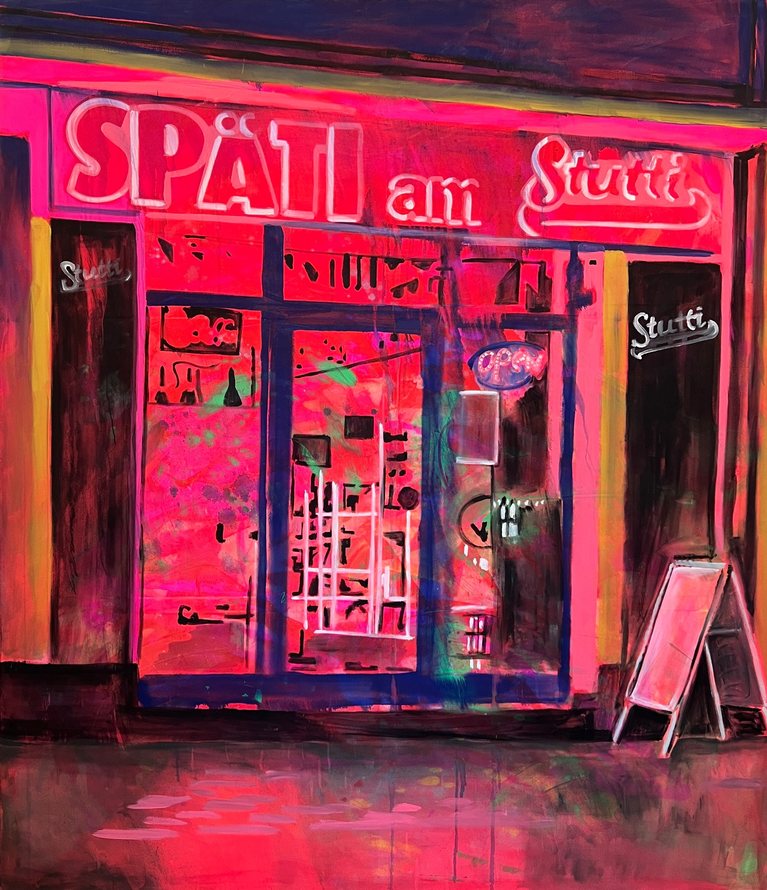
Image above: Jonas Hödicke, Späti am Stutti, 2015, Acrylic on Canvas, 250 x 200 cm
Berlin on Four Wheels
Anyone who asks Jonas Hödicke which symbol best represents Berlin to him gets a clear answer: the shopping trolley. Of all things. Other cities flaunt their cathedrals and triumphal arches – Hödicke is content with a wire basket on four wheels. And yet his explanation is rather convincing. The shopping trolley unites Berliners. From the homeless to the millionaire, everyone eventually takes hold of the same handle. And sooner or later, the thing ends up abandoned on a street corner, as if the city itself had left it there. Anyone who lives in Berlin knows the sight.
And just like that, we are right in the middle of Hödicke’s painting. This is a man with a weakness for things no one considers remarkable until they have been painted. Berlin makes his job easier, because the city produces images incessantly and cares little whether they are beautiful. Hödicke moves through the jumble of a city he knows like the back of his hand, phone at the ready. Whatever catches his eye, he photographs. If the motif still refuses to let him go later on, it may become a painting. Between the brief click on the street and the canvas lies that curious process for which we have the beautiful word painting. Reality is allowed in and emerges transformed. And when we stand before the finished work and look at it, it may, in turn, change the way we see things.
The Späti and the Lost School Hour
Take the painting Späti am Stutti, for example. The late-night shop glows red and pink into the street, as though night itself had been invented to give this light something to do. For Hödicke, Spätis were meeting places for years. This was where he got together with his friends, sometimes at hours when the school timetable had prescribed a different place for him to be. Skipping school passes. The Späti remains. And decades later, it hangs on the wall as a painting.
It is one of life’s more charming injustices: what was once held against the schoolboy as time wasted can later become a motif for the painter. Yet the artist’s personal history alone does not sustain the picture. What matters too is the shared experience and collective memory contained within the city’s microcosm. Anyone who has lived in Berlin for a long time has places like these, bound up with personal experiences and memories. They bear no commemorative plaques and appear in no guidebook. Yet they belong to the city’s inner map. You know the Späti. Yours simply has a different name. And this is where the “My” in the exhibition title begins to change hands.
New Year’s Eve, Berlin Style
Then come the fireworks. In Ecke Palas, light and colour shoot into the sky between buildings and cars. For a moment, the street seems to lose its solid form; the paint on the canvas splashes and explodes along with it. For the young Jonas Hödicke, New Year’s Eve in Berlin meant absolute freedom. Looking back, he asks: where else is the individual still allowed, with such matter-of-fact ease, to carry their own fireworks out into the street and set them off? Berlin is known for defending certain freedoms with a passion that occasionally sends innocent bystanders running for cover. On New Year’s Eve, the result is a Gesamtkunstwerk with explosives.
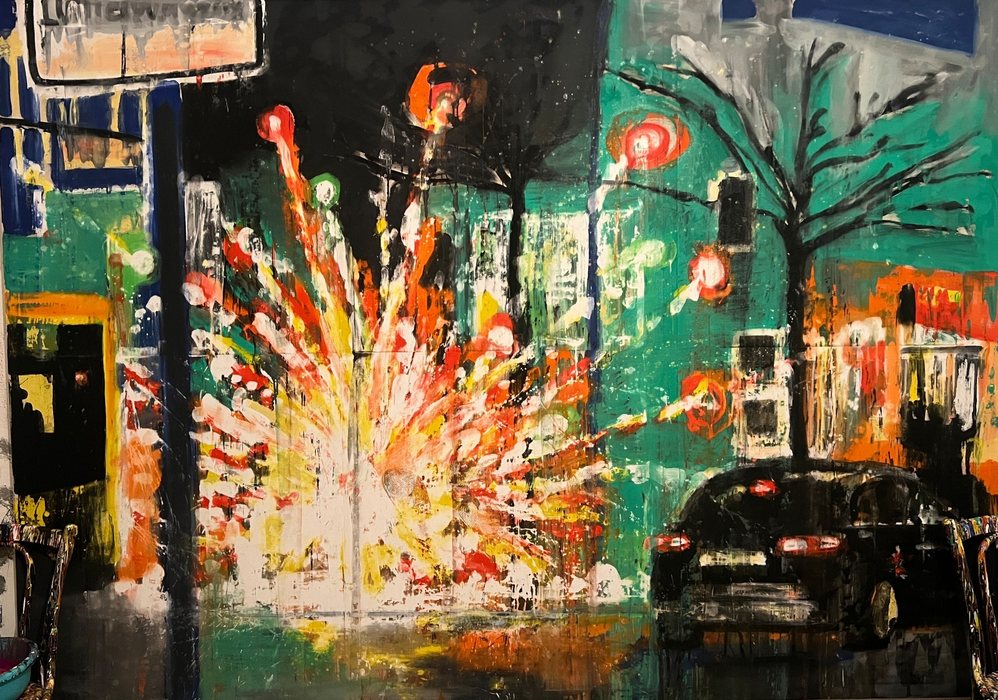
Hödicke’s firework motifs portray what unfolds in Berlin’s urban canyons on New Year’s Eve less as a joyful welcome to the new year than as the street battle it has increasingly come to resemble. This also accounts for the peculiar tension in these paintings. You are never quite sure whether to delight in the light or duck for cover. Beauty and menace have become entangled. And that is precisely why the motif works so well. The freedom Hödicke sees in it comes with no guarantee of comfort. It goes off with a bang.
Mein Berlin – my Berlin
The title of this exhibition is far less innocent than its two words might suggest. MEIN BERLIN. Who does a city belong to? To the person who was born here? To someone who has lived in the same flat for forty years? To the newcomer who stepped off the train at Hauptbahnhof yesterday and is already explaining today where to find the one true cup of coffee? Berlin has always answered such questions generously: it lets everyone claim the city as their own, while all the while continuing to belong to itself.
Who does the city belong to? Berlin has always answered such questions generously: it lets everyone claim the city as their own, while all the while continuing to belong to itself.
Hödicke’s “My” means something different. It grows out of experiences, routes through the city, encounters, chance events, memories, and that hard-to-explain knowledge of what a city looks like once you have lived in it long enough. That is why his motifs have no need for grand landmarks. The Fernsehturm may mark Alexanderplatz as Berlin, but an abandoned shopping trolley can tell you more about the city.
The Painter as Image Catcher
Painting from photographs is fundamental to Jonas Hödicke’s work. He does not set out with a preconceived idea of what Berlin ought to be or what he intends to capture on canvas. The city supplies the images. The painter responds. Something striking emerges from the constant stream of images: a shopping trolley, a playground horse, a particular neon light at night, a street in the very second the sky above it explodes. Hödicke photographs both the motif and the moment. Back in the studio, the second encounter begins. The photograph records what was there. Painting determines what will remain of it.
Hödicke takes liberties along the way: paint is allowed to run, contours lose their composure, objects are drawn into the momentum of the painting, and the artist’s shoeprints become his signature. His pictures refer almost physically to their origins in the visible world while insisting, at the same time, on being paintings. Hödicke captures in his work the aura of a city that never sleeps and is constantly in motion. Speaking about his work in THE INTERVIEW IN|DEEDS, Hödicke says: “My art seeks movement – in the city, in people, in the moment. Standing still was never my thing.” Berlin is likely to be one of the more fertile places for such an undertaking.
The Father and the City
It would be possible to write about Jonas Hödicke and Berlin without mentioning Karl Horst Hödicke. It would not be particularly wise. His father painted this city for decades and belongs to the generation of artists who gave post-war West Berlin a distinctive painterly language. For the son, this history forms part of his own biography. Asked in the DEEDS interview who had influenced him most as an artist, Jonas Hödicke replied simply: “My father.”
In 2024, paintings by Karl Horst Hödicke and Jonas Hödicke were shown side by side at Galerie Noack in Berlin in the joint exhibition Meine Stadt, presenting their respective views of Berlin. But cities are inherited differently from houses. The father saw a different Berlin from the son. Karl Horst Hödicke experienced the division of the city, the Wall, its fall and the profound changes that followed. Jonas Hödicke’s memories belong to a later generation. His Berlin has Spätis and shopping trolleys. That sounds more banal than it is, because every generation recognises a city by different signs. Eventually, inconspicuous things can tell us more accurately about an era than grand monuments.
A Small Shift in Perspective
Until just a few days ago, Jonas Hödicke’s large-scale flower paintings were still in bloom at CSR.ART. FLOWER POWER allowed colour to spread across the canvases. Now Berlin comes in. Or rather, the Berlin that has been standing outside the door all along enters the exhibition space.
You do not need to have studied the city’s history to understand MEIN BERLIN. It is enough to have stood outside a Späti at night, to know how a Berlin street looks and smells on New Year’s morning, to be familiar with graffiti-covered entrances and overflowing rubbish bins, and to have encountered a shopping trolley whose journey defies any reasonable attempt at reconstruction.
Jonas Hödicke paints his city out of such encounters. The personal element is obvious. What is surprising is how quickly you find yourself in them. You stand before Hödicke’s Späti motif and remember your own. You recall the graffiti you see as you step out of your building onto the street. You look at his fireworks and hear the explosions of New Year’s Eves past. You push your shopping trolley through the supermarket and know exactly the street corner where one was standing yesterday. In this way, for the duration of a painting, MEIN BERLIN becomes something shared. The painter saw it. Apparently, we were there too. Jonas Hödicke captured the moment for us. And that Berlin feeling
Jonas Hödicke was born in Berlin in 1984. From 2007 to 2014, he studied sculpture at the Kunstakademie Düsseldorf under Markus Lüpertz and Siegfried Anzinger. His work spans painting, sculpture and drawing. Hödicke lives and works in Berlin and Ireland.
WHEN?
Vernissage: Thursday, 1. October 2026, 6 – 9 pm, qith Artist Talk at 7 pm
Exhibition dates: Tuesday, 22. September until Saturday, 17. October 2026
open Tuesday – Saturday 10:00 am – 7:00 pm
WHERE?
CSR.ART
Budapester Straße 35-50
ground floor, to the left of the entrance towards Zoo Palast cinema
10787 Berlin