

PROLOGUE | PERSONAL
Margarete, imagine you would welcome us in your studio or home. Where do we talk together, where do we meet you?
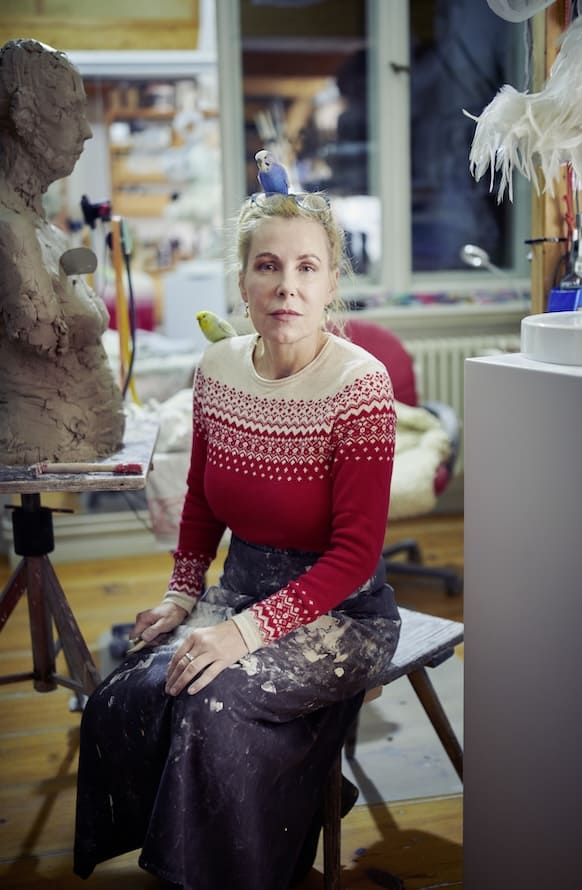
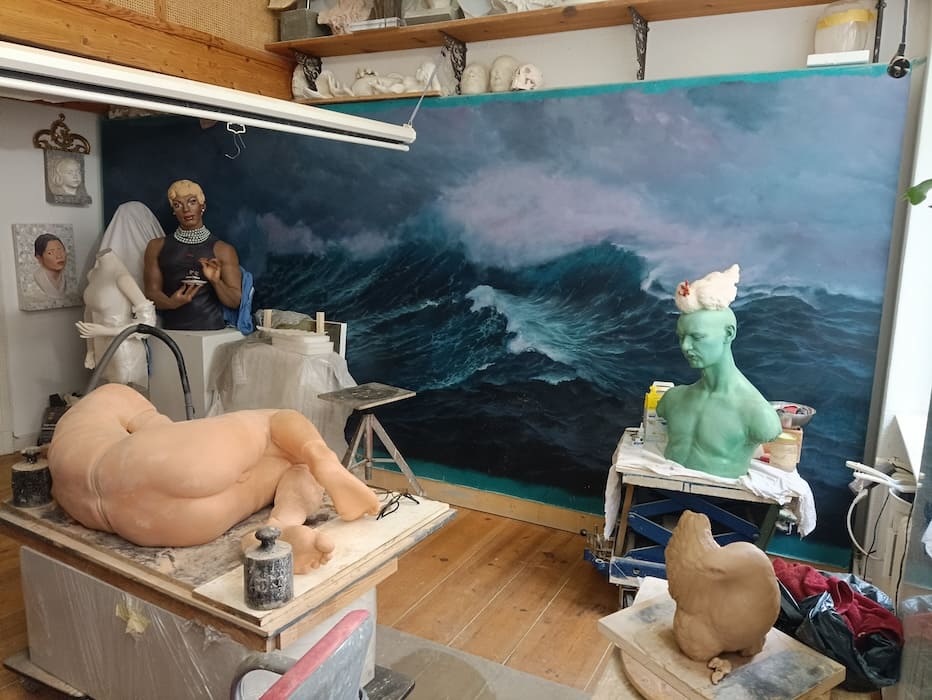
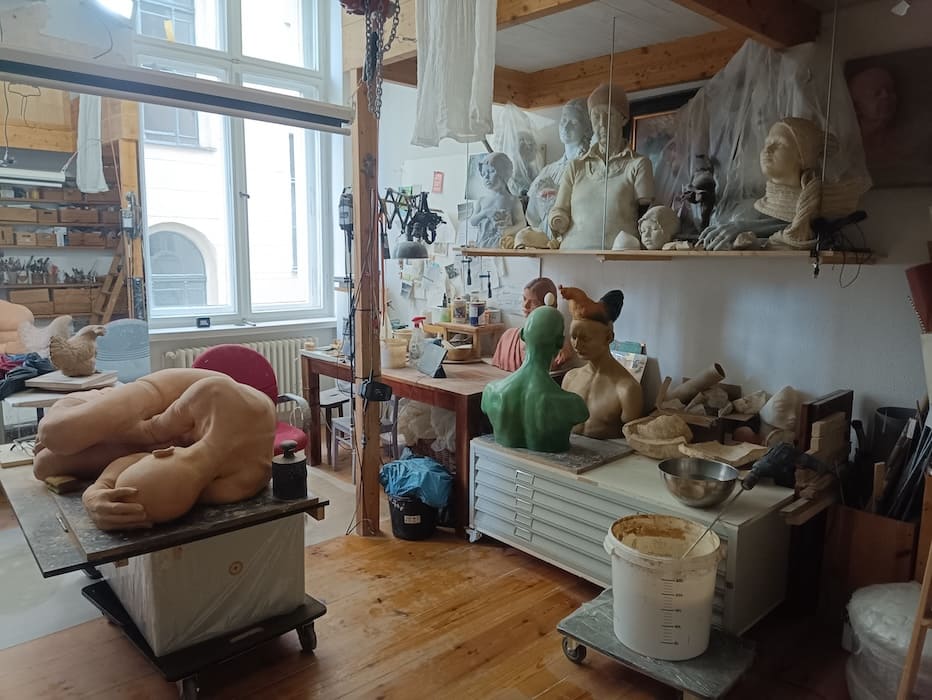
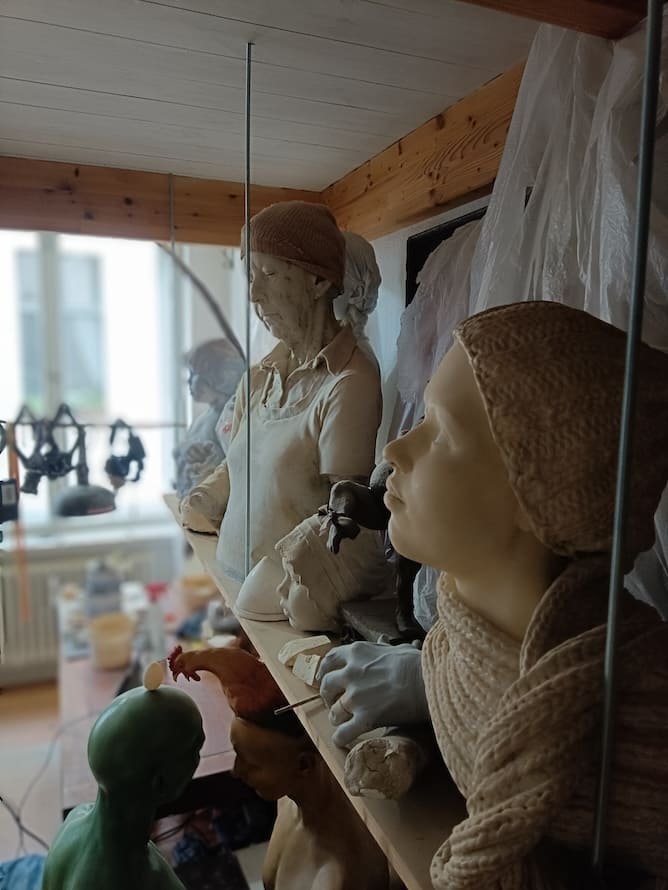
My studio is part of my apartment in Berlin Mitte, where I have lived for over 25 years. With a ceiling height of 4.60 metres, I have built a second level inside it where my computer workstation is also located. From here I look out onto the garden and the backyard. It looks like work, but organised — I dislike chaos in my surroundings.
Image above: Portrait Margarete Adler | © Studio Margarete
Perhaps we are sitting in your favourite place?
My balcony looks out onto greenery, but when I have work-related visitors, I usually stay in the studio and keep working.
Which stages and people have been particularly formative in your life so far?
My children, because I have learned the most from them. Every decade of my life has been a station: childhood and youth in the GDR, the reunification, travels and studies, children and my own company, teaching, life as an artist.
Which writers do you find exciting at the moment and which books can be found on your bookshelf?
Leigh Bardugo with the Alex Stern series, Becky Chambers’ Wayfarers, Joshua Tree, D. Preston & L. Child, C.K. McDonald’s Stranger Times, Anne Perry, Jane Austen…
My shelves also hold many reference books and art catalogues, as I need them for my work.
Which books have influenced or shaped you?
The adventure books of my childhood. Chingiz Aitmatov in my youth.
What are you currently reading, and where do you keep the book within reach?
The Watchmaker of Filigree Street / The Lost Future of Pepperharrow by Natasha Pulley is on my bedside table.
What music do you listen to and when?
Soundtracks when driving. While working I listen to audiobooks.
If you were to cook something for us, what would it be?
I very much dislike cooking, but when forced to, I have a recipe book for the best housewife of all. Take your pick.
What is your favourite food?
Potatoes.
And what do you think about breakfast?
The most important meal — I celebrate it every day.
What kind of sport or balance to your artistic work do you pursue?
Yoga at home, for the preservation of substance.

Do you have any special passions (hobbies) that you are passionate about, and if so, which ones?
I am always working, and when not actively, then in my head. To relax I knit or repair things.
What personality trait particularly defines you?
I consider myself Prussian in discipline, very reliable, and also direct. My gallerist would lovingly add: “Margarete explains the world — quantum physics and everything in between included.“
Hast Du ein Anliegen, das Du mit uns teilen möchtest? Oder eine Antwort auf eine (nicht von uns gestellte) Frage, die Dich aktuell bewegt?
Dear fellow human beings: seek what connects you — and the glass is always half full! Dear fellow artists: take your audience seriously, they are not blind. “Is it art or can it go?” should not be anyone’s motto.
INTERVIEW | ARTIST + POSITION
Margarete, you were born in Greifswald in 1967. From 1992 to 1998, you studied Fine Art at the Dresden Academy of Fine Arts, graduating with a diploma in painting and graphic art. Study visits to India, Nepal and New York helped shape your artistic development early on. You work primarily in a figurative style across the field of sculpture. Your works have been exhibited nationally and internationally and are held in private and institutional collections. In 2020, you were a finalist for the Yasha Young Sculpture Award at the Beautiful Bizarre Art Prize. Alongside your own artistic practice, you have also worked as a lecturer, including at the Braunschweig University of Art and at various design and media colleges. Is there anything important missing?
My work in film set design — since 1992 I have been working in parallel in film production, where I also work sculpturally and have acquired many craft skills.
How did you get into art? Why art?
I started drawing early, but when it came to choosing a profession, the focus was on independence and freedom. Art seemed to be the only niche for that.
What makes you happy at the moment?
I am about to finish several sculptures for my solo exhibition at AOA;87, which opens in June — pieces I have been working on for a year. I will genuinely be relieved when they are done. Spring in Berlin is the best time. Children, family, and friends always make me happy.
And what’s worrying you at the moment?
The erosion of democracy, and the curtailing of freedom of expression — including in the arts — I find deeply threatening.
Do you think art has a social responsibility? And what do you think it can achieve?
Yes, art can carry a social responsibility. Can — not must. Throughout history, in the context of the dictatorships that shaped the 20th century, the impact of political art is well documented. On an individual level, art can evoke strong emotions — positive as well as negative. It is therefore up to the artist whether and how they take a position, provided the political environment allows for it. (Censorship.)
What defines your art? What is your work about – what are the central themes?
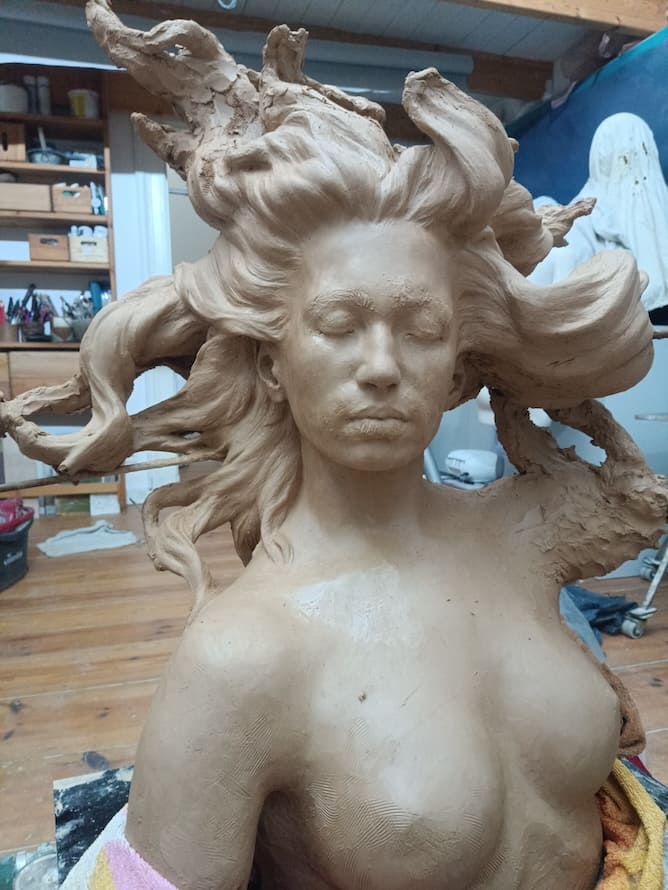
I model all my veristic sculptures by hand from life. The central themes are the individual within social structures (e.g. the series “Mother Love”) and, more broadly, people within societal and social constraints. My upcoming exhibition 104.5° at AOA;87 focuses in particular on holistic dependencies — the idea that systems and phenomena must be understood as interconnected wholes rather than reduced to their individual components.
INTERVIEW | CENTRAL WORK
THE DEED | DAS WERK: Margarete Adler

Please describe the central theme and key message of your artistic work.

My core themes are interpersonal relationships and conflicts. I want to portray universal truths, independent of time, era, or place. I am interested in timeless, recurring, fundamentally human stories that can be told — and understood by the viewer — detached from era, zeitgeist, nationality, continent, or even gender. The exterior of my sculptures is shaped by a beauty that lies in my eyes and need not be objective. It is the love of the artist for their model.

Tell us about the piece of work that best exemplifies the message of your body of work, or that you feel best embodies it.

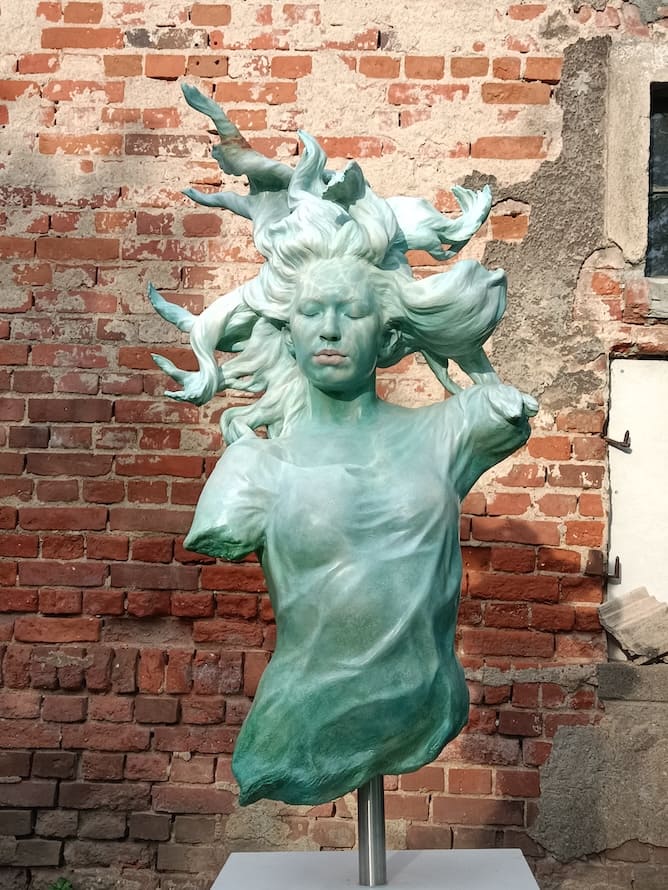
The sculpture "Medusa", which I will show for the first time in the exhibition 104.5° at AOA;87 in June, depicts a proud young woman, life-size, her long hair floating underwater, the waves reflecting on her calm face and closed eyelids. She is at one with herself and in her element. In ancient Greek, Medusa means to guard, to protect. As the mortal daughter of sea deities, she is raped by Poseidon, cursed with ugliness and a head of snakes by Athena, and killed by Perseus. Medusa's story speaks of power and powerlessness, perpetrators and victims, men and women, beauty and ugliness. Is it not interesting that an angry woman appears powerful and indomitable? That many people feel threatened by her? And that one woman takes revenge on another for something the latter bears no responsibility for? Medusa is not simply beautiful or profoundly ugly. She is neither victim nor perpetrator. She is powerful — and yet powerless.

What is the aim of your art, of your artistic work? What effect do you want it to have on the viewer?

In all my sculptures, alongside what is explicitly depicted, there are always further layers of meaning. The design, the title, or additional objects pose questions for the viewer and invite them to go deeper. I do not want to offer answers or ready-made statements — I want to trigger an emotional and intellectual dialogue within the viewer and bring forth depth.

--------------------------------------------------------------
Die Frage nach THE DEED | DAS WERK ist ein ergänzender und separat präsentierter Teil des THE INTERVIEW IN|DEEDS mit Margarete Adler
How do you protect yourself from being overwhelmed by inspiration these days?
There is no such thing as too much inspiration.
How much of your work is planned in advance – and how much comes about intuitively?
I plan 90%, because it is technically necessary. Sculptures cannot simply be painted over afterwards. I react while working — in the execution of details or when things go wrong — and then plan again.
What are your (next) goals?
After the exhibition I am looking forward to an entirely new portrait series using new materials. Since I always seek out a technical and artistic challenge and try something new, I am full of anticipation.
What are your views on faith? Do you have any core beliefs, or is there a motto that guides you?
I am openly non-religious. The motto sounds like a cheap calendar quote, but I believe it: the universe has no limit for happiness — make the most of your day.
What project would you like to carry out if time, courage or financial resources were no obstacle?
I would love to cast life-size sculptures in bronze, especially for public spaces. That really excites me — oversize would be even better. I never suffer from lack of courage.
In your view, what are the hallmarks of good art?
Good art should have an emotional and/or intellectual effect on the viewer.
Are you born an artist? Or is studying art a must?
People are born creative. Then their creativity is educated out of them. The profession of artist, however, has only a small part to do with creativity — it is far more complex. An art degree is not mandatory. It prepares no one for the real challenges. If you are lucky, art school offers self-knowledge through continuous work, and some craft support from the institution.
How do you see the future of art in the age of AI?
The word “handmade” will gain a new value. AI is not the enemy of art — just a new tool, neutral for now. What makes the difference is how people use this tool and with what intention within the art world. I would not worry too much. First a lot of hype, then a lot of hot air about nothing — see NFT.
What’s your view on NFTs?
Pointless.
Who do you show your new work to first?
My gallerist and my children.
What does the first hour of your day look like?
Breakfast, planning the day, yoga.
In the age of the Internet of Things, are galleries still necessary? If so, why and for what purpose?
Galleries are the intermediaries between the artist and the public and collectors. Without an engaged gallery, selling art is even harder than it already is. A good gallery supports its artists and finances a great deal upfront — gallery spaces, art fairs, exhibition slots, media presence, press, studio visits, etc.
Social-Media – Segen oder Fluch?
Curse and blessing. The topic of visibility is much invoked, and Instagram in particular has become almost indispensable. A curse because it takes a lot of work to constantly present oneself. A blessing because it is easier to show what you are currently working on in conversation. Consistent, serious sales for a broader cross-section of artists, however, are rather rare — as far as I can judge.
EPILOGUE | CURRENT
Is there currently a solo exhibition of your work, or is one planned in the near future? When and where?
https://www.aoa-87.com/exhibition/1045/
My solo exhibition “104.5°” opens on 25 June 2026 at AOA;87 contemporary in Sophienstr. 5, 10178 Berlin-Mitte.
www.instagram.com/margarete.adler
DEEDS interviews are not edited or abridged by our editorial team and are always reproduced verbatim. We therefore do not provide translations of the interviews into English or German, unless these are submitted by the interviewee or we are specifically asked to provide a translation. In this case, the German and the English version of the interview was submitted by the artist.