


For the first time, all ten surviving portraits by the Netherlandish painter Jan van Eyck (documented as active from 1422 to 1441) will be brought together in a single exhibition. Entitled “Van Eyck: The Portraits”, the exhibition at the National Gallery in London will run from 21 November 2026 to 11 April 2027, presenting nine paintings and the artist’s only surviving drawing. The works come from major European collections and represent approximately half of the twenty or so surviving paintings attributed to van Eyck himself, one of the most important figures of the Northern Renaissance and a pioneer of modern painting.
Image above: Jan van Eyck, Portrait of a Man with a Blue Chaperon, c. 1428–1430, oil on wood, 19.1 × 13.2 cm (excluding later additions), Brukenthal National Museum, Sibiu, Romania © Brukenthal National Museum, Sibiu, Romania
The exhibition offers the first opportunity to see all of van Eyck’s surviving portraits together in one place and to compare his extraordinary techniques directly. At its heart is the emergence of a new understanding of portrait likeness, one that placed the individual and their distinctive features at the centre of artistic representation.
While portraits before van Eyck primarily served to convey social status or power, often idealising their subjects, the Netherlandish painter placed particular emphasis on capturing their actual appearance as accurately as possible. He recorded not only characteristic facial features but also fleeting details such as bloodshot eyes, emerging stubble or untidy hair. This precision and immediacy gave his portraits a degree of individuality rarely seen before.
An exceptional loan from Dresden
Among the exhibition’s most significant loans is the Portrait of an Elderly Man, created around 1438 and held in the Kupferstich-Kabinett of the Staatliche Kunstsammlungen Dresden. Executed in silverpoint and goldpoint on prepared paper, it is van Eyck’s only surviving drawing. A dense network of fine strokes models the sitter’s face, accompanied by exceptionally precise colour notations that provide insight into the artist’s working methods. The drawing is considered the only securely identified preparatory study for a Netherlandish painting of this period, as well as the earliest surviving material record of a formal portrait sitting.
In London, the drawing will be reunited for only the second time ever with the painting for which it served as a preparatory study: Portrait of an Elderly Man (A Scholar?), dated 1438 (?), from the Picture Gallery of the Kunsthistorisches Museum in Vienna.
Three further drawings complement the exhibition. Among them is Portrait of a Young Woman, created around 1435–1440 by Rogier van der Weyden and held in the British Museum, which was probably made in response to van Eyck’s work. Two additional drawings by artists from van Eyck’s circle or working within the tradition he established illustrate his influence on subsequent developments in portraiture. They also offer an opportunity to compare the draughtsmanship and technical approaches of different artists of the period.
The Arnolfini Portrait meets its Berlin counterpart
Another highlight is the first-ever joint presentation of the celebrated Arnolfini Portrait (1434) from the National Gallery’s collection and Portrait of a Man (Giovanni Arnolfini?) (c. 1435–1438) from the Gemäldegalerie of the Staatliche Museen zu Berlin. Both paintings depict the same man. That van Eyck portrayed an individual other than a ruler on two separate occasions was highly unusual at the time and suggests a particularly close relationship between the artist and his sitter. The Arnolfini Portrait is one of the National Gallery’s best-known works and has the most-viewed painting page on its website.
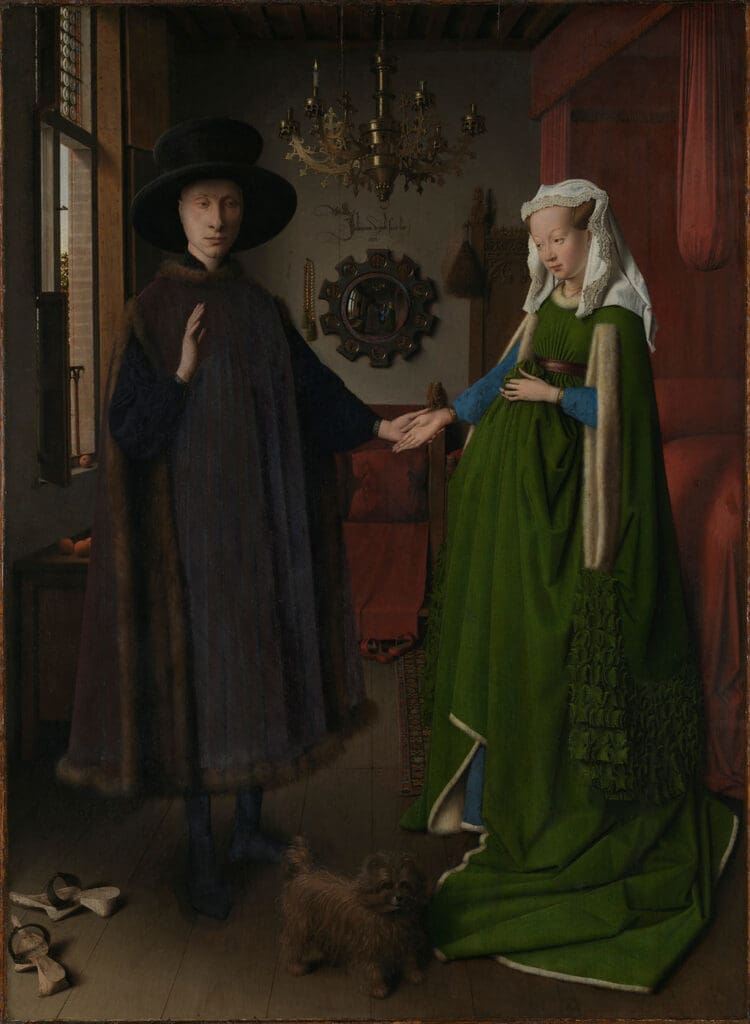
oil on wood, 82,2 × 60 cm © The National Gallery, London
Van Eyck’s recently conserved Portrait of a Man (Self Portrait?) (1433) from the National Gallery’s collection will also be presented in a new context. It will be displayed alongside the 1439 portrait of his wife Margaret, on loan from Musea Brugge.
The portrait of Margaret is considered the earliest dated portrait of an identifiable woman who was not a member of the aristocracy. It marks a significant shift in European portraiture: alongside rulers and members of the nobility, successful craftsmen, artists’ family members and friends increasingly became subjects of portraits. The genre thus gradually moved beyond its predominantly dynastic function.
Among those believed to have been friends of van Eyck was the goldsmith Jan de Leeuw, whose 1436 portrait from the Kunsthistorisches Museum in Vienna will also be on display in London. The sitter makes direct eye contact with the viewer – a technique in which van Eyck appears to have been a pioneer.
With the loans of Portrait of Jan de Leeuw and Portrait of an Elderly Man (A Scholar?), the Kunsthistorisches Museum in Vienna is, for the first time in its history, allowing both of its paintings by Jan van Eyck to be lent simultaneously.
Frames, Reverses and Illusionistic Effects
Van Eyck’s extraordinary technique extended far beyond the depiction of human faces. He also incorporated the frames and reverses of his panels into his painted compositions. With remarkable precision, he imitated precious metals and various types of stone, creating painted surfaces so convincing that they could be mistaken for the actual materials. These trompe-l’œil effects provide a deliberate contrast to the realism of his portraits. While the faces appear as true to life as possible, the painted materials create the illusion of physical properties they do not actually possess.

Musea Brugge – Groeningemuseum, Bruges (Inv. No. OOOOGRO 0162.I) © Musea Brugge. Photo: The National Gallery, London
The portraits were not originally intended solely to be hung on walls. As three-dimensional objects decorated on several sides, they could be held in the hand, examined at close range and discussed. The exhibition design reflects this aspect: for the first time, several portraits will be displayed in the round, allowing visitors to see their reverses, including the surviving painted marbling.
Signatures and the Self-Confidence of a Renaissance Artist
Another distinctive aspect of van Eyck’s work is his approach to authorship. While the vast majority of artists of the late medieval period remained anonymous, he signed his paintings almost systematically. Alongside his name, he frequently recorded the date of completion, sometimes even specifying the exact day. Some works also bear his personal motto, “Als ich kan”, which roughly translates as “As well as I can”. The inscriptions are executed to resemble lettering carved into stone or engraved into metal. In fact, they too are painted, extending van Eyck’s illusionistic imitation of different materials.
The precise meaning of these inscriptions often remains unclear to this day. Nevertheless, they reveal a pronounced sense of artistic self-confidence and reflect the changing social status of painters, who increasingly emerged from the anonymity of craftsmanship to become recognised figures during the Renaissance.
Court Painter, Diplomat and Internationally Acclaimed Artist
Little is known about Jan van Eyck’s origins and training. His activities at the Burgundian court, however, are well documented. In 1425, he was appointed court painter to Philip the Good (1396–1467). The Duke of Burgundy was among the most powerful European rulers of his time, enjoying a position that was virtually equivalent to that of a king.
Van Eyck remained in his service until his death in Bruges in 1441. Philip held the artist in exceptionally high regard, entrusting him not only with painting commissions but also with diplomatic missions and so-called “secret journeys”. In 1428–29, van Eyck was part of an embassy sent to Lisbon to negotiate the duke’s marriage to the Portuguese princess Isabella (1397–1473). On this occasion, he painted a portrait of the princess, which was sent to Flanders so that Philip could examine her likeness and give his approval to the marriage. The painting is now lost.
The close relationship between the duke and the painter is further demonstrated by the fact that Philip the Good became godfather to one of van Eyck’s children in 1434. Van Eyck enjoyed an international reputation during his lifetime. His paintings are documented in the collections of prominent European patrons and collectors throughout the 15th century and beyond.
New Research and the First English-Language Monograph on Van Eyck’s Portraits
Alongside the unprecedented gathering of the works, the exhibition presents new art-historical and technical research. Particular attention is given to van Eyck’s painting techniques, the original frames of his works and their inscriptions. The exhibition also addresses ongoing debates concerning the identities of individual sitters.
The accompanying exhibition catalogue will be the first English-language monograph devoted exclusively to Jan van Eyck’s portraits, a remarkable fact given the extensive body of art-historical literature on the artist.
Emma Capron, Curator of Early Netherlandish and German Paintings at the National Gallery, emphasises the fundamental transformation van Eyck brought about in the history of portraiture. Whereas earlier portraits largely presented stylised likenesses, van Eyck depicted individuals with such accuracy that they could, in theory, be recognised if encountered on the street. By exploiting the possibilities of oil painting, he succeeded in creating a convincing illusion of reality. His sitters appear alive, return the viewer’s gaze and engage in a dialogue through elaborately executed inscriptions, some of them multilingual.
At the same time, Capron notes, the works resist straightforward interpretation. Their enigmatic inscriptions and the illusionistic treatment of frames and reverses introduce additional layers of meaning that are not immediately apparent. The curator describes the gathering of these works as a once-in-a-lifetime opportunity to demonstrate van Eyck’s pioneering contribution to the development of portraiture.
Sir Gabriele Finaldi, Director of the National Gallery, also emphasises the artist’s significance both for European art history and for the museum’s collection. Van Eyck’s portraits are distinguished by an extraordinary sensitivity towards their sitters and exceptional technical virtuosity. Bringing them together offers a remarkable opportunity to appreciate this body of work as a whole.
The exhibition forms part of the Sunley Exhibition Programme, supported by the Bernard Sunley Foundation. Additional supporters include the Huo Family Foundation, David and Molly Lowell Borthwick, and other donors. Research for the exhibition is supported by the Rick Mather David Scrase Foundation.
WHEN?
Saturday, 21. November 2026 – Sunday, 11. April 2027
WHERE?
The National Gallery
Trafalgar Square
London WC2N 5DN
Großbritannien