

“Feminism is like the wake of a ship in the waves. Again and again, the waves close behind it, as though nothing had ever happened.” With these words, the artist, author, art historian and feminist Gisela Breitling gave one of her most important books its title in 1980. In The Ship’s Wake in the Waves she explored the question of why women artists had disappeared from art history over the centuries. Not because their works were absent. Their stories simply ceased to be told. More than four decades later, this idea has lost none of its relevance. Artists such as Lotte Laserstein, Jeanne Mammen and Louise Stomps have once again become an established part of twentieth-century art history. The fact that their works are once more being exhibited, researched and collected is due in part to the persistent efforts of women like Gisela Breitling. In Germany, Gisela Breitling was among the early pioneers and protagonists of the emerging feminist debate on art. It is therefore all the more remarkable that her own work as a painter is far less well known today than that of many of the women artists whose visibility she herself fought to advance.
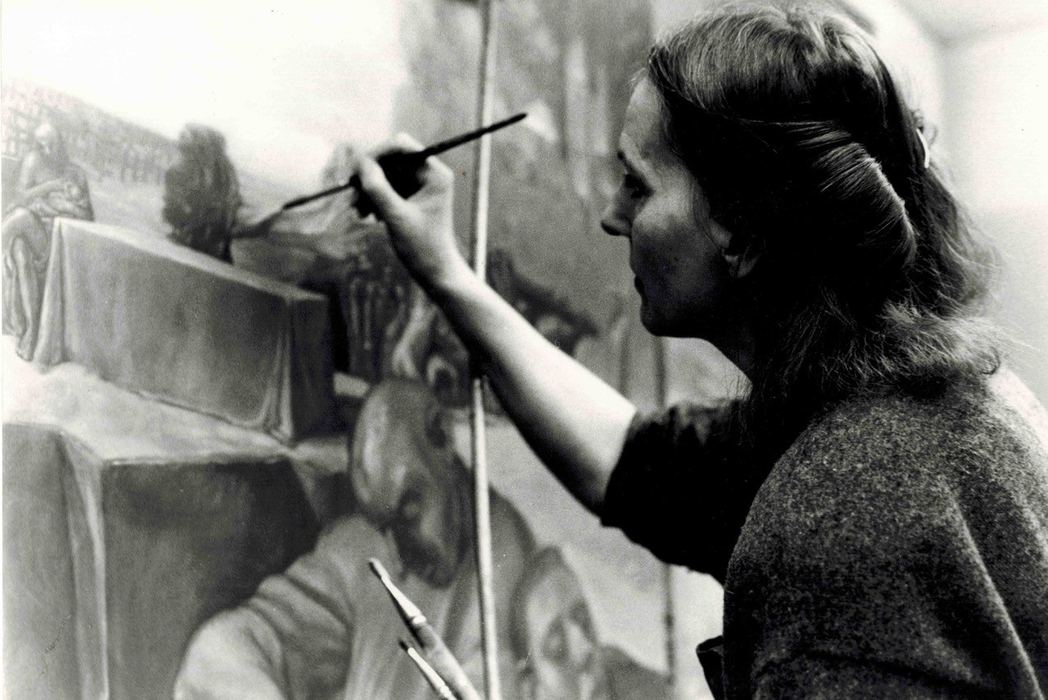
Image above: Gisela Breitling painting St. Matthäus Church in Berlin, photo: Dr. Satzinger, by courtesy of Galerie Creative Game
Gisela Breitling was born in Berlin on 27 May 1939. Due to the war, she spent her childhood and youth on Lake Constance before, following her initial training in the applied arts and studies in textile design, transferring to the Hochschule der bildenden Künste in West Berlin in the early 1960s. Study trips to Rome and Florence introduced her at an early stage to the world of the Italian Renaissance—an experience that would stay with her throughout her life.
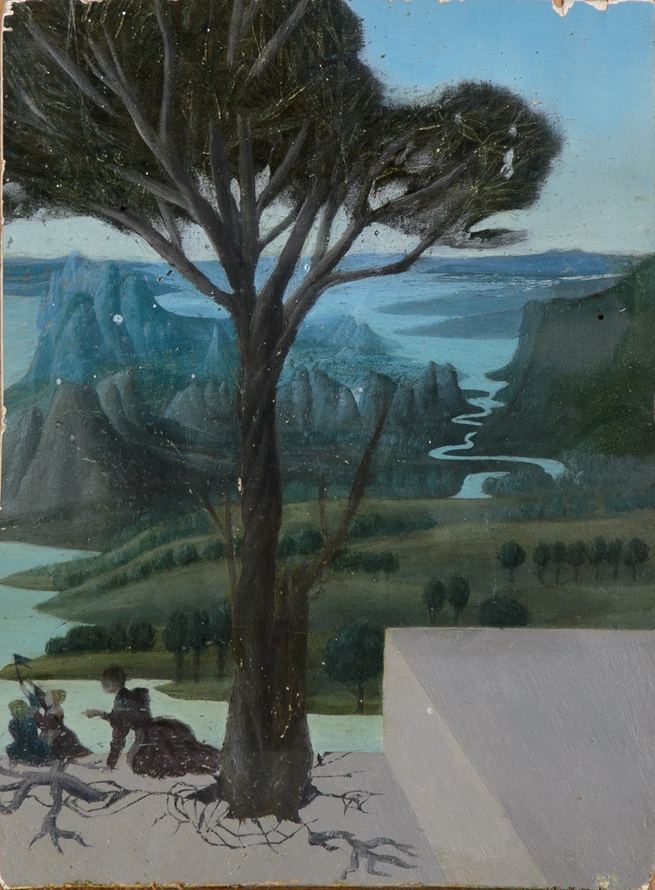
During her studies as a master student of the graphic artist Friedrich Stabenau, Breitling initially produced drawings, etchings and small-format paintings that were close to Fantastic Realism. The decisive turning point in her artistic development came in 1977/78, when she received a fellowship at the German Academy Villa Massimo in Rome. There, Breitling immersed herself in the painting techniques and representations of the human figure developed during the Renaissance. From this encounter emerged the complex figurative visual language that would shape all of her later work, driven by a profound interest in the human figure and, in particular, in the depiction of self-assured women.
Gisela Breitling published seminal writings, was actively involved in the autonomous women’s movement and was among the initiators of Das Verborgene Museum in Berlin, which brought forgotten women artists back into public awareness. When Gisela Breitling died in Berlin on 12 March 2018, her own work as a painter had, ironically, largely faded from view. Her own story, in particular, reveals just how persistent the very mechanisms can be that she spent her life challenging through both her writing and her work.
From Painter to Questioner
While Gisela Breitling was painting, she simultaneously embarked on another kind of work. She began asking questions: Why did women artists barely appear in standard works of art history? Why did their works disappear into museum storage? Why were generations of women painters trained, exhibited and collected, only to be scarcely mentioned later? Who, in fact, writes art history? By what criteria is it decided what is worth remembering and what is allowed to fall into oblivion? These questions occupied her for decades.
In Search of the Forgotten Women Artists
Breitling did not limit herself to criticising a male-dominated writing of art history. She conducted research in archives, examined artists’ estates and set out in search of women artists whose work had disappeared from public awareness. In 1980, she published The Ship’s Wake in the Waves: An Autobiographical Search for Women in Art History, one of the early key works of feminist art history in Germany.
Together with the Berlin artist Evelyn Kuwertz, Breitling initiated the research and exhibition project Das Verborgene Museum in the mid-1980s. At the time, its initiators took an unusual approach: they were not looking for new artistic positions. Instead, their focus was on works that had long existed but remained unseen. They had disappeared into the storerooms of West Berlin museums: the Kunstbibliothek, Brücke-Museum, the Artothek of the Neuer Berliner Kunstverein, Georg Kolbe Museum, Königliche Porzellan-Manufaktur Berlin, Kupferstichkabinett, Berlin Museum, Gemäldegalerie, Nationalgalerie, Berlinische Galerie, Bauhaus-Archiv and the collections of the Stiftung Preußische Schlösser und Gärten Berlin-Brandenburg. Over the course of two years, a working group of the Neue Gesellschaft für bildende Kunst (nGbK) examined the holdings of these West Berlin museums, bringing to light around 600 overlooked and, in many cases, forgotten works by women artists.
The results were presented in the 1987/88 exhibition Das Verborgene Museum at the Akademie der Künste in Berlin, in the form of 150 selected works that had remained hidden in museum storage for decades. The project led to the establishment of the association of the same name, Das Verborgene Museum, which for more than 35 years played a defining role in researching and bringing forgotten women artists back into public view, before its work was taken over by the Berlinische Galerie in 2022.
When the Painter Disappeared Behind the Author
It is one of the most striking contradictions of Gisela Breitling’s biography that her own work as a painter, of all things, was seen less and less. While her books continued to be read and she made a name for herself as an author, university lecturer in Berlin and Kassel, and feminist thinker, her painting gradually lost its public presence. This development is explicitly noted in her catalogue raisonné, even though her works are held in public collections including the Berlinische Galerie, the Nationalgalerie, the Kupferstichkabinett and the National Museum of Women in the Arts in Washington. The theorist moved to the foreground; the painter receded from view.
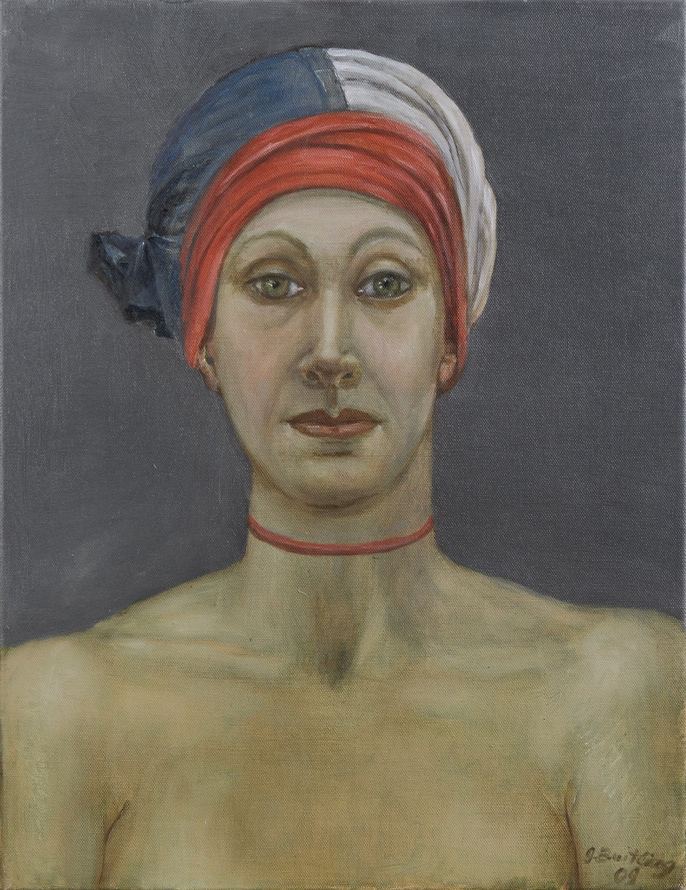
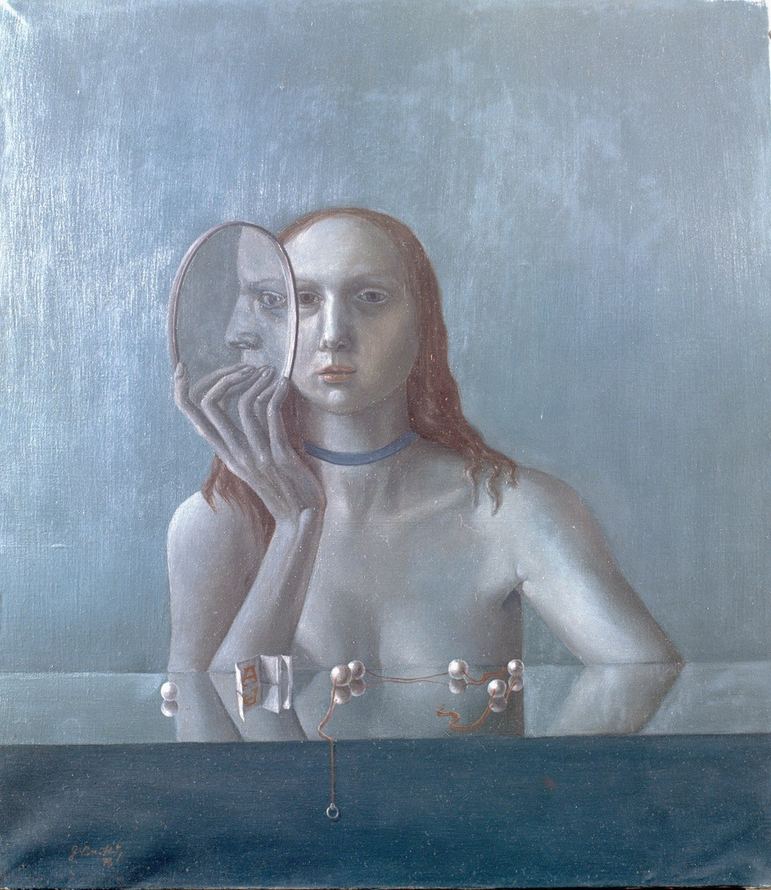
Over the course of almost five decades, Breitling created an extensive body of paintings. She portrayed women with a natural self-assurance that still feels unusual today. Her figures appear neither as allegories nor as surfaces for projection. They claim space; they radiate dignity and autonomy. Many of the paintings possess a quiet intensity. They do not impose themselves. They hold their ground.
A Life on Her Own Terms
Gisela Breitling seems never to have regarded art as a career project. She followed neither fashions nor the expectations of the market. After winning the competition to design the tower of Berlin’s St. Matthäus Church, she devoted several years to one of the most demanding projects of her life: creating a cycle of 16 panels for the church tower at the Kulturforum, focusing in particular on the stories of women in biblical texts. The large-scale project is considered one of the major works of the painter and women’s rights advocate. After its completion, she accepted no further major commissions.
In 2001, Gisela Breitling was awarded the Cross of the Order of Merit of the Federal Republic of Germany in recognition of her commitment.
The Enduring Relevance of a Pioneer
In recent years, art history has increasingly turned its attention to women artists of the twentieth century. Museums are reassessing their collections, artists’ estates are being researched and catalogues raisonnés compiled. This process follows precisely the trail that Gisela Breitling laid decades earlier. That her own work is now returning to the centre of attention therefore has a particular sense of consequence. It closes a circle that she herself once opened.

A Berlin retrospective will revisit her work in the coming days. With the solo exhibition The Female Gaze at Galerie Creative Game in Berlin-Lichterfelde (31 July–9 August 2026), attention is once again turning to an artist whose painting and work anticipated many of the questions being intensely discussed today: How are women represented? Who tells their stories? And why do certain artistic positions disappear from collective memory, even though they provided important impulses in their time?
At least as important as the current exhibition itself is perhaps the question Gisela Breitling leaves behind: How many significant women artists are still waiting to be seen again?
Text: Stephanie Schneider, M.A.
WHEN?
Gisela Breitling – The Female Gaze (Der weibliche Blick)
Opening: Friday, 31. July 2026, 7 pm
Opening hours:
Saturday, 1 August + Sunday, 2 August 2026, 1–5 pm
Thursday, 6 August 2026, 1–5 pm
Saturday, 8 August + Sunday, 9 August 2026, 1–5 pm
Closing: Friday, 7. August 2026, 7 pm
WHERE?
Galerie Creative Game
Jägerstraße 12A
12209 Berlin