
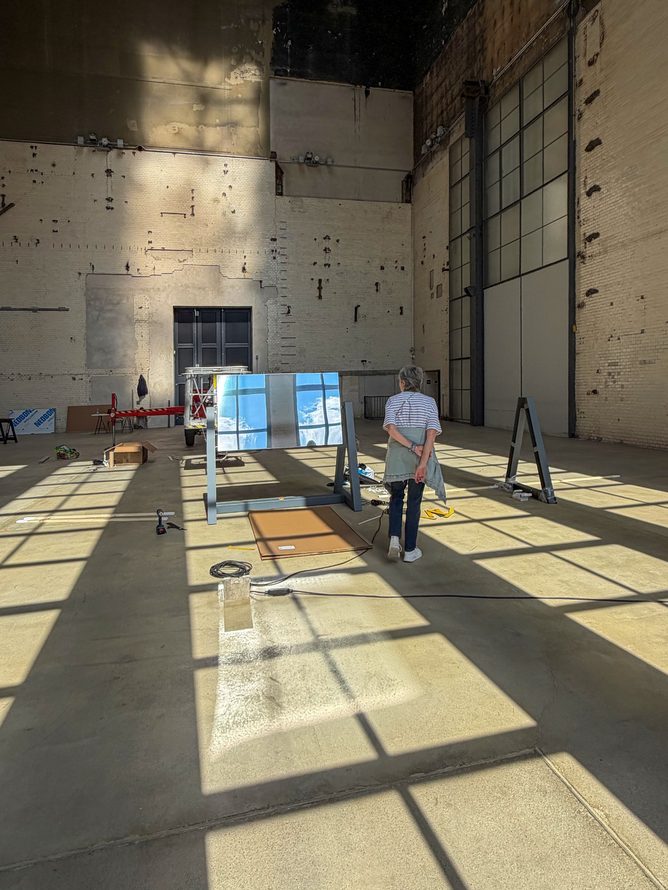

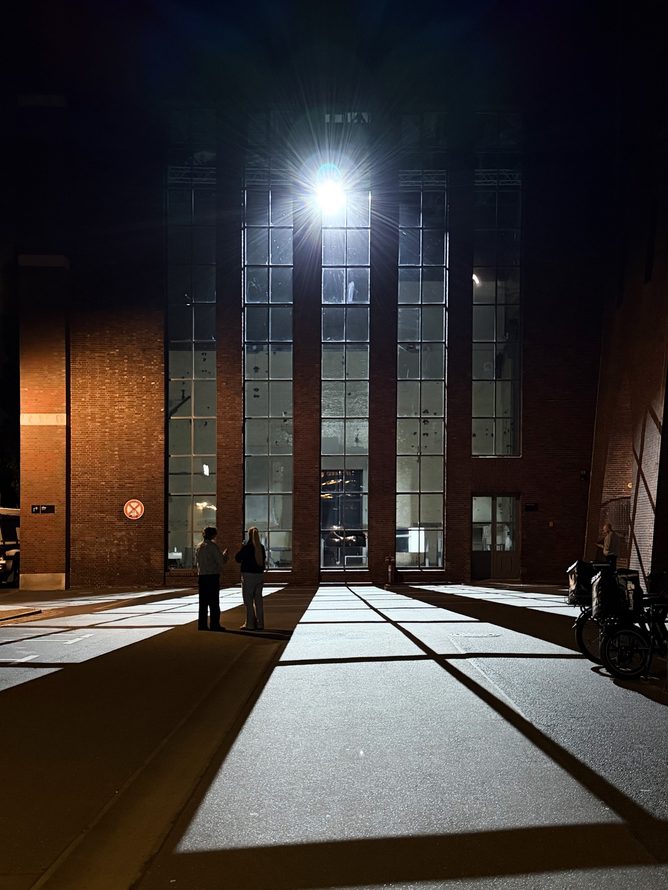
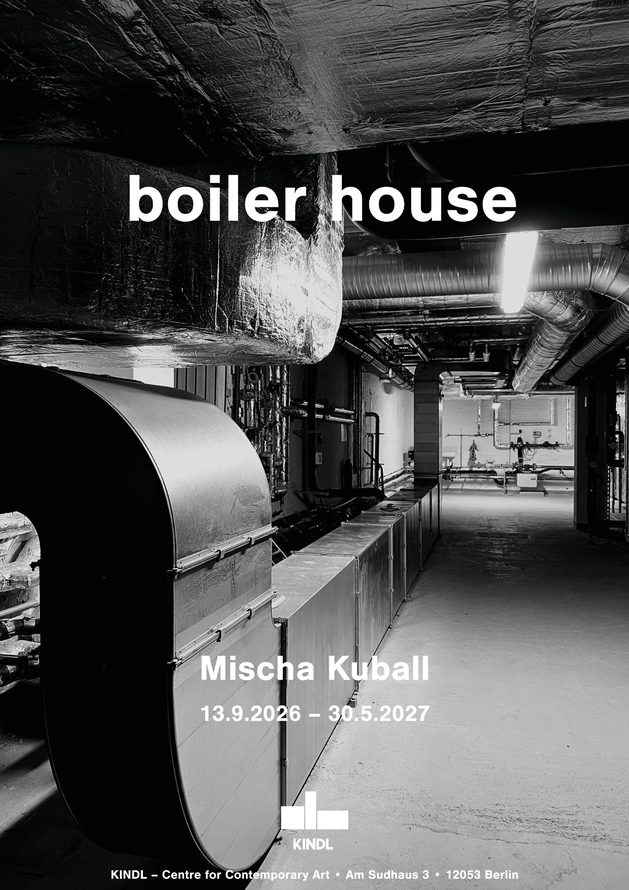
As part of Berlin Art Week 2026, KINDL – Zentrum für zeitgenössische Kunst (Centre for Contemporary Art) will open boiler house, a site-specific installation by Düsseldorf-based conceptual artist Mischa Kuball, on 12 September 2026. For the 20-metre-high Kesselhaus (Boiler House) of the former Kindl-Brauerei (Kindl Brewery), Kuball has developed a system of rotating mirrors that sets the space in motion through light and reflection. The intervention draws on the building’s industrial history and brings it into the present. Depending on the speed of rotation, the space appears to expand or dissolve into fleeting fragments. Reflections pass through the tall bands of windows into the surrounding exterior space, turning the Kesselhaus into a light figure visible from afar. Curated by Kathrin Becker, boiler house will be on view at KINDL in Berlin-Neukölln from 13 September 2026 to 30 May 2027.
Image above: Archiv Studio Mischa Kuball, 2026
An empty space is rarely truly empty. Especially when it is 20 metres high, was once part of a brewery and still bears the traces of its industrial past in its walls. In the Kesselhaus (Boiler House) at KINDL, Mischa Kuball now sets this distinctive architecture itself in motion. For boiler house, the Düsseldorf-based conceptual artist installs a system of rotating mirrors. They cast light through the space, slowly at first and then faster. Making its dimensions appear to expand for a moment, only to dissolve into reflections the next. In doing so, Kuball connects the present with the history of the exhibition site, using a medium that has shaped his work for decades: light.
The site-specific work has been created for KINDL, Zentrum für zeitgenössische Kunst (Centre for Contemporary Art) in Berlin-Neukölln, and will open as part of Berlin Art Week 2026. Curated by Kathrin Becker, boiler house will be on view from 13 September 2026 to 30 May 2027. The opening will take place on Saturday, 12 September, from 6 to 10 pm.
With boiler house, Kuball also continues a series of site-specific works for which the Kesselhaus (Boiler House) has become a distinctive setting since KINDL opened. Before him, artists including Roman Signer, David Claerbout, Haegue Yang, Alexandra Bircken, Mona Hatoum and, most recently, Alfredo Jaar and Cornelia Parker have engaged with the architecture and distinctive dimensions of this former industrial space. Kuball continues this history through his own medium: light becomes an instrument with which the space can be read and transformed.
At KINDL, Kuball’s understanding of a site’s history as more than a mere backdrop takes on a specific historical dimension. From 1937, the Kindl Brauerei (Kindl Brewery) held the designation “Nationalsozialistischer Musterbetrieb” (National Socialist Model Company); during the Second World War, prisoners of war and forced labourers were deployed at the Neukölln site. In the Kesselhaus (Boiler House), a two-by-two-metre QR code refers to the years 1933 to 1945. In this way, a history that forms part of the architecture of this site is made visible and is not omitted from its present-day use as an art centre.
A Boiler House Without Boiler
The Kesselhaus (Boiler House) is the oldest part of the former brewery complex and at the same time its most spectacular exhibition space. Its industrial function has disappeared. Boilers and machinery no longer reveal what once took place here. What remains is the immense volume of the space.
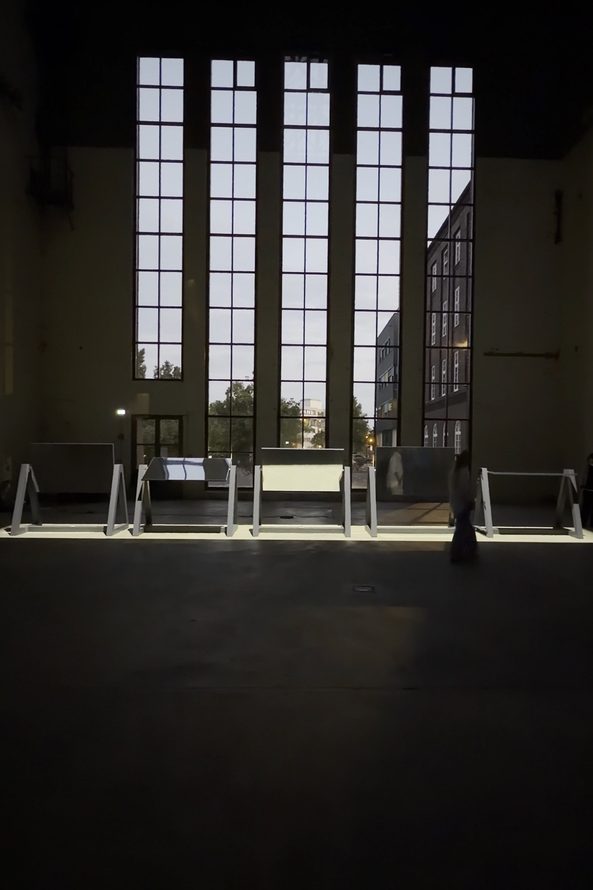
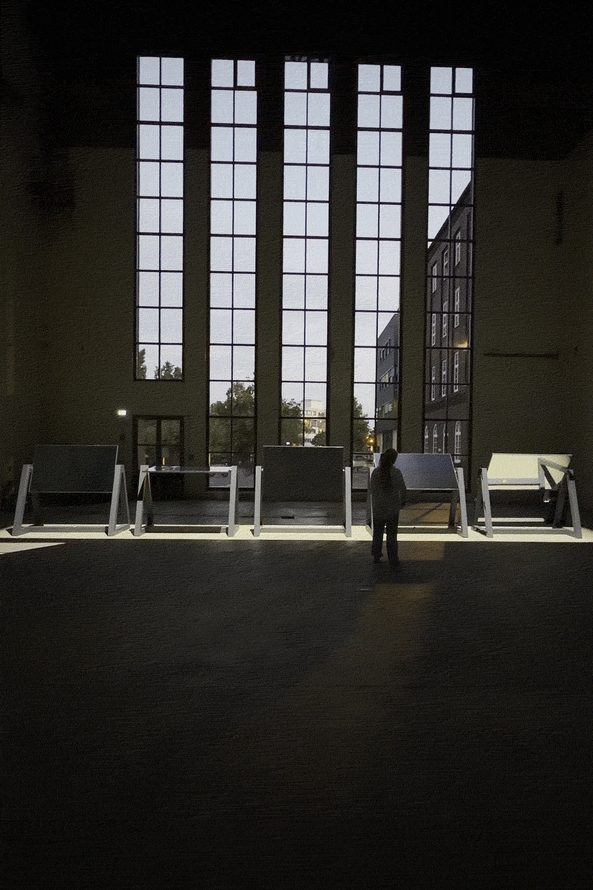
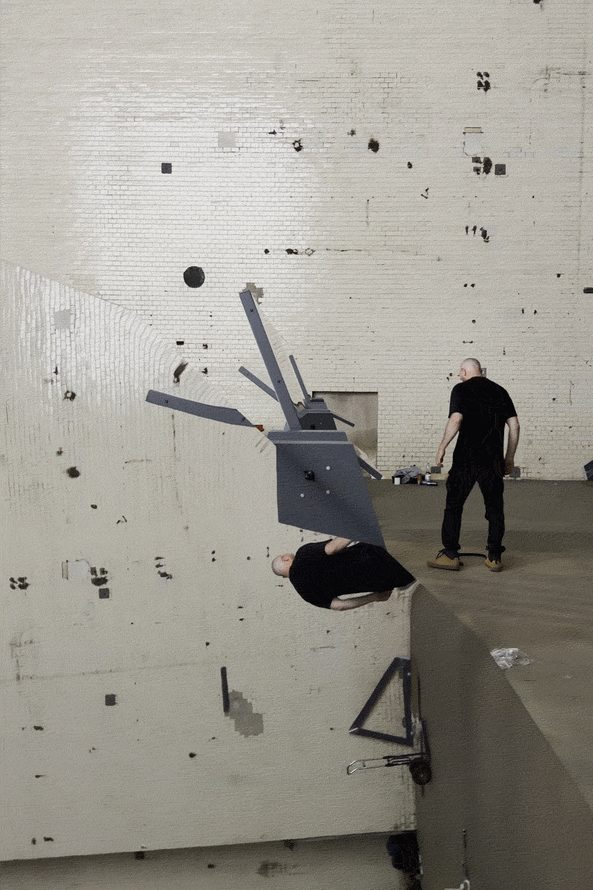
This is precisely where Kuball’s site-specific intervention begins. His mirrors form a new optical machinery. It takes up the architectural and historical context of the Kesselhaus (Boiler House) and reinterprets it from a contemporary perspective. This is by no means a simple reconstruction of the building’s former use. Rather, it is about how movement and reflection alter the perception of what is already there.
The mirrors rotate at different speeds. Slow rotation expands the space, while faster rotation breaks it into fleeting fragments. The architecture remains unchanged, yet seems to lose its stability. The emptiness becomes perceptible solely through the movement of the reflections. It no longer appears as a static state, but as a dynamic process.
The eye searches for stability. What it finds is movement.
An Architecture of Reflection Emerges
Yet the light does not remain confined to the interior. Through the bands of windows in the Kesselhaus (Boiler House), the reflections travel outside, extending the installation into KINDL’s exterior space. What appears inside as a fragile architecture of reflection becomes a public figure of light outside. The façade transforms from a fixed boundary into a membrane between the art institution and the surrounding neighbourhood.
This transition is fundamental to Kuball’s work. His interventions frequently extend beyond the architectural boundaries of an exhibition space. Light, after all, follows its own logic. It falls through windows and travels across surfaces. In the Kesselhaus (Boiler House), this quality becomes part of the work itself. The history of the site remains present without being illustrated. Where energy was once generated for production, reflections and images emerge today.
Kuball has long been interested in what is embedded in architecture. For him, buildings are so much more than containers for art. Their original use and their social function become part of the work. At KINDL, this interest encounters a space whose former purpose is immediately imaginable yet entirely absent.
boiler house turns this emptiness into a process. Depending on where one stands and how quickly the mirrors rotate, the space changes. Visitors, too, are caught up in the reflections. They observe the installation while simultaneously becoming part of its image. The emptiness is set in motion.
Light as a Tool
Mischa Kuball, born in Düsseldorf in 1959, lives and works in Düsseldorf. Since 1977, he has worked in public and institutional spaces. Light is his best-known medium, yet the common classification of Kuball as a light artist is too narrow. He uses light to explore architectural spaces as well as social and political discourses. His interventions reflect socio-cultural structures and engage with architectural and historical contexts. In this way, the legibility of a place is transformed. This approach can be traced across several decades of his work.
With refraction house in 1994, Kuball made the former synagogue in Stommeln visible from afar through a light intervention. In 1998, private light / public light, one of his key projects, followed for the 24th São Paulo Biennial. Kuball exchanged lamps from private households for standardised light fixtures and brought the collected individual light sources into the public context of the Biennial. The title already describes this movement: the private becomes public – the familiar shifts into a different context.
For New Pott, created as part of RUHR.2010, Kuball visited one hundred households of people from different backgrounds across the Ruhr region. Once again, the boundary between private living space and the public sphere became the field of his artistic enquiry. Here, light also meant visibility. Who is seen? Who belongs to a city, and who tells its story? The project was shown in 2010 at the Kunstsammlungen der Ruhr-Universität Bochum (Art Collections of Ruhr University Bochum).
Berlin and the Experience of Emptiness
In Berlin, boiler house has an interesting precursor. From 2017 to 2019, the Jüdisches Museum Berlin (Jewish Museum Berlin) presented Kuball’s large-scale installation res·o·nant, which he developed for two of the so-called Voids in Daniel Libeskind’s museum building.
These 24-metre-high voids are themselves carriers of meaning. Kuball responded to them with rotating projectors and mirrors. Sound was added as another element. The floor plans of the Voids appeared as moving projections on the walls and ceilings. Architecture became perceptible through movement. Over the course of the project, more than 120 musicians and sound artists contributed short compositions.
The connection to boiler house is evident, although the two works emerge from very different contexts. Once again, Kuball encounters a space whose emptiness carries meaning. Again, he works with rotation and reflection. The architecture changes in perception, while its physical substance remains untouched.
At the Jüdisches Museum Berlin (Jewish Museum Berlin), the Voids are a constitutive element of an architecture of remembrance. At KINDL, the emptiness arose from the loss of the building’s industrial function. Both spaces carry their history in the absence of what was once there. Kuball does not fill this emptiness. Instead, he succeeds in activating it.
From the Interior into the City
boiler house extends beyond the interior. The light leaves the Kesselhaus (Boiler House). As the reflections pass through the windows into Neukölln, their function changes. What forms part of the artistic intervention inside enters everyday life outside. Passers-by can encounter the work without ever having entered KINDL.
Kuball’s work has operated at this threshold between institution and public space for decades. His art often emerges through the relationship between different social spaces. The institutional space opens up to the city. Private space can become public. Historical architecture encounters its present-day use.
Kuball brings this expanded approach together under the term Public Preposition. What matters is the relationship that art establishes in public space. The preposition points to relationships: to a place, between people or within existing social structures.
Current projects continue this line of thought. In 2026, alongside boiler house, Kuball is developing on construction / public preposition in Dortmund and NEWTON GOETHE GALILEO in Rome, among other projects. In Düsseldorf, he is presenting archiv//archiv.
Opening Programme – When Light Meets Sound
For the opening of boiler house on 12 September 2026, the installation will be activated through sound and performance. Two interventions will enter the architecture of reflection over the course of the evening. At 8 pm, Severin Black will perform a live set with clarinet and electronic music. At 9 pm, Abi Asisa will follow with cello and electronics. Admission to both performances is free. The opening event is supported by Carhartt WIP.
For a few hours, the movement of light thus acquires an acoustic counterpart. The former Kesselhaus (Boiler House) becomes an active space once again. Its industrial past remains inscribed in the building, while Kuball’s intervention opens up a new perception of the site.
Mischa Kuball | Short Biography
Mischa Kuball, born in Düsseldorf in 1959, lives and works in Düsseldorf. Since 1977, he has developed works for public and institutional spaces. Using light as a central medium, he explores architecture as well as social and political discourses. His interventions reflect socio-cultural structures and engage with the history of their respective sites.
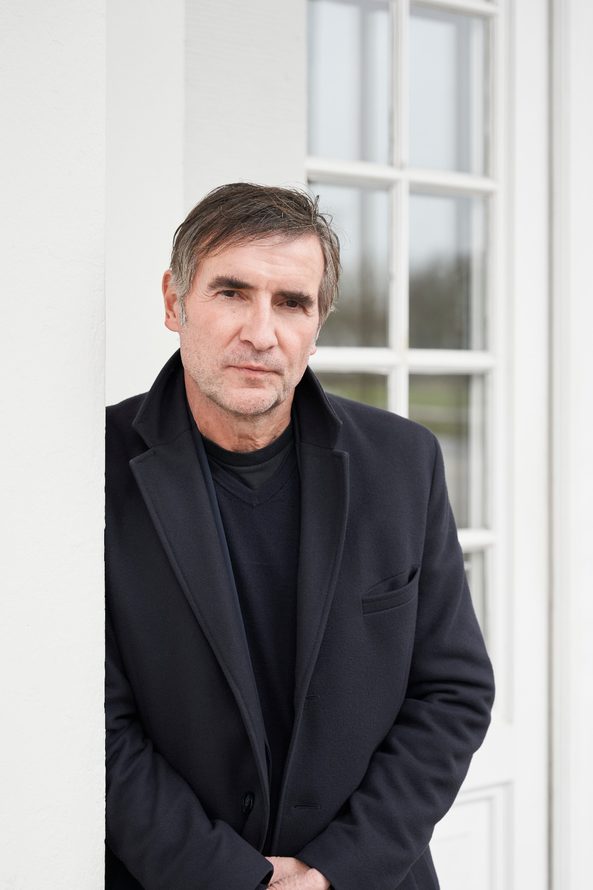
From 2007 to 2026, Kuball was Professor of Public Art at the Kunsthochschule für Medien Köln (Academy of Media Arts Cologne). From 2006 to 2008, he taught Media Art at the Hochschule für Gestaltung/ZKM Karlsruhe (Karlsruhe University of Arts and Design/ZKM). Since 2015, he has been a member of the Nordrhein-Westfälische Akademie der Wissenschaften und der Künste (North Rhine-Westphalian Academy of Sciences, Humanities and the Arts). In 2016, he received the Deutscher Lichtkunstpreis (German Light Art Award).
Selected Exhibitions and Interventions

1990 | Megazeichen
An early large-scale intervention by Kuball in public space, already demonstrating his interest in light and signs.

1994 | refraction house, Synagoge Stommeln
Light intervention in the former synagogue in Pulheim-Stommeln.

1998 | private light / public light, 24th São Paulo Biennial
Participatory project exploring the relationship between private and public space. The work is considered one of Kuball’s key projects.

1999 | Power of Codes, Tokyo National Museum, Tokyo
International project at the Tokyo National Museum.

2000 | Horizontal Parallel Structure, Riehen/Basel
Architecture-related intervention exploring the perception of spatial structures.

2005 | pacemaker, Stadtwerke Düsseldorf
Work situated within the urban and infrastructural context of Düsseldorf.

2009 | Artist in Residence, Chinati Foundation, Marfa, Texas
Residency at the Chinati Foundation, founded by Donald Judd.

2010 | New Pott, Ruhr region / Kunstsammlungen der Ruhr-Universität Bochum
One hundred encounters in private households form a portrait of a region shaped by migration.

2010 | public alphabet, Museum DKM, Duisburg
Project exploring signs and communication in public space.

2011 onwards | platon’s mirror
Ongoing body of work exploring projection and the relationship between image and reality.

2012 | MetaLicht, Wuppertal
Large-scale light work within the architectural space of the Universität Wuppertal.

2017–2019 | res·o·nant, Jüdisches Museum Berlin
Walk-in light and sound installation in two Voids of the Libeskind building. Over the course of the project, the installation was expanded through numerous artistic interventions.

2018 | des Archives (présence d’absence), Kunsthalle Düsseldorf
Exploration of the archive and the relationship between presence and absence.

2020 | nolde/kritik/kuball
Artistic examination of Emil Nolde, his political past and its reception.

2021 | (un)finished, St. Matthäus-Kirche, Berlin
Berlin solo exhibition in a sacred space.

2022/23 | nolde/kritik/documenta, documenta archiv, Kassel
Continuation of Kuball’s critical engagement with Nolde and his art-historical reception.

2023 | light_poesis
Continuation of his long-standing exploration of light as a spatial and conceptual material.

2023 onwards | missing link_
Ongoing project exploring spatial relationships and connections.

2025 | r a d i a l system, Berlin
A more recent Berlin work by Kuball.

2026 | on construction / public preposition, Dortmund; NEWTON GOETHE GALILEO, Rome; archiv//archiv, Düsseldorf; boiler house, Berlin
Current projects in which Kuball continues his engagement with architecture and public space.

Since August 2026 | Guest Professor for ‘public art / design curating’, Bergische Universität Wuppertal
WHAT?
Mischa Kuball – boiler house
WHEN?
Opening: Saturday, 12 September 2026, 6–10 pm
with live musical interventions
8 pm: Severin Black, live set with clarinet and electronic music
9 pm: Abi Asisa, cello and electronics
Exhibition: Sunday, 13 September 2026 – Sunday, 30 May 2027
WHERE?
KINDL – Zentrum für zeitgenössische Kunst
Am Sudhaus 3
12053 Berlin-Neukölln