

Japanese artist Yayoi Kusama has died. She passed away on 14 August 2026 at the age of 97 in a hospital in Tokyo. Her death was announced on 27 August by her studio and the Yayoi Kusama Museum. No cause of death was given. According to her studio, Kusama continued to paint until the final days of her life.
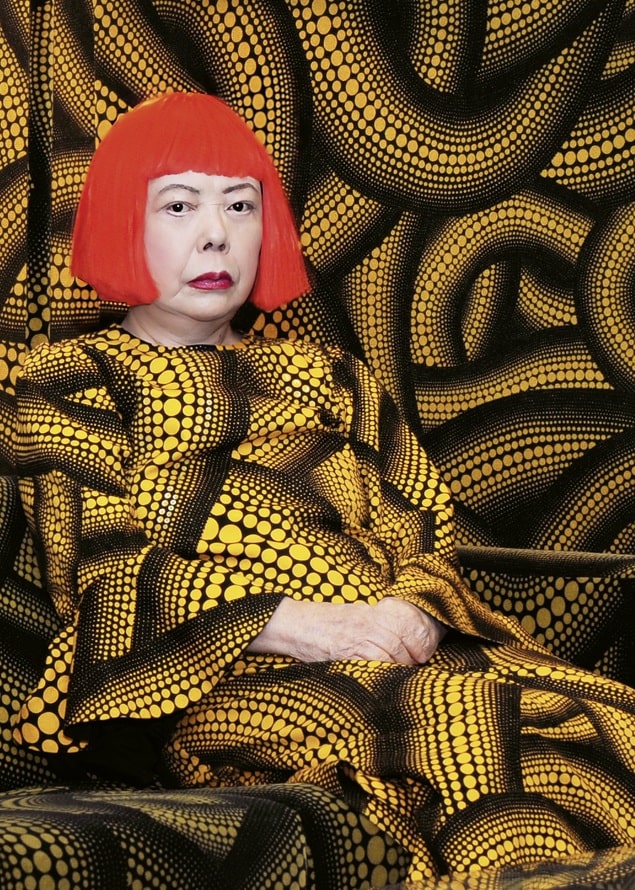
Image above: KUSAMA with YELLOW TREE / Living Room at the Aichi Triennale, 2010, © YAYOI KUSAMA, Courtesy of Ota Fine Arts, Victoria Miro, David Zwirner.
With the death of Yayoi Kusama, the art world has lost an artist whose work had long since reached far beyond museums and galleries. Dots, pumpkins and mirrored rooms made her instantly recognisable around the world. Yet the immense popularity of these motifs can easily obscure just how radical and multifaceted her work remained over more than seven decades. Kusama worked in painting and sculpture, created installations and performances, made films and wrote novels and poetry. Her practice moved between abstraction and Pop Art, Minimalism and feminist art, without ever settling permanently within any one of these movements.
Born in 1929 in Matsumoto, in Japan’s Nagano Prefecture, Kusama began drawing and painting as a child. From an early age, she experienced hallucinations in which dots, nets and plant-like forms seemed to spread across her surroundings. What initially felt threatening, she translated into images. Repetition became a central principle of her art and later developed into an idea she described as “self-obliteration”, the dissolution of the self. The individual motif disappears into the multitude, the body into space, the self into a seemingly boundless environment.
In 1957, Kusama left Japan, initially moving to Seattle and, soon afterwards, to New York. There she encountered an art scene undergoing profound change. Her large-scale Infinity Nets, their surfaces covered with countless small arcs, quickly attracted attention. In the 1960s, the Accumulations followed: furniture and everyday objects covered with sewn, phallic fabric forms. At the same time, she staged happenings, body-painting events and protests against the Vietnam War. Kusama was part of New York’s avant-garde and worked alongside artists such as Donald Judd and Andy Warhol.
In 1965, she created her first Infinity Mirror Room. Mirrors, light and repetition produced a space whose boundaries seemed to elude perception. Decades later, the concept would become her best-known exhibition format. In the Infinity Mirror Rooms, visitors see themselves while simultaneously watching their reflections disappear into an endless succession of images. The rooms became major public attractions and, late in her life, made Kusama one of the most widely recognised contemporary artists in the world.
Kusama returned to Japan in 1973. From 1977 onwards, she voluntarily lived in a psychiatric hospital in Tokyo, working every day in her nearby studio. She never separated her mental illness from her art. She described painting as existential, a means of living with fear and recurring hallucinations. Yet this biographical dimension, while illuminating aspects of her work, does not fully explain it. Kusama’s art is equally concerned with infinity, the relationship between the individual and the cosmos, and the dissolution of fixed boundaries.
After years of receiving less international attention, Kusama’s work began to be rediscovered in the late 1980s. In 1993, she represented Japan at the Venice Biennale. She had, however, already made her presence felt in Venice in 1966, when she presented Narcissus Garden without an official invitation. Major retrospectives and exhibitions at leading museums around the world followed. In 2017, the Yayoi Kusama Museum opened in Tokyo. Her collaboration with Louis Vuitton and the extraordinary proliferation of her polka-dotted pumpkins eventually made her a figure of popular culture as well. An artist who had spent decades exploring the dissolution of the self had herself become an unmistakable brand.
Shortly before her death, Kusama’s work was more present in Europe than it had been for many years. From 14 March to 2 August 2026, Museum Ludwig in Cologne presented a major retrospective featuring more than 300 works spanning every phase of her career. The exhibition, previously shown at Fondation Beyeler near Basel, was completely sold out towards the end of its run. In response to the enormous demand, the museum even extended its opening hours until 2 a.m. during the final weekend. In September, the retrospective will travel to the Stedelijk Museum Amsterdam for its next presentation.
Yayoi Kusama lived to see a deeply personal visual language become universally understood. Her dots can appear playful and decorative. Behind them, however, lies a lifelong engagement with perception, fear and infinity. Kusama transformed an experience that had isolated her into an art that millions of people could enter.
She continued working until the end. Her studio’s statement that she never put down her paintbrush, even in the final days of her life, therefore reads like the fitting final line of an extraordinary artistic biography.