


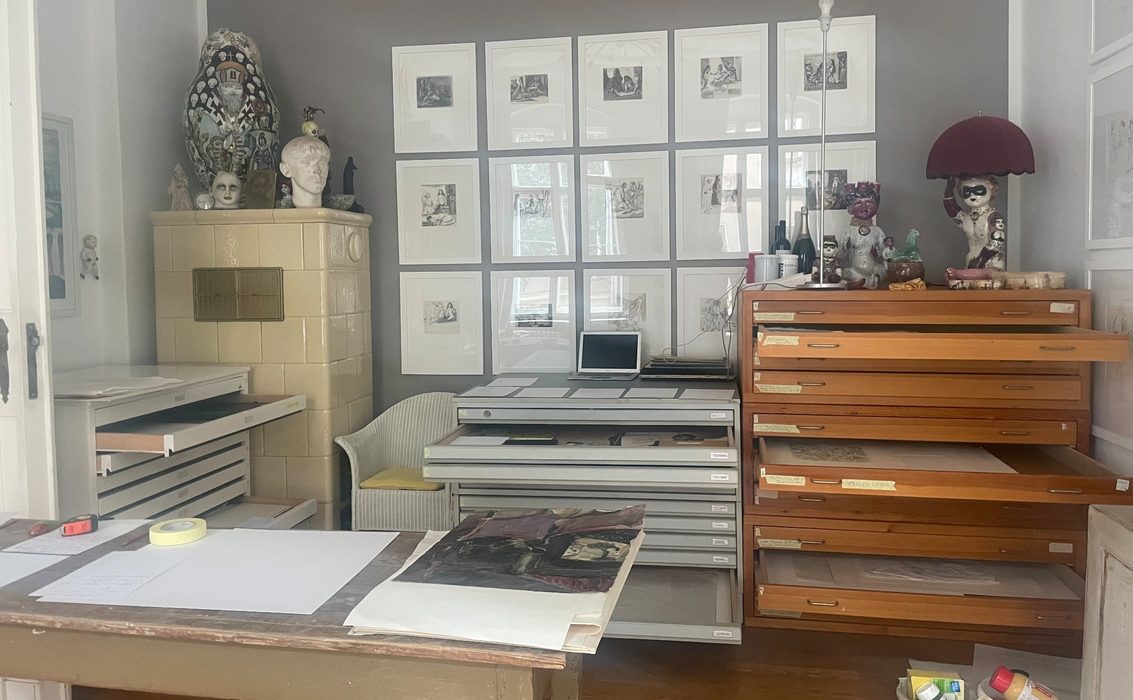
On 12. September 2026, the Joachim John Archive and Private Museum will open in Berlin-Schöneberg with an exhibition offering a comprehensive insight into the work of one of the most idiosyncratic German draughtsmen and printmakers of the 20th century. The museum has been initiated and is run by John’s son, the Berlin-based artist and ceramist Hinrich Kröger-John, on whose premises his father’s archive is already housed. On display will be works from 1961 to 2018, including large-format pencil drawings, prints, gouaches and watercolours. The exhibition focuses in particular on John’s intense engagement with historical and political events, such as the French Revolution and German reunification, as well as works arising from his long-standing interest in literature and theatre. The opening will take place on 12 September from 5.30 pm at Eisenacher Straße 114 in Berlin. The opening coincides with the 30th anniversary of the Galerie & Werkstatt Hinrich Kröger-John.
Image above: Joachim John Archive + Private Museum © Hinrich Kröger-John
The new archive preserves a significant part of Joachim John’s collection of drawings. This collection is supplemented by an extensive literary estate comprising manuscripts, speeches, diaries, notes and photographs, which is being preserved in parallel with the corresponding collection in the Archive of the Academy of Arts. The Joachim John Archive and Museum is run by his son Hinrich Kröger-John, himself an artist and ceramist. The opening on 12 September 2026 coincides with a second milestone: Hinrich Kröger-John has been running his gallery and studio in Berlin for 30 years. This links the cataloguing of his father’s body of work with the history of a place where the son has been developing and presenting his own artistic work for three decades.
An artist straddling the worlds of drawing, literature and history
Joachim John was born on 20 January 1933 in Tetschen, now known as Děčín in the Czech Republic. Following an eventful youth and various career stages, he studied art education in Greifswald from 1955 to 1959. In 1963, he joined Hans Theo Richter’s masterclass at the Academy of Arts of the GDR, before working as a freelance artist from 1966 onwards. In 1986, John became a member of the Academy of Arts of the GDR; following German reunification, he served as secretary of the Fine Arts Section of the Academy of Arts in Berlin from 1991 to 1993 and was involved in the process of unifying the two academies.
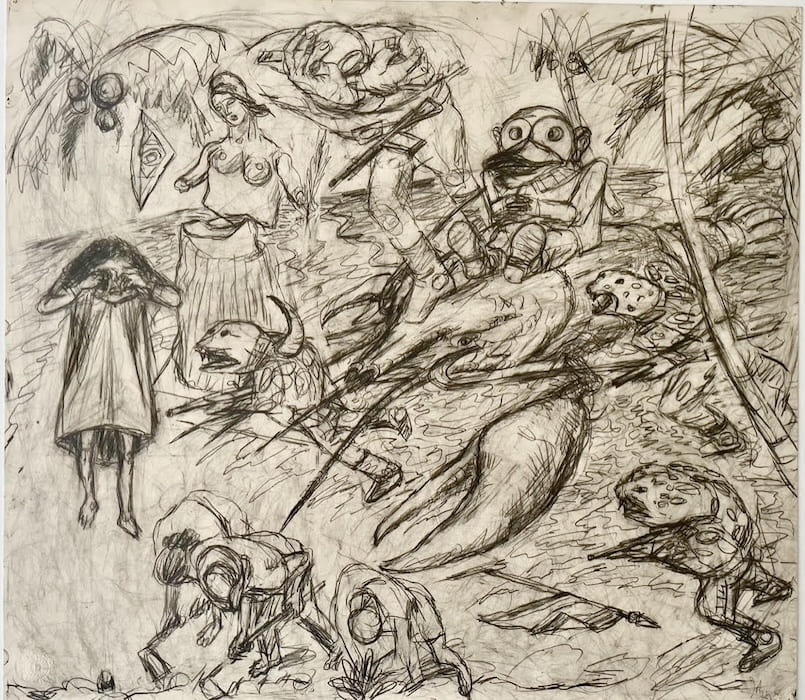
His work attracted public attention from an early stage. In 1961, at the invitation of the sculptor Fritz Cremer, John took part in the exhibition ‘Young Artists – Painting’ at the Academy of Arts. Over the following decades, he developed an extensive body of work that cannot be confined to a single medium or subject. Alongside drawings and prints, he produced paintings, gouaches and works for books and literary publications. People, landscapes, historical events and social issues consistently featured prominently in his work.
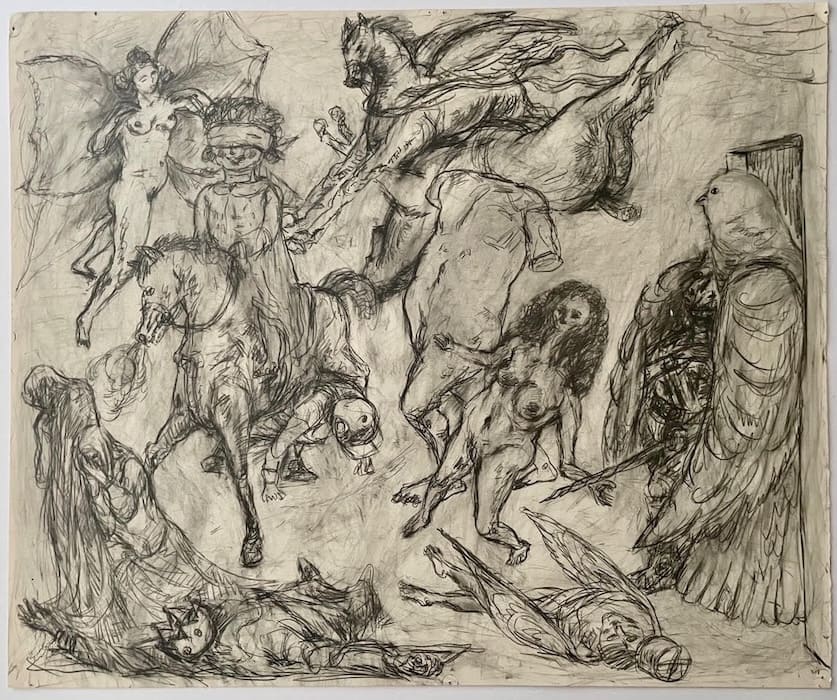
The art collection of the Academy of Arts describes John’s works as both sensual and critical. Particular emphasis is placed on his engagement with literature, theatre, history and fundamental social issues. His drawings on Shakespeare, Niccolò Machiavelli, the French Revolution and German reunification demonstrate how closely image and text, historical tradition and contemporary reflection are intertwined in John’s work.
History as the Present
A key element of John’s work is his engagement with historical events. His aim was not merely to depict them illustratively. Rather, history became a tool for revealing political and social mechanisms and questioning their significance for the present day.
His works on the French Revolution are particularly well known; this was a subject he explored over a considerable period. An exhibition at the Staatliches Museum Schloss Burgk in 1989, entitled ‘Joachim John Sees the French Revolution’, was already dedicated to his drawings and etchings on this historic upheaval. The Academy of Arts also cites the French Revolution as one of the central thematic areas within his body of drawings.
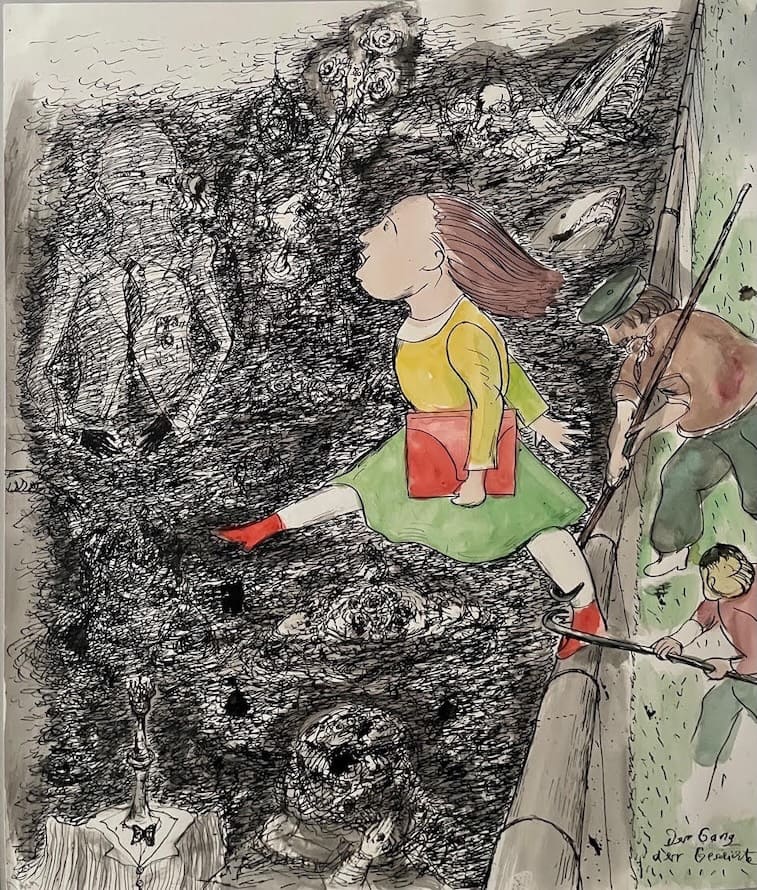
John engaged just as intensively with the political upheavals of the 20th century. Among his works on German reunification is the well-known depiction of the character ‘Hanns Guck-in-die-Luft’, which John used following the fall of the Berlin Wall. The character from Heinrich Hoffmann’s Struwwelpeter thus became an ironic and at the same time critical commentary on the social changes following 1989. The Dresden State Art Collections hold a watercolour drypoint of ‘Hanns Guck-in-die-Luft’, dated 1990, in their collection.
Literature as a starting point for images
John’s affinity with literature is another key to understanding his work. The Academy of Arts explicitly highlights his engagement with Shakespeare, Machiavelli and other literary subjects. This has given rise to distinctive visual worlds in which text and drawing enter into an open dialogue with one another.
This is particularly evident in his works on Niccolò Machiavelli’s comedy *Mandragola*. For this, John created a series of drawings and etchings, which were published in a bibliophile edition in 1996. His engagement with Georg Büchner’s *Woyzeck* also led to original graphic works. In 2004, Volker Braun’s *Der berüchtigte Christian Sporn* was published. *Ein anderer Woyzeck* (Another Woyzeck), featuring five etchings and six drawings by Joachim John.
This interplay between literature and the visual arts was characteristic of John’s working method. His line work could relate directly to a character, a scene or a literary idea, without merely replicating the narrative. It was precisely this that gave his graphic works an independent, sometimes fragmentary and consistently surprisingly contemporary quality.
The line as a language in its own right
Within his extensive body of work, drawing holds particular significance. John developed a dense, dynamic line style that oscillates between precise observation and spontaneous execution. Descriptions of his work particularly highlight the delicate, at times almost torn-open, line work, which contrasts with deliberately left-blank areas.
People and portraits were just as much a part of his recurring motifs as landscapes. The exhibition held in 2018 at Galerie Parterre Berlin to mark the 11th Egmont Schaefer Prize for Drawing presented around 70 works ranging from the 1960s to John’s late work. The jury expressly recognised his decades-long engagement with political and social issues, literature, theatre, everyday life, people and landscape.
John received the Egmont Schaefer Prize for his life’s work just a few months before his death. He died on 26 March 2018 in Neu Frauenmark in Mecklenburg-Western Pomerania. By that time, he had long since secured a firm place within German art history, without, however, allowing himself to be fully categorised within the aesthetic or institutional frameworks of his respective era.
From Berlin to Mecklenburg
A significant turning point in John’s life was his move away from Berlin. In 1977, he settled in Frauenmark near Schwerin, where he worked until his death. From Mecklenburg, John continued to develop his artistic practice and remained in close contact with writers, artists and cultural institutions. His decision to live in rural seclusion did not, therefore, signify a withdrawal from social or political issues. However, it enabled him to develop artistically away from trends or other influences.
His independence from prevailing art movements later became a key feature of how his work was received. The Parterre Gallery described his drawings as defiant of short-lived ‘zeitgeist’ trends and, at the same time, as works that appear enduringly relevant precisely because of their independence.
A work that bridges the experience of the GDR and a European perspective
John’s artistic biography is closely linked to the history of the GDR, but cannot be viewed exclusively from this perspective. His works draw on European literary and visual traditions and engage with historical events that extend far beyond the German context. His significant series of prints include, for example, works on Thomas Müntzer and ‘América Latina’. In contemporary discussions of his work, it is precisely this combination of historical research, political reflection and precision in drawing that has been highlighted.
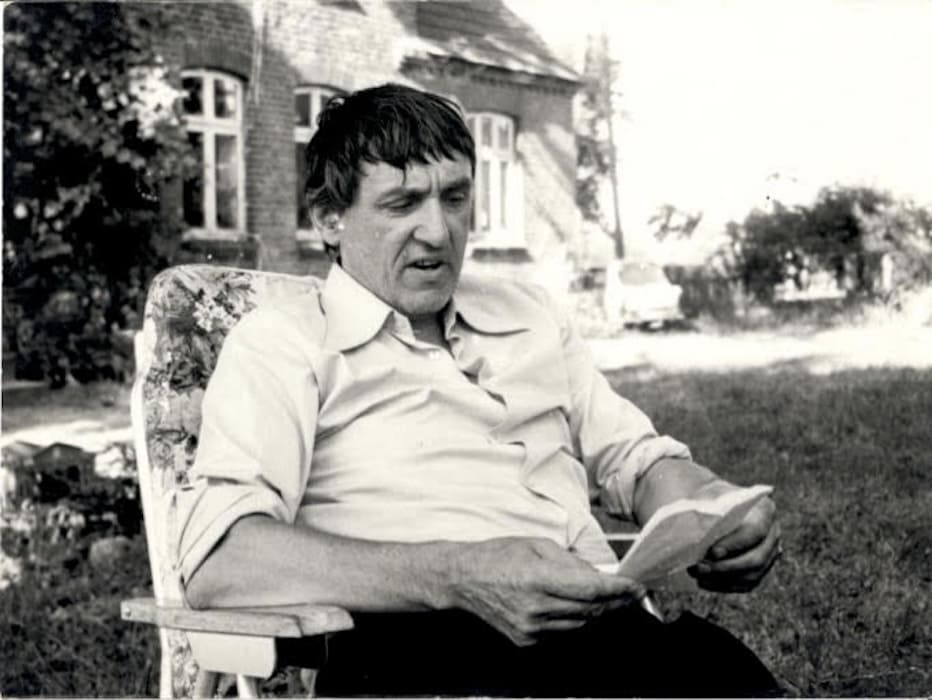
This significance was also recognised at an institutional level. In 1985, John received the Käthe Kollwitz Prize, one of the Academy of Arts’ most prestigious awards for visual artists. In 1986, he became a member of the Academy of Arts of the GDR. Later, he received, amongst other honours, the Culture Prize of the State of Mecklenburg-Western Pomerania.
Hinrich Kröger-John: 30 Years of the Gallery, the Studio and His Own Artistic Approach
The opening of the Joachim John Archive coincides with an anniversary that gives the venue a second chapter in its history. Hinrich Kröger-John has been running his own gallery and workshop in Berlin since 1996. After 25 years in Berlin-Mitte, he moved both to Schöneberg. At 114 Eisenacher Straße, larger workshop spaces were created, along with additional areas for exhibitions, gatherings and events.
Hinrich Kröger-John is himself an artist and ceramist. From 1982 to 1984, he completed an apprenticeship in pottery, after which he worked in various Berlin ceramics workshops. From 1989 to 1995, he studied painting at the Dresden Academy of Fine Arts. His work thus combines two areas that continue to run through his oeuvre to this day: a first-hand knowledge of the craft of ceramics and a visual artistic conception of surface, form and vessel.
His artistic roots, however, go back further. Kröger-John grew up in an artistic household in East Berlin. His father was the draughtsman, painter and writer Joachim John, and his parents’ artist friends were part of their immediate circle. Art, as Hinrich Kröger-John himself later described this experience, had simply been a part of his life from childhood onwards.
Drawing on this background, he has developed a distinctly individual style. Terracotta and various types of porcelain are key materials in his work. He creates vessels, figures and sculptures whose surfaces become pictorial spaces. Painting, drawing and three-dimensional form intertwine. Kröger-John himself emphasises the importance of craftsmanship, concentration and patience in the creative process.
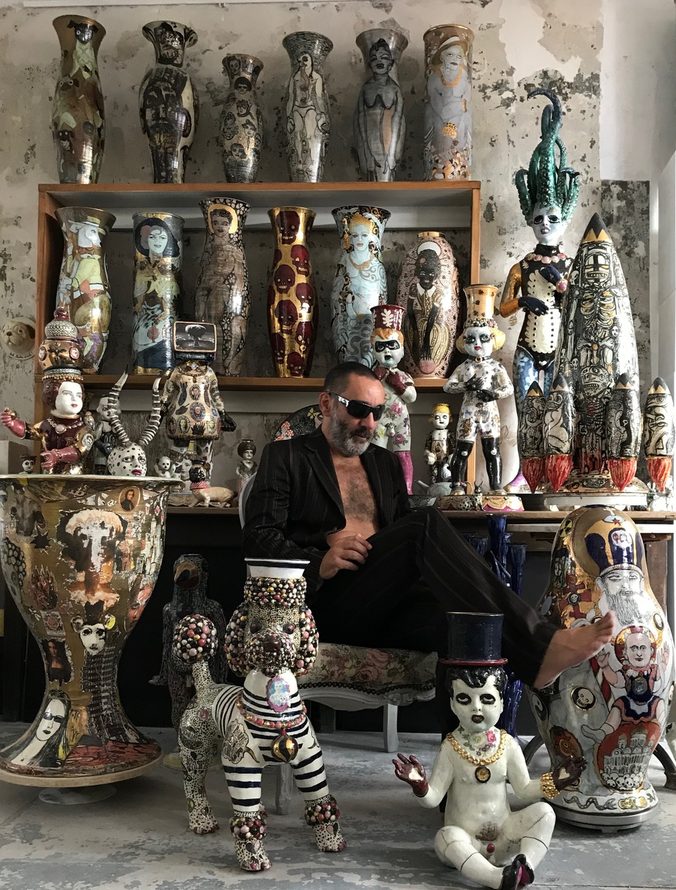
International recognition of his work now extends far beyond Berlin. His works are held in private and public collections; his more recent collaborations include a project with Jean Paul Gaultier. In 2026, he was also awarded the Tapio Wirkkala Rut Bryk Design Award. The 30th anniversary of his gallery thus marks three decades of continuous artistic practice.
Two generations of artists in one place
The opening of the Joachim John Archive and Museum adds a special dimension to this anniversary. Hinrich Kröger-John is establishing a permanent home for his father’s work within the spaces of his gallery and the private rooms above it. The archive, museum, gallery and studio are thus brought together under one roof.
The connection between the two artists is not limited to their family relationship. It also tells of different paths within the visual arts. Joachim John developed his work primarily through drawing and printmaking, as well as through his engagement with history and literature. Hinrich Kröger-John found his own artistic language chiefly in ceramics and porcelain, in sculptural form and painted surfaces. This shared space brings these different artistic biographies into view without equating them.
For Hinrich Kröger-John, the archive brings with it an additional responsibility. Alongside his own work as an artist and gallery owner, he preserves and promotes his father’s body of work, making it accessible to the public. The fact that this is taking place to mark the 30th anniversary of his own gallery lends the celebration a special significance: a dedicated art space, developed over decades, is simultaneously becoming a home for the artistic legacy of the preceding generation.
The Joachim John Archive and Museum in Berlin
The opening now offers the opportunity to bring together different facets of Joachim John’s oeuvre in one place. The exhibition encompasses works spanning almost six decades and brings together early pieces from the 1960s with works from his later creative period. Alongside drawings on the French Revolution and the fall of the Berlin Wall, the exhibition features works on Latin America, Franz Kafka and Woyzeck, as well as gouaches and pastels. Furthermore, as part of Berlin Art Week, porcelain and ceramic works by Joachim John will be shown for the first time alongside new works by Hinrich Kröger-John.
The archive is not alone in this endeavour. The Academy of Arts in Berlin itself holds a significant collection of John’s drawings and prints and, back in 2011, published the book Joachim John. The Draughtsman, which provides an overview of his work from the early 1960s up to the present day at that time.
The new archive and museum now add a private perspective, directly linked to the family. Thirty years after founding his gallery, Hinrich Kröger-John is creating space for his father’s work within his own artistic space. This makes accessible a body of work whose themes – revolution, social change, political power, literature, memory and the relationship between the individual and history – remain highly relevant today.
WHEN?
Opening: Saturday, 12. September 2026, 5:00 to 9:00 pm
WHERE?
Galerie Hinrich Kröger-John
Joachim John Archive and Private Museum
Eisenacher Straße 114
10777 Berlin