




The Alfred Ehrhardt Stiftung presents for the first time the historical industrial photographs of Alfred Ehrhardt (1901-84) in an entirely new, contemporary light. From 1954 to 1963, Ehrhardt produced numerous films and photographic works on commission for the tobacco company Reemtsma & Co. These works have remained largely underrecognized and stand in contrast to his well-known artistic photographs of nature and landscapes. The documents, which have rarely been exhibited, form the foundation for Leipzig-based artist Ramona Schacht’s (b. 1989) latest work: equality between property and photography, Images on Commission for Reemtsma. Schacht engages intensively with the working environments depicted in the images, examining which political, economic, and physical orders they reveal- and which remain concealed. Tobacco as a raw material is present throughout the exhibition in the form of plants grown by the artist herself.
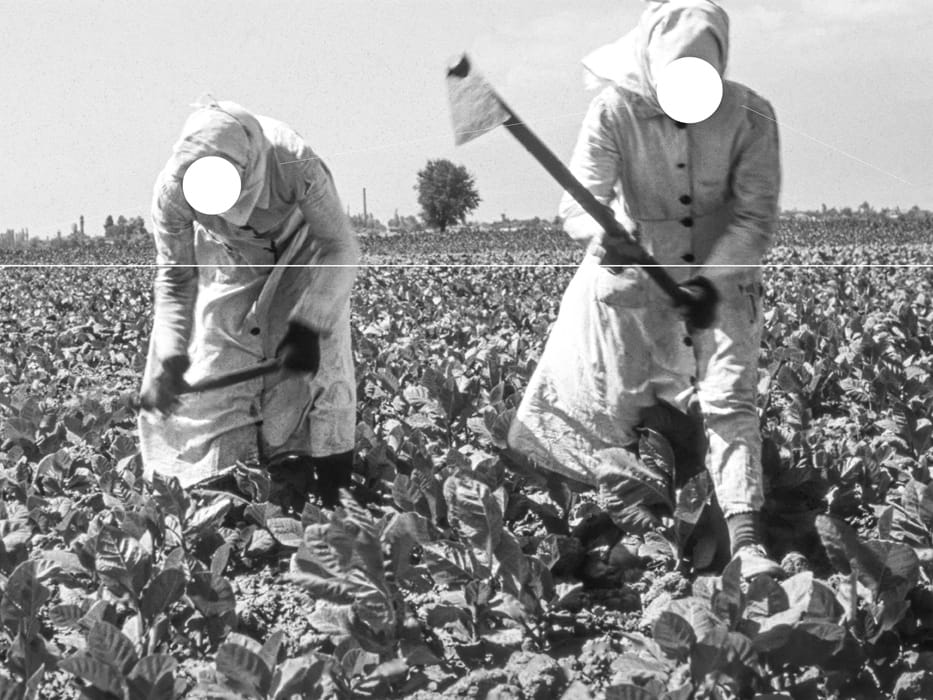
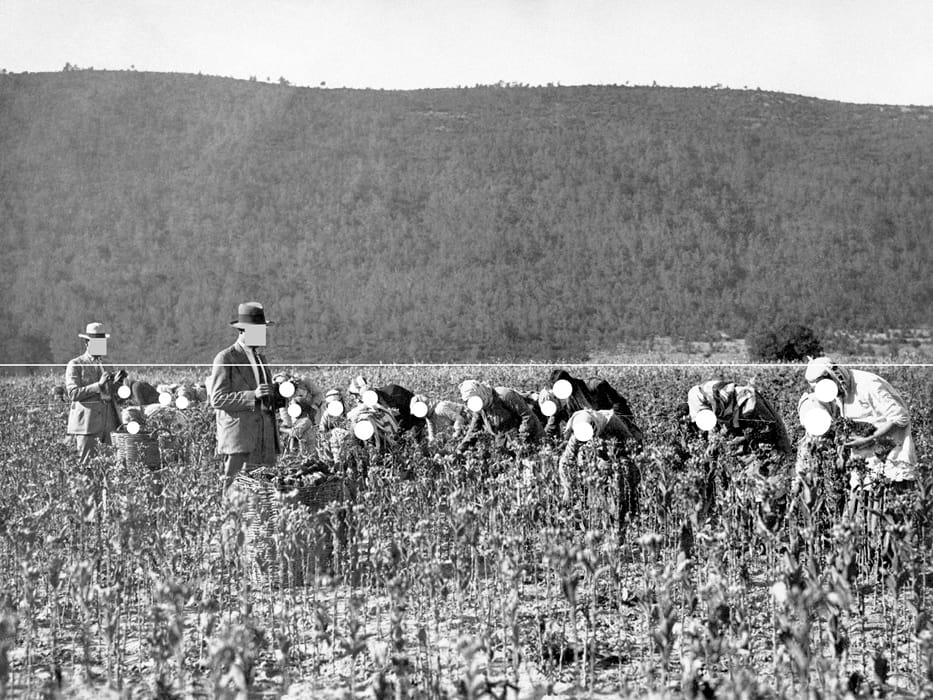
Image above: Ramona Schacht, o. T. (Detail), „Hacken, Unkraut jäten und immer wieder Hacken. Das ist die unentwegt pflegende Arbeit der Tabakbauern, wie es auch die Arbeit unserer deutschen Weinbauern ist.“, (Sprechertext), Einzelbild aus dem Auftragsfilm Die Welt des Tabaks, 1954/55, Alfred Ehrhardt Stiftung, Berlin aus dem Tableau Gebeugte Körper, innerhalb der Werkserie Photography’s Claim to Property. Bilder im Auftrag Reemtsmas, 2026, © Ramona Schacht.
Ehrhardt’s film Die Welt des Tabaks (The world of tobacco) from 1956-together with the photographs produced alongside it, which are also featured in the exhibition-documents various sites and stages of tobacco production. The journey leads from the traditional cultivation of tobacco plants in Macedonia, through the technological modernity of American factories, and finally to Hamburg, where the production capacity of the Reemtsma conglomerate is showcased.
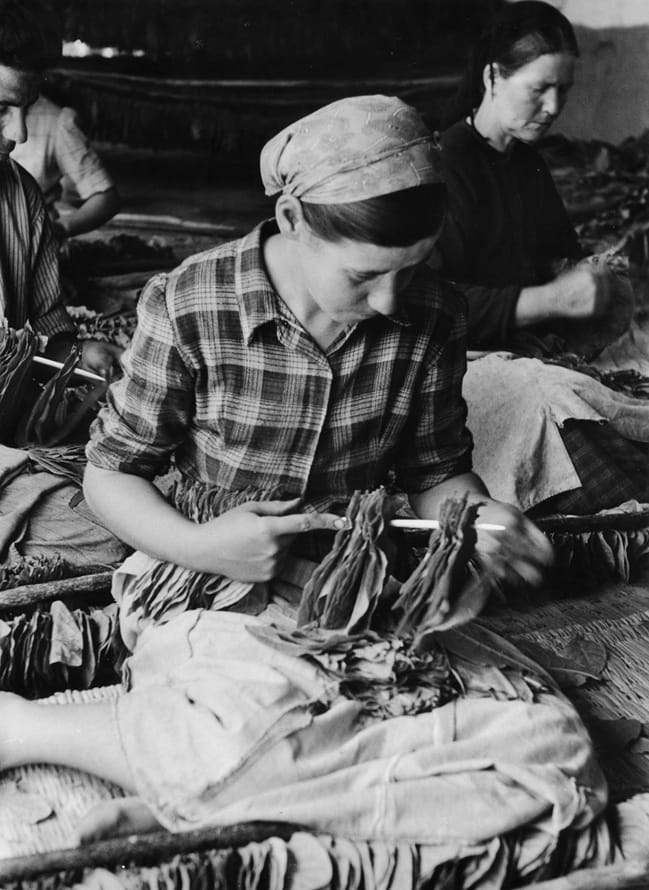
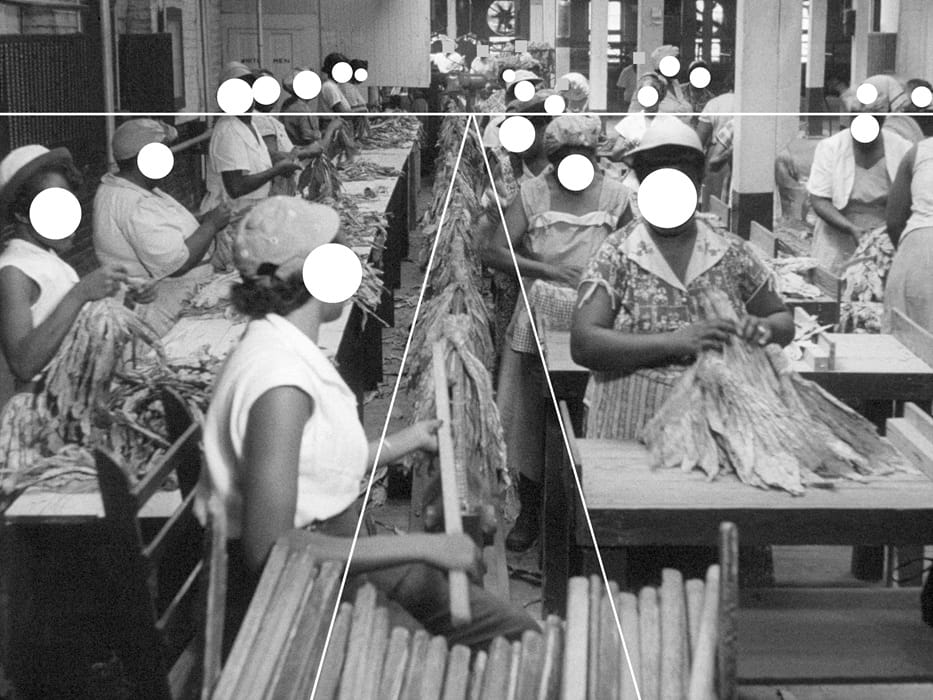
Building on this, Schacht conducted extensive research in the Reemtsma photo archive as well as in other archives related to tobacco production from the 1920s to the 1950s, shifting the focus from individual documents to broader patterns of image organization. She approaches this archival material in a decidedly fragmentary manner since no single image today is capable of conveying the entirety of historical reality. Rather than constructing a cohesive narrative, she focuses on recurring structural elements, including certain postures, lines of sight, distances, sequences, and bodily arrangements. Through a lens of social critique, she examines how women’s labor is simultaneously made visible and evaluated in Ehrhardt’s images.
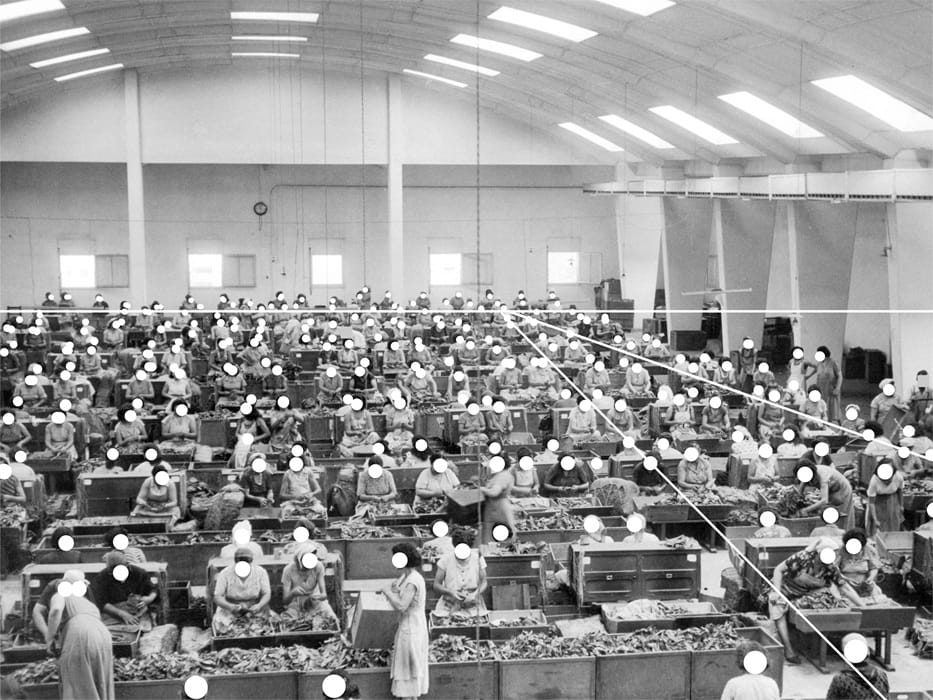
In the film, women’s labor is primarily portrayed through mass and rhythm. This observation forms the basis of Schacht’s first two series of works, in which she directly intervenes in Ehrhardt’s footage. Her tableaux-evocatively titled Gebeugte Körper (Bent bodies) and Vorbestimmte Besetzung (Predetermined line-up)-comprise various shots of laborers in the tobacco fields and factory halls, revealing both the structures of industrial visual language and the gestures and postures of the women workers. The women are not merely passively placed within the image but actively determine its composition. Schacht isolates vanishing lines, central perspectives, repetitions, and geometric patterns, translating these into precise lines and points and thereby creating a new graphic framework.
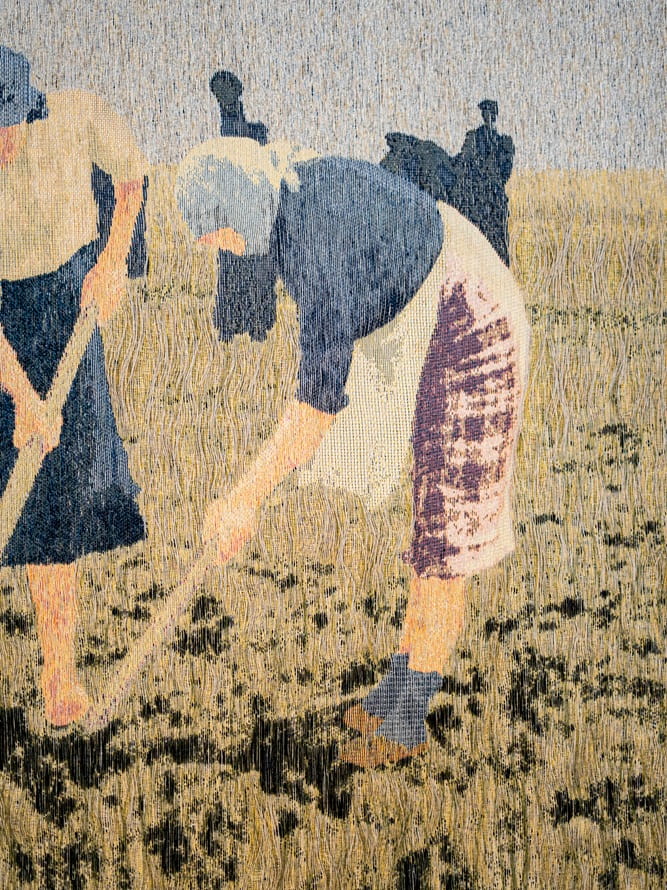
The motif of the female body bent over extends far beyond tobacco production and recalls art historical icons such as Jean-Francois Millet’s The Gleaners from 1857. Such depictions were often aestheticized and presented with a beauty that softened the harshness of the labor involved. Other related art historical references displayed in the vitrines provide insight into Schacht’s research process. In the case of the field workers, the trail leads to photographs from the 1943 Krim-Album, a collection images from Crimea held in the Reemtsma archive. These documents raise critical questions about the history of tobacco production during National Socialism, particularly the use of forced labor in Crimea. Schacht transforms a photograph of women field workers into an elaborate jacquard textile. Here, she evokes historical tapestries and wall hangings, which for centuries served as media of power, wealth, and the display of authority. In commissioned photography as well, women workers are invariably exploited in two ways-by the companies and by the photographer’s camera.
In a staged conversation filmed from the perspective of the present, Schacht encounters a fictional post-war filmmaker and questions him about his role as author, director, and narrator. Presented as a standalone filmic work, this encounter brings together various levels of artistic research. The historical film, the archival images, the male gaze, the question of historical responsibility, and the possibility of reinterpreting historical material from a contemporary perspective are thus woven together.
Across all levels, the exhibition invites viewers to approach historical images not as neutral documents. It enables an ongoing engagement with the layers of history, labor, and cultural perception. Schacht’s portrayal of women’s labor in particular opens up new perspectives on often overlooked realities within processes of production, including precarious working conditions, global supply chains, and bodies controlled and made interchangeable by economic systems. Rather than merely looking back, her research is a precise attempt to identify structures within historical imagery whose effects continue to be felt today.
WHEN?
Opening: Friday, 11. September 2026, 7-9 pm
Exhibition period: Saturday, 12. September until Sunday, 20. December 2026
Opening hours: Tue-Sun, 11 am – 6 pm
Accompanying events: (Advance registration is required at info@aestiftung.de):
Guided tour of the exhibition with the artist Ramona Schacht and the curator Stefanie Regina Dietzel: Thursday 24 September 2026, 6.00 pm
In conjunction with the Literaturhaus der Fotografie series: »Need a Light?«, Reading and discussion with Melanie Aufenvenne on the cultural history of smoking, moderated by Thomas Böhm (radioeins: Die Literaturagenten): Thursday, October 8, 2026, 7pm:
»Das neue Rauchen: Ein künstlerischer Blick auf die Gegenwart der Tabakindustrie«, talk with photographer Oliver Heise and Prof. Dr. Steffen Siegel, Professor of the Theory and History of Photography at Folkwang University of the Arts: Sunday, October 11, 2026, 2pm
»Labour as Image, Gender as Medium: Women’s Work in the Industrial Archive, from the Filmfabrik Wolfen to Ramona Schacht«, slide presentation by Dr. Katerina Korola, Assistant Professor of Film & Media, University of California, Berkeley (in English): Thursday, November 26, 2026, 7pm
Guided tour of the exhibition with artist Ramona Schacht and curator Stefanie Regina Dietzel, featuring a sound performance by Kyoco Taniyama: Sunday, November 29, 2026, 4pm
WHERE?
Alfred Ehrhardt Stiftung
Auguststraße 75
10117 Berlin





 in an entirely ...)