

In February 2026, Arnold Schoenberg’s highly demanding “Gurrelieder” with Sir Donald Runnicles at the Philharmonie, Franz Schreker’s DER SCHATZGRÄBER, and Detlev Glanert’s DIE DREI RÄTSEL will return to the program of the Deutsche Oper Berlin.
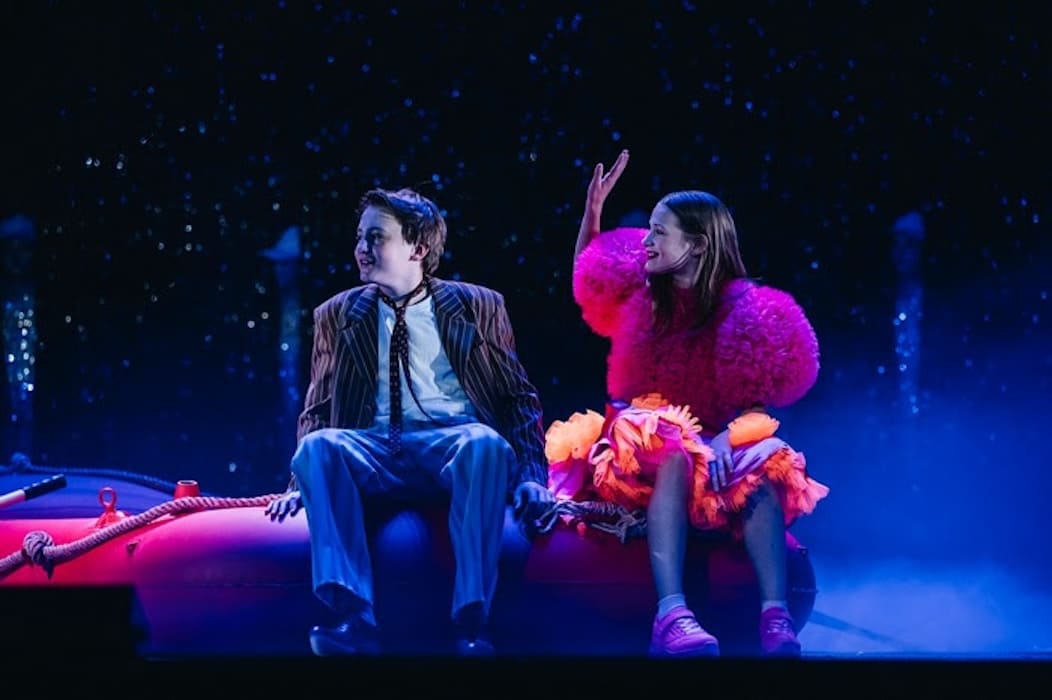
Image above: DIE DREI RÄTSEL © Nancy Jesse. Courtesy of Deutsche Oper Berlin
On 10. February Arnold Schoenberg’s “Gurrelieder,” one of the absolute pinnacles of choral-symphonic literature, which is rarely performed due to its immense demands, will be presented. In addition to the Chorus and Orchestra of the Deutsche Oper Berlin, the Berlin Radio Choir will participate, along with soloists AJ Glueckert, Felicia Moore, Annika Schlicht, Thomas Blondelle, Thomas Lehman, and narrator Thomas Quasthoff. Sir Donald Runnicles will conduct, and Jeremy Bines has prepared the choirs.
The concert will take place on February 10th at 8 pm in the Philharmonie.
It began as a song cycle for two voices and piano accompaniment and became a mammoth choral-symphonic work: Arnold Schoenberg’s “Gurrelieder,” based on poems by the Danish writer Jens Peter Jacobsen, tell the story of the love between Tove and King Waldemar. In the “Gurrelieder,” Schoenberg, following in the footsteps of Richard Wagner, Gustav Mahler, and Richard Strauss, combines all the musical influences of late Romanticism into an almost two-hour monumental work that represents a high point of that artistic era—and at the same time an endpoint: In fact, during the years of completing and premiering the “Gurrelieder,” Schoenberg had already taken the step into atonality.
The performance of the “Gurrelieder” also marks the end of an era at the Deutsche Oper Berlin, as it is part of the farewell to General Music Director Sir Donald Runnicles, who will relinquish this post after 17 years of service at the end of the 2025/26 season.
The concert will be broadcast live on rbb radio station radio3.
Re-releases: Schreker’s THE TREASURE GRABBER and Glanert’s THE THREE RIDDLES
Conductor Marc Albrecht describes Franz Schreker’s mystical masterpiece as “a gigantic chamber music piece for 120 musicians.” The work tells the story of Els, the motherless innkeeper’s daughter who incites her lovers to steal coveted jewelry and then ruthlessly murders them after handing over the loot. Quite different is the traveling minstrel Elis, who, with his mysterious lute, can track down treasures which he generously gives away. But even the possession of all the gold jewelry cannot quench their mutual desires.
THE TREASURE GRABBER was one of the most important operas of the 1920s. Its premiere in Frankfurt in 1920 was a sensational success, followed by 44 productions at various opera houses over the next five years. But then the once-popular work faded into obscurity. The role of Els is sung by Olesya Golovneva, recently celebrated in the title role of Respighi’s LA FIAMMA. Daniel Johansson returns to the Deutsche Oper Berlin as Elis, with Thomas Cilluffo as the Fool and Tómas Tómasson as the Bailiff. Performances are on 30. January, 7. February, and 12. February.
Detlev Glanert’s THE THREE RIDDLES enjoyed a brilliant premiere in October 2025, and the production returns to the repertoire for three performances on 13. February (11 a.m.) and 15. (2 p.m. and 6 p.m.). In this work, the children’s choir and the youth choir are the main actors on stage alongside the young protagonists Lasso and Scharada, portrayed by soloists from the children’s choir as well as ensemble members who embody the dubious world of adults. “When a production succeeds so well that each individually arranged scene is greeted with thunderous applause, it shows that musical theater can also send a young audience into ecstasy – and with the same musical quality as that of the ‘grown-ups’,” commented the Deutsche Bühne after the premiere. Director Brigitte Dethier, recently honored with the FAUST Prize for her life’s work, and set designer Carolin Mittler have created a production with meticulous attention to detail. Dominic Limburg is the musical director, leading a large number of young musicians alongside the orchestra.
Cast highlights: ELEKTRA and RIGOLETTO
Catherine Foster remains one of the most outstanding interpreters of Elektra, and we are delighted to welcome her back in this role on February 21 and 27. She recently captivated audiences as the Dyer’s Wife in Tobias Kratzer and Donald Runnicle’s interpretation of THE WOMAN WITHOUT A SHADOW. Alongside her are the charismatic Karita Mattila as Clytemnestra, Flurina Stucki as Chrysothemis, and Tobias Kehrer as Orestes.
Xabier Anduaga is undoubtedly one of the most exciting young tenors currently conquering the major opera houses. He made a sensational debut as Nemorino (L’ELISIR D’AMORE) at the Metropolitan Opera, and has also performed at the opera houses in Vienna, Munich, London, and Madrid. He also gave a compelling performance in ANNA BOLENA at the Deutsche Oper Berlin. Now, we eagerly anticipate his portrayal of the Duke of Mantua in RIGOLETTO on February 22 and March 1, alongside Juan Jesús Rodriguez in the title role and Lilit Davtyan, who makes her debut as Gilda.