

On 20. June 2026, the Deutsche Oper Berlin will stage the premiere of Albert Lortzing’s ZAR UND ZIMMERMANN. This marks the return to the opera stage of a hit production that has not been seen on Berlin stages for a long time.
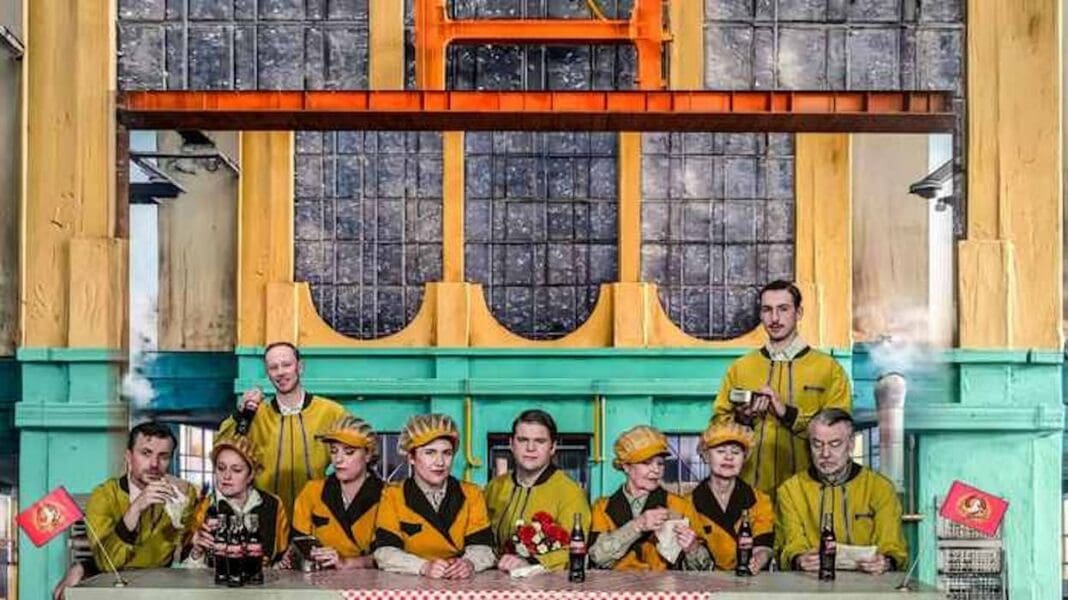
Image above: Filmstill © Vincent Stefan
Just 25 years ago, Albert Lortzing’s operas formed the backbone of German theatre programmes; then, within a short space of time, they vanished almost entirely from the repertoire without a trace. Unfairly so – according to conductor Antonello Manacorda and director Martin G. Berger, who are now bringing Lortzing’s greatest hit, ZAR UND ZIMMERMANN, back to the opera stage. Describing the opera, which premiered in 1837 and centres on Tsar Peter I – who in 1698 acquired basic skills as a shipwright whilst working incognito at a Dutch shipyard – as a brilliant blend of comedy of errors with a serious undertone and a precursor to operetta and musical, Berger situates the work within this context. For in Lortzing’s work, the comedy of mistaken identity becomes a piece that lightly reveals the weaknesses and ideals of a society that, in many respects, has not changed all that much since then. The deserter Peter Ivanov, who fears discovery and really just wants to be left in peace; the feisty mayor’s niece Marie, who wants an equal relationship and insists on it; and her uncle van Bett, who on German stages has become the epitome of the official who is as overwhelmed as he is authoritarian – all remain convincing in their believability – as does the Tsar, who remains an outsider in this world.
Berger is not merely concerned with the humour that arises time and again throughout the play from the mix-ups and contrasts between high politics and small-town life, but also with the juxtaposition of two social models in this opera: on the one hand, the West with its modernity and profit-seeking; on the other, the hopelessly outdated, authoritarian people’s tsarist regime of Chirikistan, which here replaces the Russia of the original text. The balance of wordplay and seriousness that characterises ZAR UND ZIMMERMANN is also reflected in the new spoken texts, in which Berger draws on his experience as a director and translator of musicals – not to improve on Lortzing, but to adapt the pace of the comedy to our contemporary sensibilities. This is a play to be rediscovered; with its wordplay, its musical humour – informed by Italian buffo opera – and its catchy melodies, it ranks among the most successful German comedies of all time.
The enthusiastic ensemble of the Deutsche Oper Berlin, led by Artur Garbas as the Tsar – most recently seen as Haly in L’ITALIANA IN ALGERI – Kieran Carrel, who has just been acclaimed for his role as Froh in RHEINGOLD, and Padraic Rowan, an ever-magnificent Papageno, will showcase their comic talents in ZAR UND ZIMMERMANN alongside guests such as Nadja Mchantaf, Patrick Zielke and Philipp Kapeller.
Nadja Mchantaf was a member of the Komische Oper ensemble until 2024, where she appeared in the title roles of Massenet’s CENDRILLON, Dvořák’s RUSALKA, as Tatyana in Tchaikovsky’s EUGEN ONEGIN, and as Fiordiligi in Kirill Serebrennikov’s production of Mozart’s COSÌ FAN TUTTE, winning over audiences with her clear soprano voice and great versatility.
The bass Patrick Zielke was awarded the FAUST Prize in 2020 for his portrayal of Ochs in Die Fledermaus and has also made a name for himself in major Wagner roles such as Daland, Gurnemanz, King Marke and Hagen; Rocco and Boris Godunov are also part of his repertoire. The Austrian tenor Philipp Kapeller is highly regarded for his comic talent, which he has demonstrated in roles such as Alfred in DIE FLEDERMAUS and Fenton (FALSTAFF). He can also be seen in roles such as Belmonte, Don Basilio, Lysander and Tebaldo (Bellini’s I CAPULETI E I MONTECCHI).
As the long-standing principal conductor of the Kammerakademie Potsdam, Antonello Manacorda brings to the table his knowledge of historical performance practice as well as his experience with the timing of Rossini’s comic operas. In the summer of 2025, he made his debut at the Salzburg Festival with a new production of Donizetti’s MARIA STUARDA and is a highly regarded guest at many major opera houses, including those in Paris, London, New York and Berlin.
WHEN?
Saturday, 20. June 2026
WHERE?
Deutsche Oper Berlin
Bismarckstraße 35
10627 Berlin