
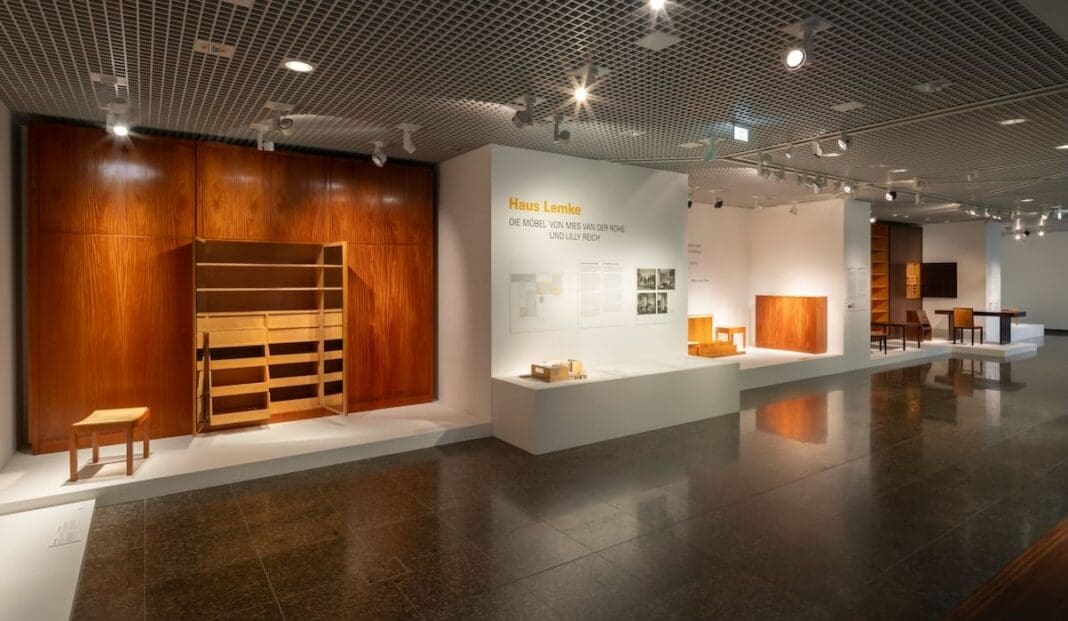

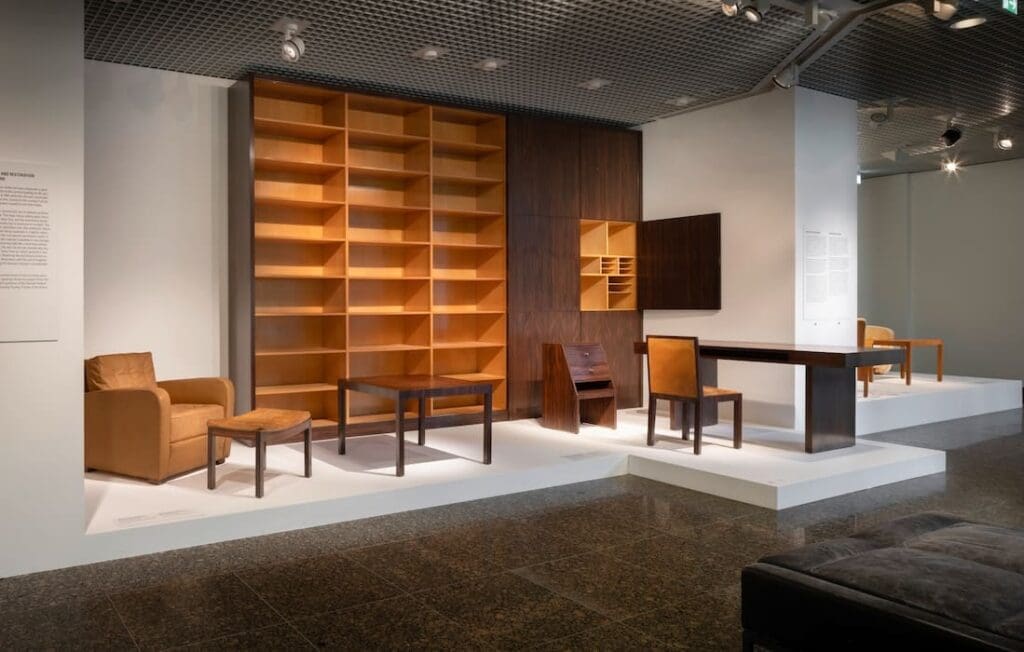
With the first complete presentation of the furniture from Haus Lemke in Berlin, the Museum of Decorative Arts showcases one of the most extensive original interior furnishings preserved from the work of Ludwig Mies van der Rohe.
Image above: Exhibition view “Haus Lemke – The furniture of Mies van der Rohe and Lilly Reich” in the Kunstgewerbemuseum. Foto: Staatliche Museen zu Berlin, Kunstgewerbemuseum / Stephan Klonk
Haus Lemke was built in 1932/33 by Ludwig Mies van der Rohe and is now internationally known as the “Mies van der Rohe House.” Located on Obersee in Alt-Hohenschönhausen (Lichtenberg district), the building, designed on a lakeside property with extensive gardens, surprises with its modest dimensions. The design reflects the moderate budget of the Lemke couple, who lived without staff and wanted a “small and modest house” that could be “extended towards the garden on nice days.”
After a series of different preliminary designs, which also included two-story variants, an L-shaped house type finally emerged, partly for cost reasons. The single-story building with wide-open window fronts faces the garden. The bedrooms, living room, and study are grouped together as the main rooms around a living terrace flanked by brick walls and shaded by a walnut tree. The level transition from the interior to the garden via the seamlessly adjoining terrace creates a special connection between the interior of the house and the surrounding nature.
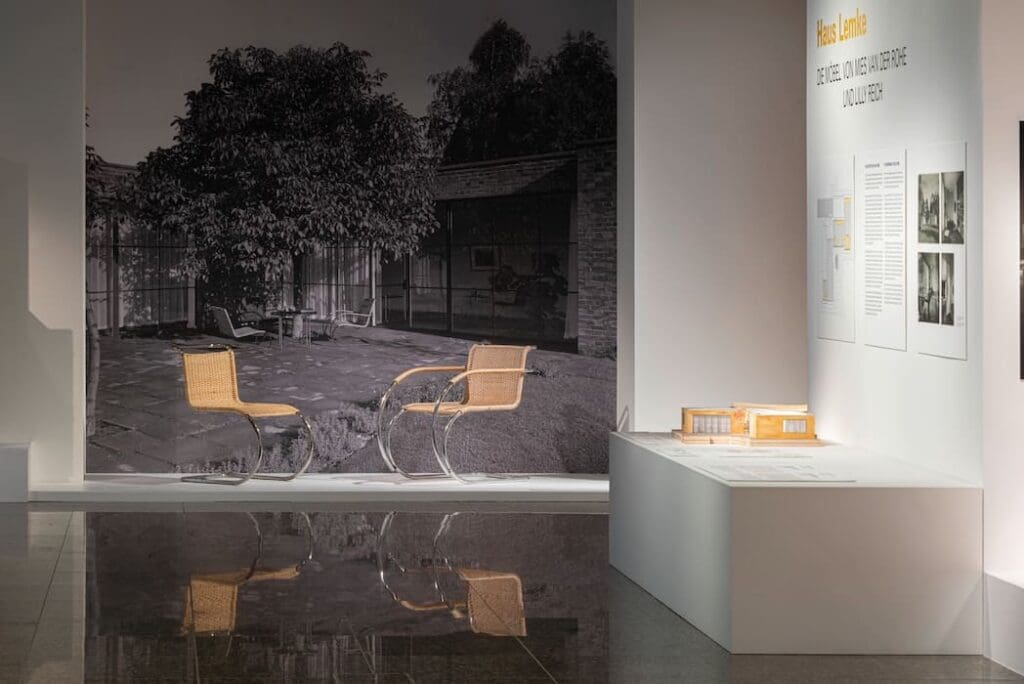
The furnishing of Haus Lemke with furniture based on designs from the Mies van der Rohe office took place after the building was handed over in April 1933. During this time, Mies presented his initial plans for the study, but these were not implemented. It is likely that the planning continued in 1934 with Lilly Reich, and former employees such as Friedrich Hirz were also consulted. The study and bedroom were furnished entirely according to the new designs, while existing furniture was used in the living room. According to Martha Lemke’s recollection, the furnishing was not completed until 1937. It was featured in the Deutsche Bauzeitung that same year with a photograph by Max Krajewsky, who had taken a series of interior photographs of the building at the time.
The furnishings of Haus Lemke are clearly based on the design developed by Mies van der Rohe and Lilly Reich since the mid-1920s. Despite the spectacular modern tubular steel furniture, veneered wooden furniture remained the basis of the interior design. In keeping with the sophisticated interior design style of their time, they combine the material aesthetics of fine wood, bound by strict geometric forms and spatial proportions, with the equally elaborate workmanship of stone, glass, and metal surfaces. Haus Lemke was the last building project realized by Mies before his final emigration and concludes a series that extends from his own Berlin apartment on Karlsbad (1926) to Haus Wolf in Guben (1927), the two Krefeld houses Esters and Lange (1928), and finally Haus Tugendhat in Brno (1930).
With the end of the war and the expulsion of the owners by the Red Army, the building underwent a series of changes in 1945, serving as a car repair shop, laundry, and warehouse for the East German secret police, among other things. This led to extensive renovations and demolitions until 1989, changing the entire ensemble of the house and garden. Listed as a historic monument by the East Berlin municipal authorities in 1977, the building came under the municipal authority of the district, now Berlin-Lichtenberg, in 1990 as a result of the peaceful revolution and civic engagement. The house was opened to the public and, with its renaming as the “Mies van der Rohe House,” was given a contemporary use as an international venue for contemporary art, architecture, and research on the life and work of Ludwig Mies van der Rohe. Finally, from 2000 to 2002, a thorough renovation was carried out in accordance with historic preservation guidelines.
Karl Lemke was the owner of the renowned Otto von Holten art and book printing company in Berlin and managing director of a graphic arts institute. His clients included institutions and artists. After his death, Martha Lemke continued to maintain good contacts with the museum world in the early 1970s. She bequeathed her estate to various Berlin museums, and so the furniture from the Lemke house found its way to the West Berlin Museum of Decorative Arts in 1984.
WHEN?
Opening: Sunday, 7. December 2025, 12 Uhr
Exhibition dates: 10. December 2025 until (to follow)
WHERE?
Kunstgewerbemuseum
Kulturforum Berlin
Johanna-und-Eduard-Arnhold-Platz / Matthäikirchplatz
10785 Berlin