

The Israel-born artist Amnon David Ar presents a comprehensive solo exhibition at the Kirche am Hohenzollernplatz in Berlin-Wilmersdorf. Light Years brings together works created since his move to Berlin in 2013 and is accompanied by the publication of a namesake art monograph. Concerts and artist talks will accompany the exhibition.
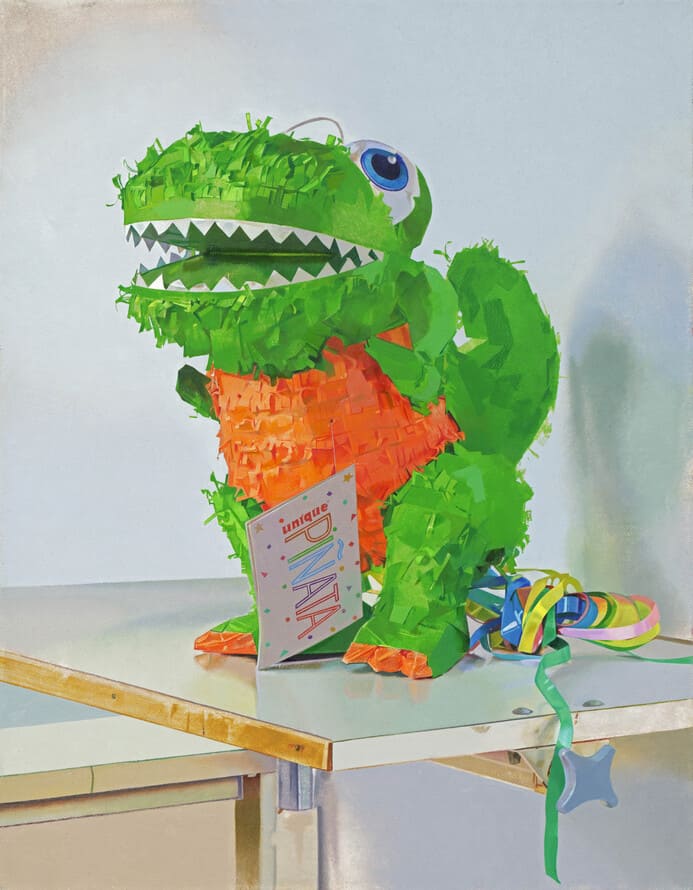
Image Above: Amnon David Ar: Childhood, 2024, aus der Serie Cycle of Life Credit: Courtesy the artist Foto: Hans Georg Gaul.
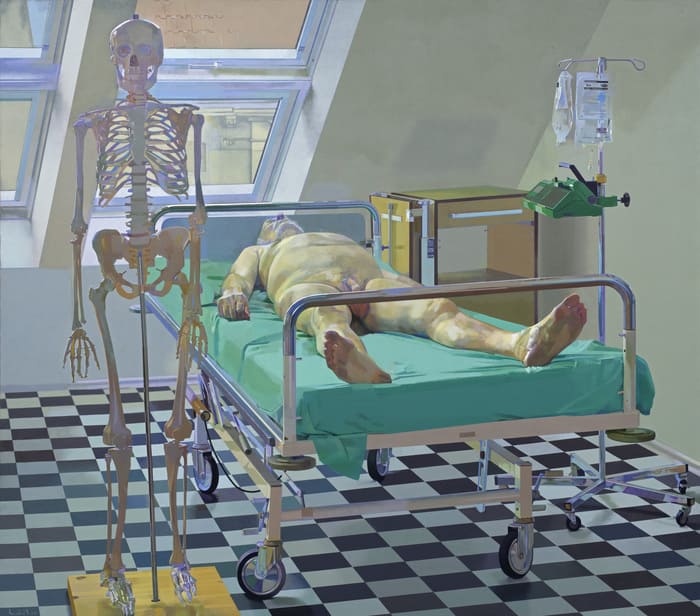
The exhibition on Amnon David Ar, curated by long-time Louvre curator for contemporary art Martin Kiefer, offers an in-depth look at the artist’s painterly oeuvre through works created in Berlin. The large-scale pieces depict everyday still lifes, overlooked objects, and portraits. In dialogue with art history, the paintings consistently provide highly personal insights into the artist’s inner world.

Ar’s style, marked by technical precision, points toward hyperrealism, yet his primary focus is always the questioning of objects. Figures, objects, and symbols are brought together in unexpected constellations, where the familiar becomes strange and subtly enigmatic. In his paintings, for example, an old sterilizer might appear next to an inflatable pig, a broken egg beside a golden Chinese lucky cat, or a bust of Lenin alongside a fresh banana.
At the center of the exhibition at the Kirche am Hohenzollernplatz is The Cycle of Life, a monumental series ongoing since 2016 that revolves around six phases of human existence: birth, childhood, youth, adulthood, old age, and death. In this large-scale series, reflections on beauty, fear, hope, and imagination are brought together.
The “light years” referred to in the exhibition title—Light Years—allude to the distance and time that light requires to reach us. This sense of inner contemplation is also reflected in the choice of exhibition space, where the paintings acquire a particular resonance. On the one hand, the staging is clearly shaped by the church interior; on the other, the space resonates with the questions of religion and knowledge that are inherent in Amnon David Ar’s work at the Kirche am Hohenzollernplatz.
Childhood is the theme of the follow-up exhibition at the Kurt Mühlenhaupt Museum, which will open during the Berlin Art Week in 2026. Ar’s series on toys reflects the tensions between fantasy and reality, mass production and individualism, as well as social indoctrination and gender roles. One work from the series Childhood, for example, shows a mass-produced dinosaur toy bearing the inscription “Unique Piñata.”

Amnon David Ar was born in 1973 in Israel and began his professional career at the age of 17 as an illustrator and caricaturist for various newspapers in Israel. After just one year at the Bezalel Academy of Arts and Design, he chose to pursue his own artistic path. Ar has received several awards, including first prize in the See.Me Competition in New York, the Haim Shiff Prize from the Tel Aviv Museum of Art, and third prize at the Boynes Artist Award in Melbourne.
He has exhibited internationally in museums and galleries, including the Museu Europeu d’Art Modern, the Tel Aviv Museum of Art, the The Armory Show, the Forum Gallery, and NordArt. His works have been featured in publications by renowned publishers such as Thames & Hudson and Hirmer Verlag, and are held in important collections including that of Len Blavatnik, the Tel Aviv Museum of Art, the Stiftung St. Matthäus, among others.
As a long-time peace activist, Ar—together with his partner, the concert pianist Yehuda Inbar, as well as other artists and scholars—is a co-founder of the Responses Culture Society e.V., a Berlin-based nonprofit organization that promotes interdisciplinary art as well as the values of democracy, social equality, and peace. Through concerts and cultural events, the organization has raised funds for Israeli and Palestinian humanitarian and peace organizations.
The Kirche am Hohenzollernplatz was designed from 1930 onward in the Expressionist style by the Polish-Jewish architect Ossip Klarwein, working in the architectural office of Fritz Höger. Shortly before the church’s inauguration in 1933, Klarwein was forced to flee Nazi Germany. As an architect, he went on to design some of Israel’s most significant buildings, including the Knesset, the Theodor Herzl Tomb, and the Dagon Grain Silo. The vibrant light inside the church, created by its famous stained-glass windows, reflects both the title of the exhibition and Ar’s work.
WHEN?
EHIBITIONS DATES: Thursday , 21. May to Thursday, 3. September 2026
WHERE?
Kirche am Hohenzollernplatz
Nassauische Straße 66-67
10717 Berlin