
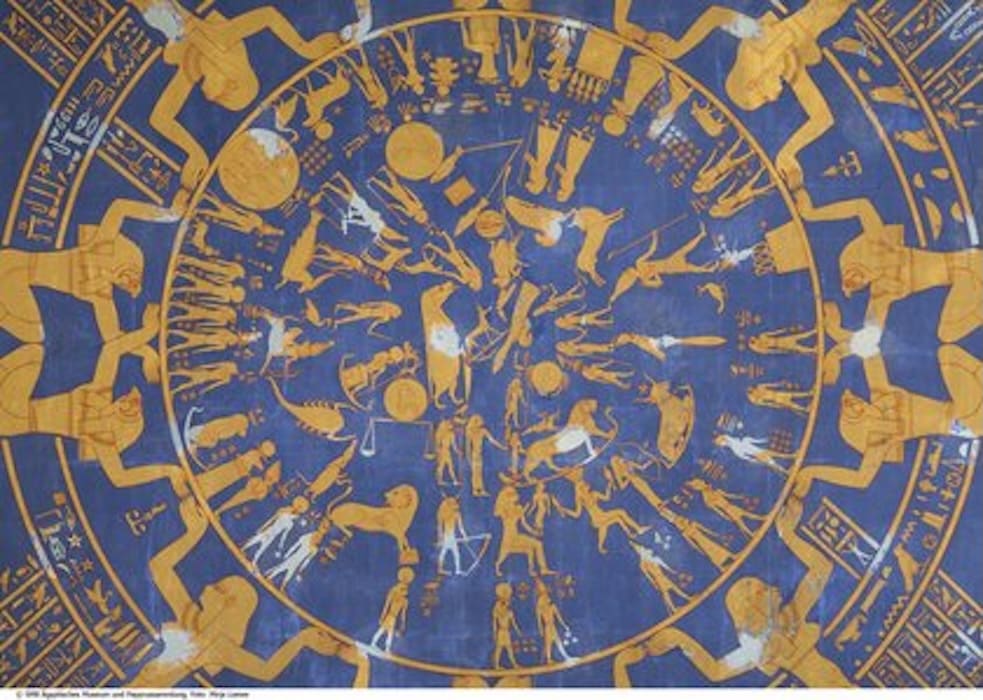

The exhibition presents the ancient zodiac in several thematic sections from current scientific and societal perspectives, explaining it against the backdrop of its contemporary significance. Using ancient artifacts, some never before exhibited, from the collections of the Egyptian Museum and Papyrus Collection as well as the Museum of the Ancient Near East, it takes visitors on a multicultural journey through space and time – from Babylonia to Egypt, Greece, and Rome (c. 400 BC to 400 AD).
Image above: Painterly rendering of the round sky image from Dendera on a ceiling in the Neues Museum © Staatliche Museen zu Berlin, Ägyptisches Museum und Papyrussammlung / Sandra Steiß
“What’s your zodiac sign?” This question is still frequently asked today, in the age of science. The zodiac has fascinated people since antiquity. It unites humanity and the cosmos, heaven and earth, astronomy and astrology, science and faith, tradition and innovation, security and uncertainty, harmony and dissonance.
But what exactly is the zodiac? An oracle that generates signs for the future? A mirror that provides insights into the psyche? A projection screen for our striving for knowledge and security? A coordinate system that makes the movement of the planets calculable? A visible expression of celestial harmony? Or all these things at once? And where does it come from, how did it spread across the world, what was it used for, and how was it depicted?
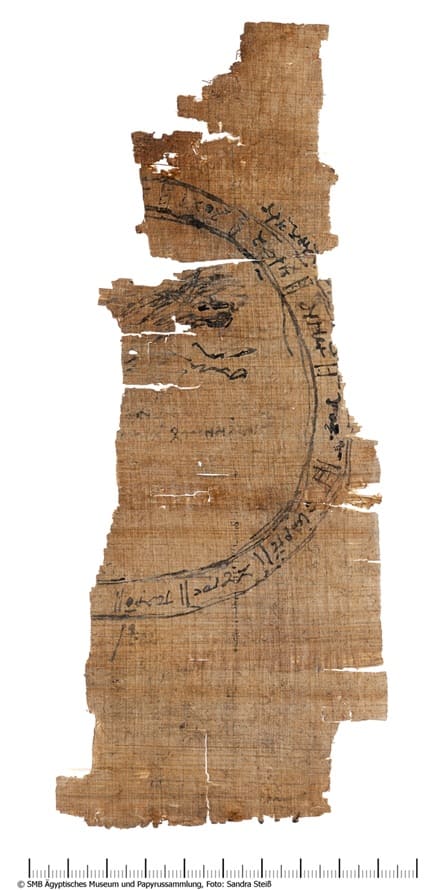
What is the contemporary significance of the zodiac? In the public perception, the zodiac is primarily associated with horoscopes today. The introduction of the zodiac was a turning point in astrology. Along with the zodiac, horoscopy emerged in Babylonia as a new astrological practice, accessible for the first time not only to kings and rulers, but also to private individuals from various social strata. Today, it is more popular worldwide than ever before, even though it is classified as an esoteric practice and pseudoscience. It is based on the belief that the position of the planets at the time of birth contains clues about a person’s nature and destiny. This belief stems from the timeless human need for meaning, knowledge about oneself and the future, security, and methods for coping with uncertainty. What could be more meaningful and appealing than the realization that a person’s nature and destiny are linked to the cosmos?
The relevance of the zodiac extends to scientific and cultural practices that are of central importance to modern society. We are accustomed to having constant access to data, analyses, calculations, and forecasts via computers and apps. The roots of systematic observation, data collection, data analysis, algorithms, calculation, and prediction lie in the zodiac and in the astronomical calculation methods developed in connection with it in antiquity. Furthermore, the journey of the zodiac and the associated new astronomical and astrological knowledge and practices through the ancient world is a prime example of innovation, globalization, intercultural exchange, and multiculturalism—central and currently much-discussed societal issues.
A richly illustrated catalogue will be published to accompany the exhibition.
WHEN?
Opening: Friday, 20. March 2026, 7 pm
Exhibition: Saturday, 21. March 2026 – Sunday, 10. January 2027
WHERE?
Museumsinsel Berlin, Neues Museum
Bodestr. 1-3
10178 Berlin