

From May 15 to October 11, 2026, the Museum of Decorative Arts will present the work of French fashion designer Madame Grès (1903–1993), one of the most important pioneers of 20th-century haute couture, for the first time in the German-speaking world. The exhibition focuses on the museum’s 25-piece Grès collection, one of the largest collections outside Paris, complemented by designs inspired by it from students. In collaboration with the School of Culture and Design at the Berlin University of Applied Sciences, the presentation opens up diverse perspectives on the work of this extraordinary couturière and her lasting influence on fashion history.
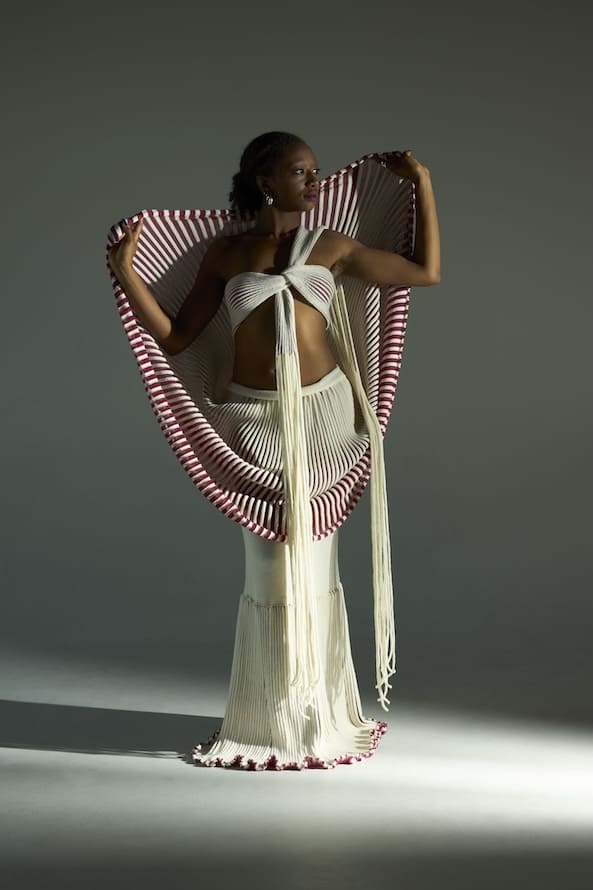
Image above: Vanessa Hoffmann, Two-tone knit dress, merino wool, summer semester 2024. Photo: Laura Wolf / Ivo Hänisch
Germaine Émilie Krebs began her career in the 1930s when, now known as Mademoiselle Alix, she founded the fashion house “Alix Barton” together with Julie Barton. One of the most significant objects in the collection of the Museum of Decorative Arts dates from this period: a glittering evening blouse made of mesh fabric with faceted gemstones. After 1937, she called herself Alix Grès, but she ultimately went down in fashion history as “Madame Grès.”
She became famous for her floor-length pleated dresses, for which Grès, who—according to rumor—actually wanted to become a sculptor, drew inspiration from ancient sculptures. The enduring relevance of Madame Grès, who designed dresses for Grace Kelly, Greta Garbo, and Marlene Dietrich, among others, is evident in the timeless elegance of these models inspired by classical antiquity. This important aspect is highlighted in the exhibition through direct comparison with exhibits from the Museum of Antiquities, the Museum of Byzantine Art, and the Picture Gallery.
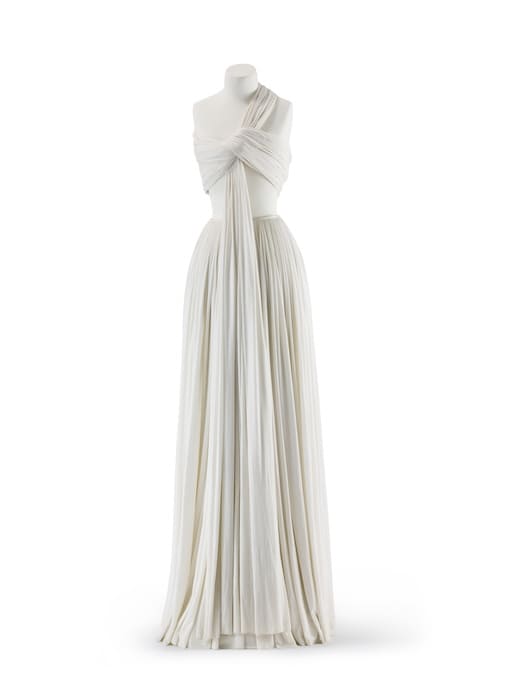
Grès’s handling of fabric is incomparable: several meters are gathered, folded, and draped into a few centimeters, creating an impressive volume. Madame Grès, of whom few personal statements have been preserved, once told the press that she designed on the model, not on the table, and that her scissors were her most important tool. What is particularly fascinating is the sophistication with which she develops what is essentially a simple cut into a highly complex sculpture on the body.
It is precisely these aspects that inspired the students at the Berlin University of Applied Sciences and which they explored in depth. Their designs are contemporary interpretations of selected pieces by Grès that are housed in the KGM and reflect around sixty years of her work. The in-depth study of the original garments in workshops led by Katrin Lindemann and Christian Mau not only resulted in a deep understanding of the techniques, fabrics, and specific materials used in the historical models, but above all in impressive independent creations in the fields of fashion design, clothing technology, knitting, photography, communication design, museology, and visual arts (3D).
Nine sections showcase around 150 diverse exhibits that can be interpreted as cross-references to the 25 models by Madame Grès, which literally take center stage in the exhibition. Among other things, the exhibition features garments on busts and mannequins, accessories, graphics, drawings, photographs, sculptures, textile objects, and multimedia installations (films, projections). These are complemented by student works and contextualizing pieces, including sculptures, paintings, photographs, graphics, films, and virtual elements.

Photographic artist Henrik Spohler explored the storage of Madame Grès’ historical clothing, resulting in eight unique photographs that subtly illustrate the museum-like aspect of handling fragile textiles. Additional AI photographs by students in Henrik Spohler’s photography class play with the question of what is fact and what is fiction, as very few reliable facts are known about the life of Madame Grès, who placed great importance on her privacy.
One section of the exhibition is dedicated to Madame Grès’ sculptural designs, featuring in-depth analyses of both Grès models and student work from the fashion design, clothing technology, and digital fashion design courses. In her installations, artist Maija Schultz explores Grès’ cutting techniques and translates them into digital models. A particular highlight of the exhibition is the grading of a Grès dress to a size 48 – thereby questioning the classic ideal of beauty.
Volume is the central theme in one of the most extensive sections of the exhibition. Previously unseen objects by Madame Grès, including coats, capes, and harem pants, impressively demonstrate her approach to cutting and pleating techniques. The students’ work translates these techniques into a new design language and new materials, such as knitwear and functional textiles.
A virtual space invites visitors to explore the students’ digital designs and navigate through this space, which was created through a collaboration between digital fashion design (Maija Schultz) and game designers from HTW.
What creative effects does layering fabrics have? Playing with transparency and layers is the focus of this section. Grès’ selection of delicate fabrics, such as muslin and crêpe de chine, forms the starting point for the students’ interpretations from the fields of fashion design and pattern construction.
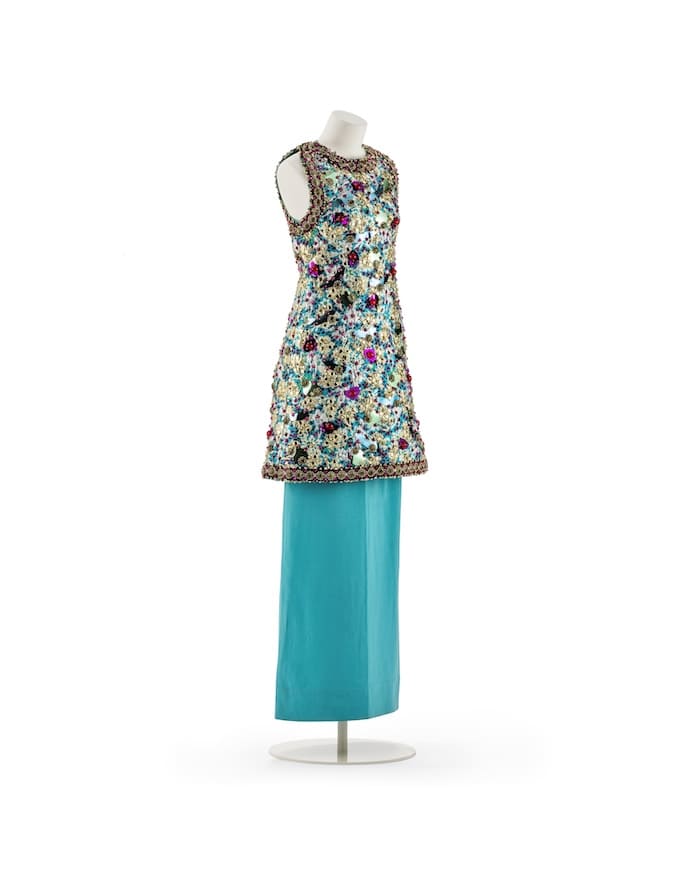
One topic that has received only marginal attention in research to date is surface design. The Museum of Decorative Arts preserves particularly delicate pieces that showcase Grès’ exploration of non-European inspirations, embroidery, and material combinations that have hardly been recognized until now. Complementing the well-known Grès pleat, these previously unknown models expand the multifaceted nature of this outstanding fashion designer.
Finally, the Museology, Product Management, and Brand Design programs at the Berlin University of Applied Sciences present the museum’s examination of the objects and today’s view of the Grès brand.
WHEN?
Opening: Thursday, 14. Mai 2026, 7 pm
Exhibition dates: 15. May – 11. October 2026
WHERE?
Kulturforum Berlin, Kunstgewerbemuseum
Johanna-und-Eduard-Arnhold-Platz / Matthäikirchplatz
10785 Berlin