
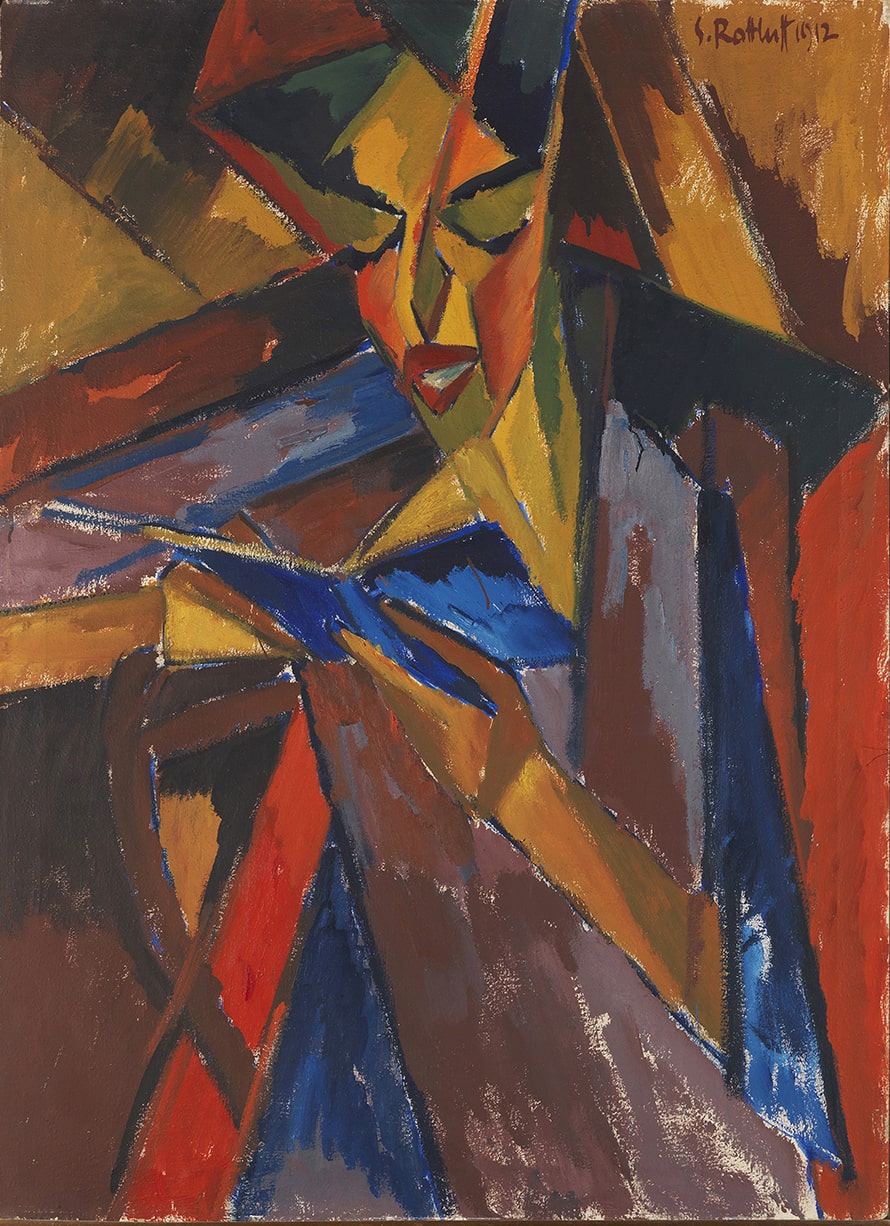

An entrepreneur from North Rhine-Westphalia succeeded in buying the famous painting “Lesende (Else Lasker-Schüler)” by Karl Schmidt-Rottluff (1912) from the Hermann Gerlinger Collection at an auction at the Ketterer auction house in Munich on 9 December 2022. It will now be given to the Von der Heydt Museum Wuppertal as a permanent loan. This brings the famous Jewish poet Else Lasker-Schüler (1869-1945) back to her birthplace (Wuppertal-)Elberfeld in the picture.
Image above: Karl Schmidt-Rottluff, „Lesende (Else Lasker-Schüler)“, 1912 © VG Bild-Kunst, Bonn 2023
Museum director Dr Roland Mönig: “We are overjoyed that Else Lasker-Schüler is virtually coming home with this portrait. The work demonstrates Schmidt-Rottluff’s full creative force at the height of his creative powers. He captured Else Lasker-Schüler’s dazzling personality in a unique composition in which an expressive, luminous colourfulness is combined with cubist experiments in form. This precious masterpiece fills a gap in our holdings of Expressionist art. Its counterpart in the Von der Heydt Museum is the famous portrait of Else Lasker-Schüler created by Jankel Adler in 1924.”
The art patron, who wishes to remain anonymous: “It was a great concern of mine to bring this special painting to Wuppertal. This is where it belongs! I am very pleased to make it available to the Von der Heydt Museum as a permanent loan.”
The work by Karl Schmidt-Rottluff was on loan in 2019/2020 in the exhibition “Else Lasker-Schüler. Prince Jussuf of Thebes’ and the Avant-garde” at the Von der Heydt Museum.
The painting will be on display at the Von der Heydt Museum in Wuppertal from the end of January 2023 – an exact date is yet to be announced.
The provenance of the work is unencumbered: Schmidt-Rottluff himself gave the precious work “Lesende (Else Lasker-Schüler)” to his long-time friend Hermann Gerlinger, an entrepreneur and patron of the arts in Würzburg who, since the 1950s, had amassed one of the most important art collections on the art of the “Brücke” ever – a rich collection of almost museum quality and high expressiveness, which was sold at several auctions in 2022.
“SCHMIDT-ROTTLUFF HAS PAINTED ME SITTING IN A TENT. […] AM ENRAPTURED BY MY COLOURFUL PERSONALITY, BY MY PRIMORDIAL FRIGHTFULNESS, BY MY DANGEROUSNESS, BUT MY GOLDEN FOREHEAD, MY GOLDEN LIDS THAT OVERSEE MY BLUE POETRY. MY MOUTH IS RED LIKE A THICKET BERRY, IN MY CHEEK THE SKY ADORNS ITSELF TO THE BLUE DANCE, BUT MY NOSE BLOWS TO THE EAST, A WAR FLAG, AND MY CHIN IS A SPEAR, A POISONED SPEAR. SO I SING MY HIGH SONG.”
Else Lasker-Schüler, Briefe nach Norwegen, in: Der Sturm. Monatsschrift für Kultur und die Künste, No. 94, January 1912, p. 752.
Biografy Karl Schmidt-Rottluff
* 1884 Rottluff near Chemnitz † 1976 Berlin
The painter, graphic artist and sculptor Karl Schmidt was born in 1884 in Rottluff near Chemnitz as the son of a miller. In 1905 Schmidt-Rottluff began studying architecture at the Technical University in Dresden. There he met Ernst Ludwig Kirchner, Erich Heckel and Fritz Bleyl, with whom he founded the artists’ association “Die Brücke” in the same year. In 1906 they published their first joint portfolio of graphic works. In his Expressionist paintings, the painter lends an intense luminosity to the passionately applied and picture-determining colour and goes furthest in the use of unmixed primary colours compared to his fellow artists. Until 1912 Schmidt-Rottluff spent long periods of time in the Dangastermoor near Varel in Oldenburg, where he found numerous motifs for his landscape paintings. When he moved to Berlin in 1911, he turned increasingly to formal problems and developed an increasingly reduced, geometric formal language. The outbreak of the war interrupted this development. During his military service he produced a cycle of religious woodcuts in which Schmidt-Rottluff processed the horrors of the war and which is considered his main graphic work. In 1918 he returned to Berlin. In the 1920s he maintained his rhythm of painting trips in the summer and studio work in the winter. Stays in Pomerania, on Lake Leba, in Ticino and in the Taunus, and also in Rome as a study guest of the German Academy in the Villa Massimo (1930) inspire Schmidt-Rottluff to his mature still lifes and landscapes. In 1937 his art was defamed at the Munich exhibition “Degenerate Art”, followed in 1941 by a ban on painting and exclusion from the professional association. After the Second World War Schmidt-Rottluff accepted a chair at the (West) Berlin Hochschule für bildende Künste. His late work follows on from the Expressionist phase in terms of motifs, but is more differentiated and less intense in terms of colour. In 1956, he was awarded the Order “Pour le Mérite” as an innovator of art, as a revolutionary, and saw himself honoured as a classic. In 1967, the Brücke Museum, founded on his initiative, was opened in Berlin. Numerous exhibitions honour Karl Schmidt-Rottluff, who is counted by art history as one of the most important representatives of German Expressionism.
The work has already been shown in the following exhibitions and associated catalogues:
Painters of the Brücke in Dangast from 1907 to 1912: Karl Schmidt-Rottluff, Erich Heckel, Max Pechstein, Emma Ritter, Oldenburger Kunstverein, Oldenburg, 2.6.-30.6.1957, No. 75 (with ill. p. 59). Brücke 1905-1913, a community of Expressionist artists, Museum Folkwang, Essen, 12.10.-14.12.1958, no. 156. Karl Schmidt-Rottluff on the occasion of his 100th birthday, Schleswig-Holsteinisches Landesmuseum, Schloss Gottorf, Schleswig, 3.6.-12.8.1984, cat. no. 14 (with ill.). Karl Schmidt-Rottluff, retrospective, Kunsthalle Bremen, 16.6.-10.9.1989; Städtische Galerie im Lenbachhaus, Munich, 27.9.-3.12.1989, cat.-no. 104 (with b/w ill., colour plate 43). Schleswig-Holsteinisches Landesmuseum, Schloss Gottorf, Schleswig (permanent loan from the Hermann Gerlinger Collection, 1995-2001). Women in the Art and Life of the “Brücke”, Schleswig-Holstein State Museum, Gottorf Castle, Schleswig, 10.9.-5.11.2000, cat. no. 126 (with ill. p. 205). Kunstmuseum Moritzburg, Halle an der Saale (permanent loan from the Hermann Gerlinger Collection, 2001-2017). Potsdamer Platz. Ernst Ludwig Kirchner and the Fall of Prussia, Neue Nationalgalerie, Berlin, 27.4.-12.8.2001, cat.-no. 43 (m. ill. p. 103). The Other Me. Portraits 1900-1950, Staatliche Galerie Moritzburg, Landeskunstmuseum Sachsen-Anhalt, Halle (Saale), 6.4.-15.6.2003, cat.-no. 258 (with ill.). Die Brücke und die Moderne, 1904-1914, Bucerius Kunst Forum, Hamburg, 17.10.2004-23.1.2005, cat.-no. 174 (with illustration). Expressive! The Artists of the Brücke. The Hermann Gerlinger Collection, Albertina Vienna, 1.6.-26.8.2007, cat.-no. 24 (with illustration). Buchheim Museum, Bernried (permanent loan from the Hermann Gerlinger Collection, 2017-2022). Building Bridges: Gerlinger – Buchheim!, Buchheim Museum, Bernried, 28.10.2017- 25.2.2018, pp. 242-245 (m. ill.). Schmidt-Rottluff. Form, Colour, Expression!, Buchheim Museum, Bernried, 29.9.2018-3.2.2019, pp. 178f. (m. ill.). Else Lasker-Schüler. “Prinz Jussuf von Theben” und die Avantgarde, Von der Heydt Museum, Wuppertal, 6.10.2019-16.2.2020, p. 141 (m. full ill.).
WHERE?
Von der Heydt-Museum
Turmhof 8
42103 Wuppertal
WHEN?
Tue – Sat 11:00 am – 6:00 pm, Thu until 8:00 pm