


The 60th International Art Exhibition, entitled Stranieri Ovunque – Strangers Everywhere, curated by Adriano Pedrosa and produced by the Biennale di Venezia, will be on view at the Giardini and the Arsenale until 24 November 2024. Since 2021, the Biennale has initiated a process to review all its activities according to established and recognised principles of environmental sustainability. The aim for 2024 is to achieve ‘carbon neutrality’ certification, which was achieved in 2023 for all activities planned by the Biennale: the 80th International Film Festival, the Theatre, Music and Dance Festival and, in particular, the 18th International Architecture Exhibition, which was the first major exhibition to test a concrete path to achieving carbon neutrality and itself reflects on the themes of decolonisation and decarbonisation.
Image above: Padiglione Centrale Giardini, Photo by Francesco Galli
THE INTERNATIONAL EXHIBITION
The title of the 60th exhibition is taken from a series of works created by the Claire Fontaine collective since 2004: neon sculptures in various colours bearing the expression ‘Stranieri ovunque’ (foreigners everywhere) in several languages, which in turn is taken from the name of a Turin collective that fought against racism and xenophobia in Italy in the early 2000s: Stranieri Ovunque. The context of the work is a world full of wars and crises of various kinds related to the movement of people across nations, territories and borders. These crises reflect the pitfalls and dangers arising from issues of language, translation and nationality, which in turn highlight the differences and inequalities determined by identity, nationality, race, gender, sexuality, freedom and wealth. In this panorama, the expression ‘foreigners everywhere’ takes on several meanings. Firstly, wherever you go and wherever you are, you will always encounter strangers: they are everywhere. Secondly, no matter where you are, you are always a stranger in reality and deep down inside.

MZO, Claire Fontaine, photo: Marco Zorzannello
The exhibition presents 331 artists and collectives who have lived in and between 80 countries, including Hong Kong, Palestine and Puerto Rico, proving that artists have always travelled and moved for a wide variety of reasons. The main focus of the 2024 Biennale Arte is therefore on artists who are foreigners, immigrants, expatriates, diaspora, exiles or refugees, especially those who move between the global South and North.
The Italian straniero, the Portuguese estrangeiro, the French étranger and the Spanish extranjero are etymologically related to strano, estranho, étrange and extraño, i.e. to the concept of ‘stranger’. The primary meaning of the word ‘queer’ is ‘strange,’ and therefore the exhibition develops and focuses on the production of other related subjects: the queer artist, who moves within different sexualities and genders and is often persecuted or banned; the outsider artist, who is on the margins of the art world, just like the self-taught artist, the folk artist and the popular artist; and the indigenous artist, who is often treated as a stranger in his own country. The work of these four subjects is the focus of the Contemporary Core exhibition.
During the research, two motifs emerged that recur throughout the exhibition. The first is textiles, which many artists explore in a variety of ways. These works testify to an interest in craftsmanship, tradition and handmade objects, as well as techniques that are sometimes considered different or foreign, strange or unusual in the visual arts. A second theme is the family of artists, many of whom are local artists connected by blood or marriage. Here, too, tradition plays an important role in the transmission of knowledge and practices from father or mother to son or daughter, or between siblings, relatives and couples.
There is also a historical core to the exhibition, bringing together works from the 20th century from Latin America, Africa, the Middle East and Asia. Much has been written about the modernisms of the Global South, and works from these areas are presented in three sections, almost an essay, a sketch, a speculative curatorial exercise that seeks to question the boundaries and definitions of modernism: abstractions and portraits in the central pavilion of the Giardini and Italians throughout the Corderie dell’Arsenale. We know the history of modernism in Euro-America all too well, while the modernisms of the Global South remain largely unknown. In this context, these histories take on real contemporary relevance: we urgently need to learn more about them and from them. Most of the artists from the historical core are exhibiting at the Biennale for the first time, thus recognising a historical obligation towards them.
As a guiding principle, the 2024 Biennale Arte has given priority to artists who have never participated in the International Exhibition before, even if some of them have already exhibited in a national pavilion, in an accompanying event or in a previous edition of the International Exhibition. Special attention is being paid to outdoor projects, both in the Arsenale and in the Giardini, as well as to a programme of performances during the days leading up to the opening and on the last weekend of the 60th exhibition.
“The 60th edition of the Art Biennale is already encapsulated in its title, Stranieri Ovunque – Foreigners Everywhere. Two powerful and “scandalous” words,‘ comments Biennale President Pietrangelo Buttafuoco, ’that open up current scenarios and possible universes, on whose horizon the curatorial line of thought is built, sharp in view from a distance, alive with complex contrasts on closer inspection. Adriano Pedrosa is designing an exhibition for the Biennale that reflects his personal attitude towards study and research, in which the prejudice of the already known plays no role. The vertigo of the unknown is an integral part of the creative process, and exploration becomes an effective lever for finding new directions.
The compass is particularly important for understanding this paradigm shift. Pedrosa is the first curator of the Art Biennale from South America and is therefore well aware that the cardinal directions themselves are humanised symbolic forms, with the North at the top – complete with a comfortable hat – and the South at his feet, barefoot, as if to say so. […]
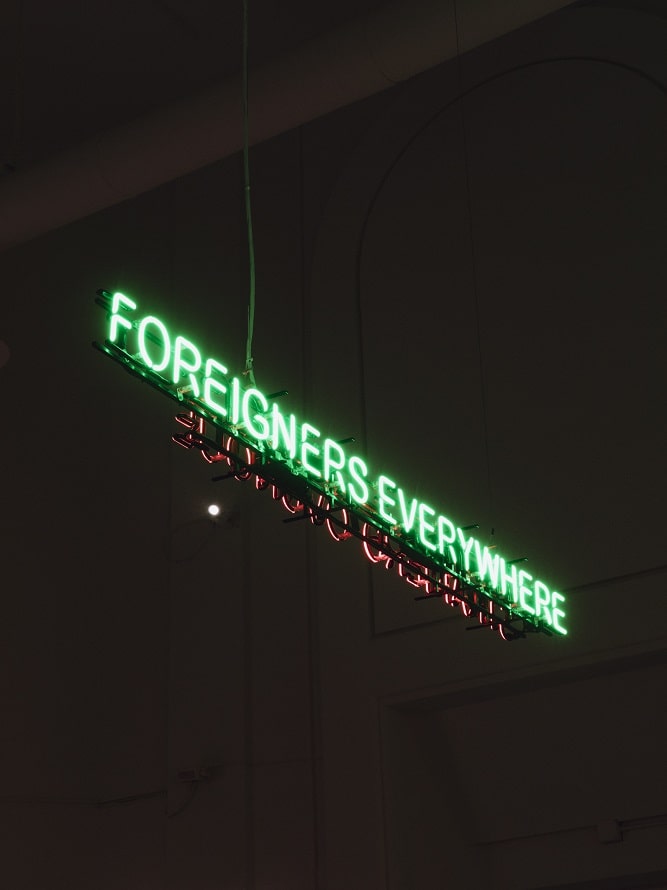
MDM, Claire Fontaine, photo: Matteo De Mayda
And there are always two threads that run through the curator’s selection: the explicit desire to focus on works that use the language of textiles, and the blood ties that connect several of the artists in the exhibition. A return to the extended times of res extensa and visceral human relationships, understood as a treasure trove of tradition and the transmission of knowledge, in an age dominated by the immaterial and the depersonalisation of content and form. This edition of the exhibition shows fragments of beauty that have been marginalised, excluded, punished and erased by prevailing patterns of thought. The central themes of Pedrosa’s exhibition – the other, the foreign, the journey, integration – find their echo in the ever-calm and ever-changing waters of the lagoon city. Once again, Venice – for centuries the gentle cradle of knowledge and communication between peoples, ethnic groups and religions – is the natural place from which new perspectives and Making Worlds – to use a local lexicon – can be shifted.
COUNTRIES
The exhibition is accompanied by 87 national contributions in the historic pavilions in the Giardini, the Arsenale and the historic centre of Venice. Four countries are represented at the Art Biennale for the first time: the Republic of Benin, Ethiopia, the Democratic Republic of Timor-Leste and the United Republic of Tanzania. The Republic of Panama and Senegal are participating for the first time with their own pavilions.
The Italian Pavilion at the Tese delle Vergini in the Arsenale, supported and promoted by the Directorate-General for Contemporary Creativity of the Ministry of Culture, is curated by Luca Cerizza, with the project Due qui / To hear by artist Massimo Bartolini, which includes contributions specially conceived by musicians and writers.
The Holy See Pavilion, promoted by Cardinal José Tolentino de Mendonça, Prefect of the Dicastery for Culture and Education of the Holy See, will be held this year at the women’s prison in Venice on Giudecca. The exhibition is entitled ‘Through My Eyes’ and is curated by Chiara Parisi and Bruno Racine. The city of Venice is represented with its own pavilion, the Padiglione Venezia, in the Giardini di Sant’Elena.
ACCOMPANYING EVENTS
The 30 accompanying events, approved by the curator and sponsored by public and private non-profit organisations and institutions, will be organised in numerous locations throughout Venice and will offer a wide range of contributions and participation, enriching the pluralism of voices that characterises the exhibition.
SPECIAL PROJECTS of the Venice Biennale
Polveriera Austriaca, Forte Marghera, Mestre – Ten works by Italian artist Nedda Guidi (Gubbio, 1927 – Rome, 2015), participating in the international exhibition, are on display at Forte Marghera in the building known as Polveriera Austriaca. ‘She was invited because of her innovative techniques in ceramic sculpture,’ explains Adriano Pedrosa, ‘Guidi combines the figure of the skilled craftsman with the genius of art; she is not a “simple” ceramist, but a sculptor who is fundamental to the development of contemporary ceramics.’
Padiglione delle Arti Applicate, Arsenale, Sale d’Armi. – Brazilian artist Beatriz Milhazes (born 1960), known for her work that blends Brazilian cultural imagery with references to Western modernist painting, will present seven paintings and an equal number of large-format collages. The pavilion project, curated this year by Adriano Pedrosa, is taking place for the eighth time and is a collaboration between the Biennale and the Victoria and Albert Museum (V&A) in London.
BIENNALE ART ACADEMY
Agnes Questionmark, Joyce Joumaa, Sandra Poulson and Nazira Karimi are the authors of the finalist projects for the 2nd edition of the Biennale College Arte 2023/24, who will receive a grant of €25,000 to realise their latest work. Their works will be presented as part of the 60th exhibition outside of the competition. More than 150 young and emerging artists under the age of 30 from 37 countries around the world applied to participate in the competition.
LEONI D’ORO ALLA CARRIERA (Golden Lions for Lifetime Achievement)
Anna Maria Maiolino, Brazilian artist (born in Italy), and Nil Yalter, Turkish artist (resident in Paris), have been awarded the Golden Lions for Lifetime Achievement at the 2024 Biennale Arte. The award will be presented on Saturday, 20 April 2024, during the award ceremony and opening ceremony of the 2024 Venice Biennale at Ca’ Giustinian, the headquarters of the Venice Biennale.
BIENNALE SESSIONS, the project for universities
For the thirteenth consecutive year, La Biennale is dedicating the Biennale Sessions project to universities, academies and all institutions involved in research and education in the fields of art, architecture and related areas. The aim is to facilitate three-day visits organised by them for groups of at least 50 students and teachers, offering the possibility of free seminars at the exhibition venues and assistance with travel and accommodation arrangements.
EDUCATION
Over the past ten years, the Venice Biennale has placed increasing importance on educational activities and developed a strong commitment to exhibition audiences, universities, young people and schoolchildren of all levels as part of its so-called ‘educational activities’. A total of 130,298 people participated in the last two major exhibitions – the Biennale Arte 2022 and the Biennale Architettura 2023 – of whom 71,525 young people took part in the educational activities. An extensive programme is also planned for 2024 for individuals and groups of students, children, adults, families, professionals, companies and universities. All initiatives focus on the active involvement of participants, are carried out by organisers selected and trained by the Biennale, and are divided into guided tours and workshop activities.
THE CATALOGUE
The official catalogue, entitled Stranieri Ovunque – Foreigners Everywhere, consists of two volumes. Volume I is dedicated to the International Exhibition, edited by Adriano Pedrosa. The first pages feature two short introductions by President Pietrangelo Buttafuoco and President Roberto Cicutto, followed by an interview with Adriano Pedrosa by Julieta Gonzàles. The first part of the volume is devoted to critical essays and several ‘conversations,’ including interviews with the Golden Lion for Lifetime Achievement winners Anna Maria Maiolino and Nil Yalter. The second part is devoted to the presentation of the artists featured in the exhibition, which is divided into two main sections: Historical Core and Contemporary Core. Each artist is presented with a detailed critical text, and their work is illustrated with an iconographic apparatus. Volume II is dedicated to national participations and accompanying events. The exhibition guide is designed to accompany visitors on their journey through the exhibition. The graphic identity and design of the Biennale Arte 2024 publications are by Estudio Campo (Paula Tinoco, Roderico Souza, Carolina Aboarrage) from São Paulo, Brazil. The three volumes are published by La Biennale di Venezia.
WHEN?
Event dates:
20. April until 24. November 2024
Opening hours:
Venice, Giardini and Arsenale, 20 April to 24 November 2024
Closed on Mondays (except 22/04, 17/06, 22/07, 02/09, 30/09, 18/11)
Summer opening hours: 11 a.m. to 7 p.m. (from 20 April to 30 September – last admission at 6.45 p.m.)
Until 30 September, only at the Arsenale: extended opening hours on Fridays and Saturdays until
8 p.m. (last admission at 7.45 p.m.)
Autumn opening hours: 10 a.m. to 6 p.m. (from 1 October to 24 November – last admission at 5.45 p.m.)
WHERE?
Sestiere Castello
30122 Venezia (VE)
COSTS?
Tickets and guided tours are sold exclusively online.
(A booking fee of €0.50 is charged for tickets and guided tours with a fixed start time.)
-Individual tickets:
Full price €30
Concessions €20 Over 65s, residents of the municipality of Venice (with valid ID at the entrances)
Reduced price for students and/or under 26 €16 (with valid ID at the entrances)
-Multiple tickets*
3 days €40 (valid for 3 consecutive days – except closing days)
Weekly ticket €50 (valid for 7 consecutive days – except closing days)
‘Biennale Sessions’ £20 (participating universities, reservation required, minimum 50 people)
*Multiple tickets are personalised and must be accompanied by valid ID at the entrances.
-Group tickets:
(Groups with more than 25 participants must split into subgroups during their visit to the exhibition rooms)
Adults €20 / Universities €15 / Students €10
(Minimum number of participants: 10 people, purchase online only. Tickets are valid for one entry per exhibition venue, Arsenale and gardens)
To purchase more than 50 group tickets at once, please write to booking@labiennale.org
-Accreditation:*
Full price €75
Reduced price €50 (for residents of the municipality of Venice)
Reduced price for students and/or under 26 €45
*Accreditations are strictly personal and must be accompanied by a valid ID at the entrances
-Art + DMT formula
(1 Art ticket + 1 Show/Concert ticket of your choice)
-Reduced rates:
Persons with proven disabilities can purchase a reduced admission ticket (single entry) for €20, which can be purchased at the information points (Giardini in Viale Trento and Arsenale in Riva di Ca’ di Dio) upon presentation of the relevant certificate. If the documentation indicates the need for an accompanying person, the latter is entitled to free admission, which must be requested again at the information points. Special rate for FAI, ACI, COOP, CRAL DOGANE, OCRAD and TCI members: reduced admission ticket (single entry) at a price of €26 upon presentation of membership card at the information points at the exhibition.
-Free admission:
Children up to the age of 6, primary and secondary school pupils receiving educational support, accompanying persons with a certified disability, provided this is indicated in the documentation.
-Guided tours – reservation required (in Italian and 8 foreign languages):
Adults 1 venue £90 – 2 venues £150
University 1 date €70 – 2 dates €120
Secondary schools 1 date €60 – 2 dates €100
Secondary and primary schools 1 venue €60
Kindergartens 1 venue €50
-Guided tours with fixed start times – reservation required:
€8 per venue, per person (in Italian and English)
-Fixed guided tours for families – reservation required
€8 per venue, per person
(available in Italian – free admission to the exhibition for participants under 12 years of age)
(A pre-sale fee of €0.50 will be added to the price of the guided tours)